More Perfect Union exposes a startling reality: the exorbitant prices at American sports stadiums aren't just bad business—they may be an illegal monopoly scheme that regulators have chosen to ignore. By resurrecting the forgotten crusade of a 1978 teacher, the author argues that the legal tools to crush stadium price gouging already exist, yet remain dormant while billionaires profit from taxpayer-subsidized venues.
The Ghost of Hot Dog Wars
The piece anchors its modern critique in the story of Ron Gordon, a high school teacher who waged a one-man war against a five-cent price hike at San Francisco's Candlestick Park. More Perfect Union writes, "There was something we've lost since Ron's day that held the secret for how we can bring down the skyrocketing cost of being a sports fan today." This historical framing is effective because it humanizes a dry economic issue, transforming a complaint about a $15 beer into a narrative about civic duty and consumer rights. The author details how Gordon spent 300 hours calculating the cost of wrapping machines and even demonstrated his own speed at wrapping hot dogs to prove the vendor's math was fraudulent.
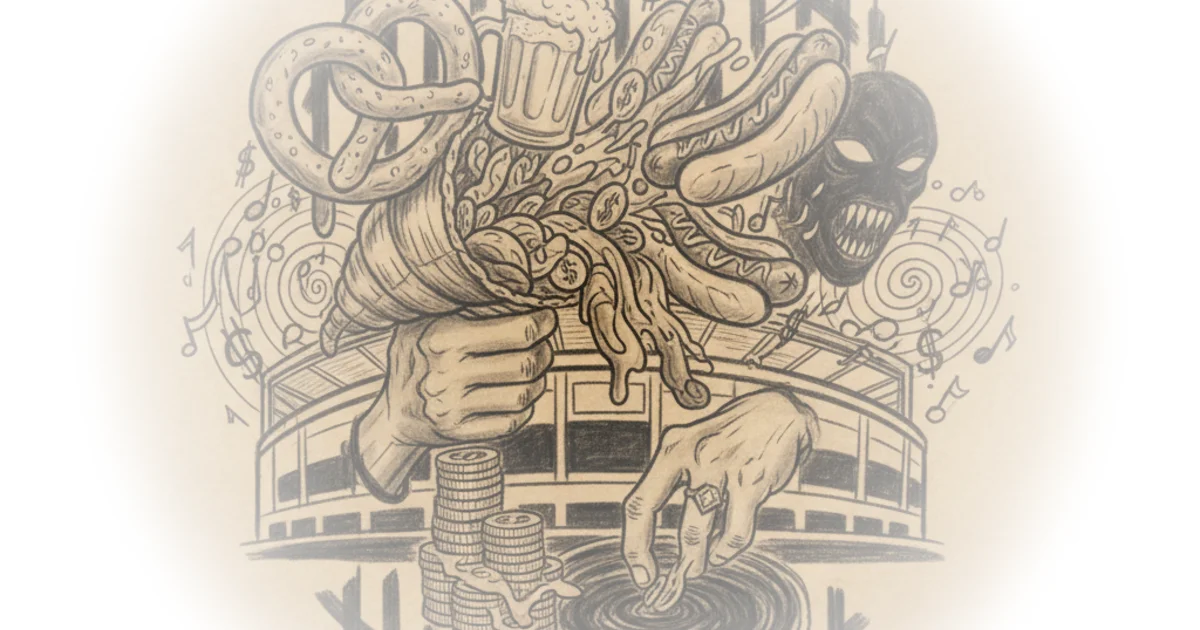
The core argument is that stadium owners leverage public money to create private monopolies, then exploit that monopoly power to charge prices that would be illegal in any other context. As More Perfect Union puts it, "When you're in a stadium, you only have one choice. And what that means is the stadium has effectively monopoly power over you." This is a crucial distinction. The author suggests that existing state laws against unfair and deceptive practices, typically used for price gouging during natural disasters, should apply to concession stands. The logic holds up: if a consumer cannot walk to a competitor during a game, the vendor holds a temporary monopoly, a condition that usually triggers regulatory scrutiny.
"Stadiums used to have shame. The business culture across the board, not just in stadiums, has grown more craven, more opportunistic, more willing to take advantage."
Critics might note that stadiums operate in a unique entertainment ecosystem where high margins subsidize player salaries and facility maintenance, a complexity the article glosses over. However, the author counters this by highlighting that these venues already receive massive public subsidies, including property tax exemptions worth hundreds of millions of dollars, which undermines the argument that high prices are necessary for survival.
The Legal Leverage We Ignore
The commentary shifts to the legal mechanisms that could force change, pointing out that regulators have simply become complacent. More Perfect Union notes, "Regulators and attorneys general have grown complacent. They've gotten used to the high prices in stadiums just like we have." The author argues that state attorneys general have the authority to intervene immediately but lack the political will. This is a provocative claim that challenges the status quo of regulatory inaction. The piece suggests that cities could demand "street pricing"—where items inside the stadium cost the same as outside—as a condition for renewing zoning permits or tax breaks.
The author illustrates the absurdity of the current system by comparing the cost of a ticket in the UK, where fan protests and fixed pricing have kept costs lower, to the US, where dynamic pricing allows for exorbitant fees. "My Knicks ticket alone cost $277. That's about the same as the average cost of an NFL ticket," the author observes, highlighting the disparity. The argument gains strength from the example of Portland's International Airport, which successfully implemented no-markup pricing without going out of business, proving that the business model is viable.
The Cost of Justice
The emotional weight of the piece lands on Ron Gordon's personal sacrifice. Despite winning his battle, Gordon spent over $3,000 (adjusted to $14,000 today) fighting the system and has not attended a game in decades. More Perfect Union writes, "The more I knew about the it and the less other people did about it, the more it became my responsibility." This quote captures the essence of the piece: the moral burden of knowing the truth and the difficulty of acting on it alone. The author uses Gordon's story to illustrate that while the legal path exists, it requires immense personal effort that most consumers are unwilling or unable to expend.
The article concludes by suggesting that the solution lies not in new laws, but in the aggressive enforcement of old ones and the use of public leverage. "We should expect cities to demand conditions," the author asserts, framing the issue as a failure of local governance rather than an inevitable economic trend. This reframing empowers the reader, suggesting that the power to fix the problem lies with local officials who are currently ignoring their own leverage.
"It's not just lawsuits. State agencies across the country could write rules explicitly banning price gouging at the concession stand under these unfair practice laws."
Bottom Line
More Perfect Union makes a compelling case that stadium price gouging is a solvable legal problem rather than an economic inevitability, backed by a strong historical precedent and clear regulatory pathways. The argument's greatest vulnerability is its assumption that political will can be easily summoned to challenge powerful sports franchises, yet the piece successfully shifts the blame from consumers to complacent regulators. The strongest takeaway is the concept of "street pricing" as a condition of public subsidy, a pragmatic policy that could immediately lower costs without dismantling the sports industry.