Robert Reich transforms a personal childhood memory into a searing indictment of the Supreme Court's latest dismantling of voting rights, arguing that the murder of a young civil rights worker in 1964 is not just history, but the direct precursor to today's political erosion. While many analyses focus on the legal mechanics of the recent ruling, Reich's piece is distinct because it forces the reader to confront the human cost of judicial philosophy, linking the brutal death of Mickey Schwerner to the cold calculus of modern gerrymandering. This is not merely a critique of a court decision; it is a warning that the safeguards bought with blood are being quietly stripped away.
The Shadow of Neshoba County
Reich opens by anchoring his political analysis in the intimate story of Michael Schwerner, a teenager he knew as a child in the Adirondacks. He writes, "I met Mickey the summer after third grade... He was kind and gentle, with a ready smile." This personal connection serves as a powerful narrative device, turning abstract statistics about voter suppression into a tangible tragedy. Reich explains that when he learned of Schwerner's murder in Mississippi in 1964, his understanding of the world shifted fundamentally. He realized that bullying was not just about playground taunts but about systemic violence: "Black people bullied by whites; workers bullied by employers; girls and women bullied by men."
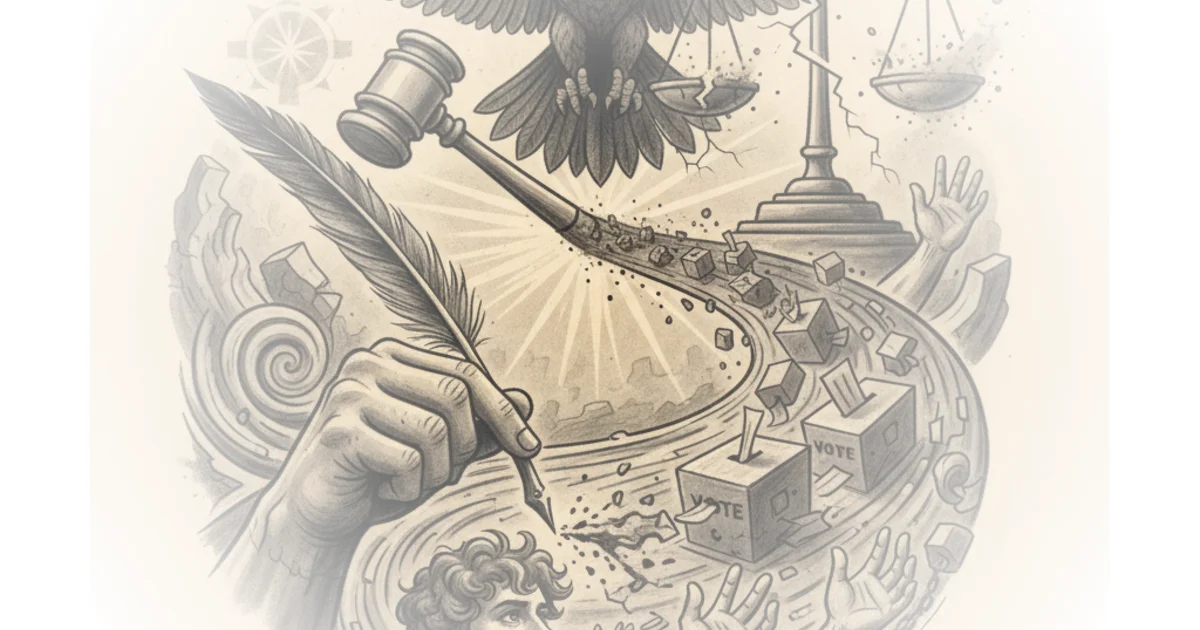
The author draws a direct line from the 1964 murders to the legislative response, noting that the Civil Rights Act of 1964 was passed partly due to the public outcry over Schwerner, Goodman, and Chaney's disappearance. He highlights the specific mechanism that protected voters for decades: Section 5 of the Voting Rights Act, which required states with histories of discrimination to get federal clearance before changing election rules. Reich argues this was the key to success, noting that "the disparity in registration rates between white and Black people dropped from nearly 30 percent in the early 1960s to 8 percent." This historical context is crucial; it establishes that the pre-clearance system worked, making the subsequent legal challenges to it even more contentious.
"It became as personal to me as were the bullies who called me names and threatened me in the boys' room and on the playground — but larger, more encompassing, more urgent."
Reich's framing of the 1980 Reagan campaign rally in Neshoba County as a "dark dog-whistle" to racists adds necessary political texture. He points out that Reagan's defense of "states' rights" at the site of the murders was a deliberate signal to the same forces that had killed Schwerner. This historical continuity strengthens his argument that the current judicial trend is not an accident but a continuation of a decades-long strategy to roll back civil rights gains. Critics might argue that Reagan's intent was broader than just racial signaling, but Reich's specific geographic and historical placement of the rally makes the connection difficult to dismiss.
The Erosion of Precedent
The commentary then pivots to the Supreme Court's role in undoing these protections. Reich details the 2013 Shelby County v. Holder decision, where the court struck down the coverage formula. He quotes Chief Justice John Roberts, who wrote, "Our country has changed," and claimed the Voting Rights Act was "strong medicine" no longer needed. Reich immediately counters this with evidence of the immediate aftermath: "Within 24 hours of the ruling, states of the old Confederacy were already proving Roberts wrong." He lists the rapid implementation of strict photo ID laws and voter purges in Texas, Mississippi, and Alabama, demonstrating that the court's assumption of a post-racial reality was flawed.
Reich reserves his sharpest criticism for the recent Louisiana v. Callais decision, where the court gutted Section 2 of the Voting Rights Act. He describes Justice Samuel Alito's opinion as "remarkably dishonest," noting Alito's claim that "vast social change has occurred throughout the country" and that Black Americans now vote at similar rates. Reich dismantles this by citing a study of nearly a billion votes showing that the racial turnout gap actually widened in areas where pre-clearance was removed. He argues that the court has effectively invited Republican legislatures to redraw maps that will create a "solid red south."
The stakes, according to Reich, are existential for democratic representation. He warns that the ruling could result in "the largest reduction in Black political representation since the death of Reconstruction," potentially costing Democrats up to 19 seats in the House and nearly 200 state legislative seats. He connects this back to the original tragedy, stating, "The Roberts-Alito court has ensured that Dred Scott and the Confederacy are reborn." This hyperbolic language is a deliberate rhetorical choice to underscore the severity of the regression. While some legal scholars might argue that the court is simply updating the law to reflect current demographics, Reich's evidence of immediate, aggressive state-level action suggests the court's decision is a green light for suppression rather than a neutral adjustment.
"The Republican appointees on the court have now invited Republican state legislatures to draw new congressional maps that will likely create a solid red south, creating the largest reduction in Black political representation since the death of Reconstruction."
Reich concludes by returning to the memory of the three civil rights workers, expressing a fear that their sacrifice was in vain. He writes, "It is hard for me to think back on the deaths of Mickey Schwerner, Andrew Goodman, and James Chaney... and not fear that... they died in vain." This emotional crescendo ties the legal analysis back to the human cost, reminding the reader that every line of the Voting Rights Act was written in response to real violence and real loss.
Bottom Line
Reich's most compelling argument is his refusal to treat the Voting Rights Act as a dry legal statute, instead framing it as a fragile shield built on the blood of martyrs. His biggest vulnerability lies in his absolute certainty that the court's decision is purely partisan, leaving little room for the complex legal debates regarding federalism that the justices cite. However, the immediate legislative reactions in Florida and Louisiana validate his core warning: the removal of federal oversight is already being weaponized to reshape the political landscape. Readers should watch closely as states like Mississippi and Alabama move to redraw their maps, as these actions will likely trigger the next major legal battles over the soul of American democracy.