Brad DeLong delivers a stark, unsettling diagnosis of a conflict that defies traditional logic: a war where victory is impossible because the only prize is to lose the least. He argues that the current administration and the Iranian leadership have locked themselves, and the global economy, into a fatal escalation trap within the Strait of Hormuz. For a busy reader tracking the geopolitical fallout, this piece cuts through the noise of daily headlines to expose a strategic vacuum where no one wins, only the surviving officers of the Islamic Revolutionary Guard Corps (IRGC) advance.
The Architecture of a Losing Game
DeLong's central thesis is that this is not a contest for dominance but a slow, grinding competition in which the prize is to lose the most. He suggests that a reckless executive branch and a significant, yet strategically overextended, Iran have trapped themselves in a scenario where retreat is politically impossible for either side. The author leans heavily on the analysis of military historian Bret Devereaux to illustrate how the United States gambled that the Iranian regime would collapse on cue, a gamble that has instead created a situation where "merely by launching a renewed air campaign on Iran, Israel could force the United States into a war with Iran at any time."
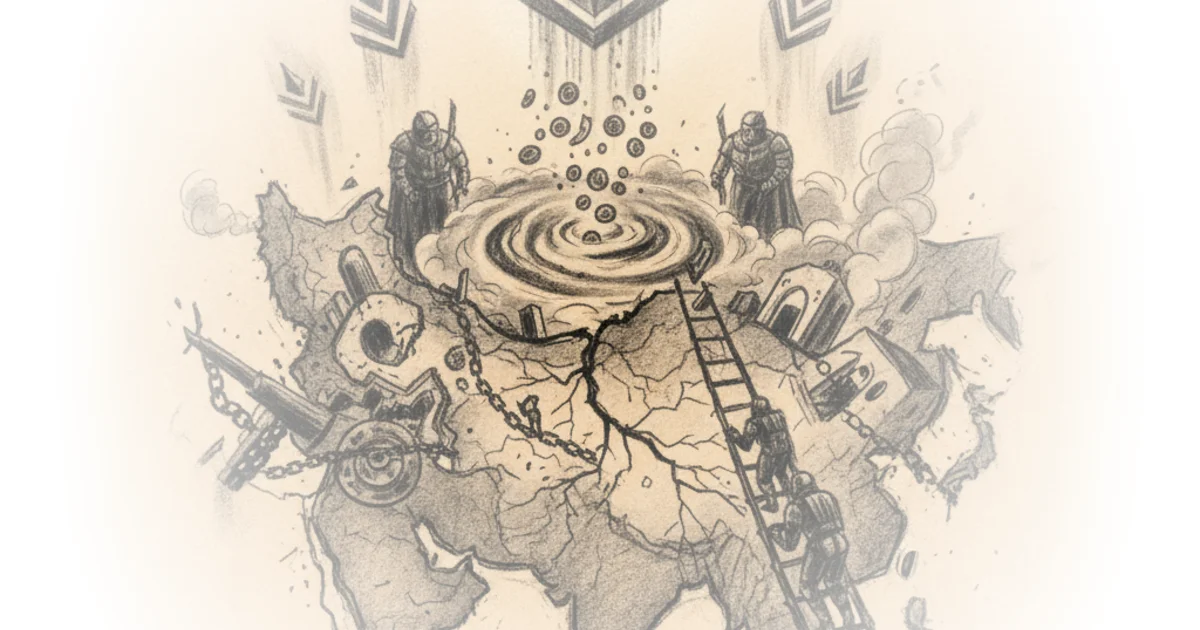
This framing is crucial because it shifts the focus from the personality of the leader to the structural failure of the strategy. DeLong points out that the administration's initial hope for a quick regime change has evaporated, replaced by a chaotic reality where objectives shift daily. He notes that the administration has offered a "bewildering range of proposed objectives," swinging from regime collapse to simply reopening the strait, without a coherent path between them. This lack of a stable plan means the US is fighting a war without a clear end state, a dangerous position for a superpower.
"It is not possible for two sides to both win a war. But it is absolutely possible for both sides to lose."
The author's use of Devereaux's historical context adds weight to this argument. He reminds us that the Middle East's strategic value to the US hinges entirely on two arteries: the Suez Canal and the Persian Gulf oil shipping system. When the administration decided to scrap the Joint Comprehensive Plan of Action (JCPOA) in 2017 without a viable replacement, they removed the "lid" that kept costs low. Now, the administration faces the consequences of that decision. As DeLong writes, "The current war is best understood as the product of a fairly extreme gamble, although it is unclear to me if the current administration understood..." This highlights a terrifying possibility: that the people making these decisions may not fully grasp the magnitude of the escalation they have triggered.
Critics might argue that the administration's aggressive posture is a necessary signal of resolve to prevent further nuclear proliferation. However, DeLong counters that the cost of this resolve is a global economic supply shock that historically has not been politically survivable for the party in power. The stakes are simply too high for a strategy based on hope rather than calculation.
The Strait of Hormuz as an Escalation Trap
The heart of the conflict lies in the Strait of Hormuz, a chokepoint where 20% of the world's liquid natural gas and a significant portion of fertilizer pass through. DeLong argues that once the strait is effectively closed, the United States cannot back off without suffering catastrophic political and economic damage. He describes this as a "classic escalation trap" where every day the war continues makes both nations weaker, yet neither can back down.
The author paints a grim picture of the military reality on the ground. He questions the operational readiness of US forces, noting reports that "everyone's working from home" at some bases, a "striking image of a great power supposedly in theater, yet trying to run a war partly over Zoom." This suggests a severe degradation of operational confidence. Furthermore, he warns that any attempt to escort tankers through the strait would be disastrous, comparing it to the sinking of the Russian warship Moskva. "Iran possesses modern anti-ship missiles (AShMs) in significant quantity and American escort ships... would be vulnerable escorting slow tankers in the constrained waters of the strait," DeLong writes.
This analysis is bolstered by the historical context of the Twelve-Day War in 2025, where Iran did not treat the US as a real co-belligerent, and the subsequent surprise attack on nuclear facilities in June 2025. These events created a dynamic where the US is now forced to respond to Iranian actions without a clear exit strategy. The author notes that the administration's threats to obliterate Iranian infrastructure, including "Kharg Island," have only hardened the Iranian resolve to reestablish deterrence.
"The result is a fairly classic escalation trap... Neither party can back down unilaterally and survive politically, [so] there's practically no amount of pain that can force them to do so."
DeLong's assessment of the internal dynamics in Washington is particularly biting. He describes an administration lacking adult supervision, where senior staff act as "courtiers guessing which way he will jump this afternoon." This lack of institutional buffer means that volatile preferences drive policy rather than strategic constraints. The author argues that the traditional realist advice to look at a leader's constraints assumes the leader is rational, a condition he finds absent in the current executive branch.
The Human and Strategic Cost
While the geopolitical maneuvering dominates the headlines, DeLong insists that the human cost is the true tragedy. He emphasizes that "many, many people will suffer," specifically the Iranian people who had no choice in the matter. He notes that the Iranian population tried to reject the regime earlier in the year and were killed for it, yet the war continues to hammer them. The author's point is clear: the regime is odious, but the war is a disaster for everyone except the IRGC officers who are receiving swift promotions.
The diplomatic fallout for the United States is also severe. DeLong predicts that when the dust settles, countries will remember that the US "unilaterally initiated by surprise a war of choice which set off severe global economic headwinds and uncertainty." This is a long-term strategic defeat that cannot be undone by tactical victories. The author suggests that the only likely outcome is a deal where Iran feels it has forced the US to "blink," resulting in a de facto Iranian veto on traffic in the strait and significant sanctions relief.
"The United States is... going to bear diplomatic costs... countries... will remember that the United States unilaterally initiated by surprise a war of choice."
A counterargument worth considering is that a show of force might eventually force a rational calculation in Tehran, leading to a negotiated settlement. However, DeLong's evidence suggests that the regime, facing an existential threat, will fight on regardless of the pain inflicted. The "great deal of ruin in a nation" means that the Iranian leadership can absorb immense costs without collapsing, leaving the US in a prolonged, draining conflict.
Bottom Line
Brad DeLong's most compelling contribution is his dismantling of the illusion that this conflict can be won; he convincingly argues that the only outcome is mutual loss, with the Strait of Hormuz serving as the crucible for a strategic defeat for the United States. The piece's greatest vulnerability lies in its reliance on the assumption that the administration's volatility will prevent any coherent de-escalation, a variable that is difficult to predict with certainty. Readers should watch for whether the administration can pivot from regime change rhetoric to a realistic strategy for reopening the strait before the economic shock becomes politically untenable.