This piece from The Walrus does something rare in diplomatic reporting: it strips away the geopolitical abstraction to reveal a single father's terror. Katharine Lake Berz argues that the Indian government's accusation against Amarjot Singh—a Canadian truck driver branded a terrorist for attending a peaceful protest—is not an isolated legal dispute, but a calculated act of transnational repression designed to silence dissent abroad. The story's power lies in its juxtaposition of official state narratives against the quiet, devastating reality of a family uprooted and hunted.
The Architecture of Fear
Berz opens by grounding the reader in the visceral shock of the accusation. "The phone rang early that morning. Amarjot Singh, half asleep in his Montreal apartment, fumbled for his cell," she writes, capturing the sudden intrusion of state power into domestic life. The core of her argument is that the Indian state is leveraging false terrorism charges as a weapon of leverage, targeting not just activists, but their families living in diaspora communities.
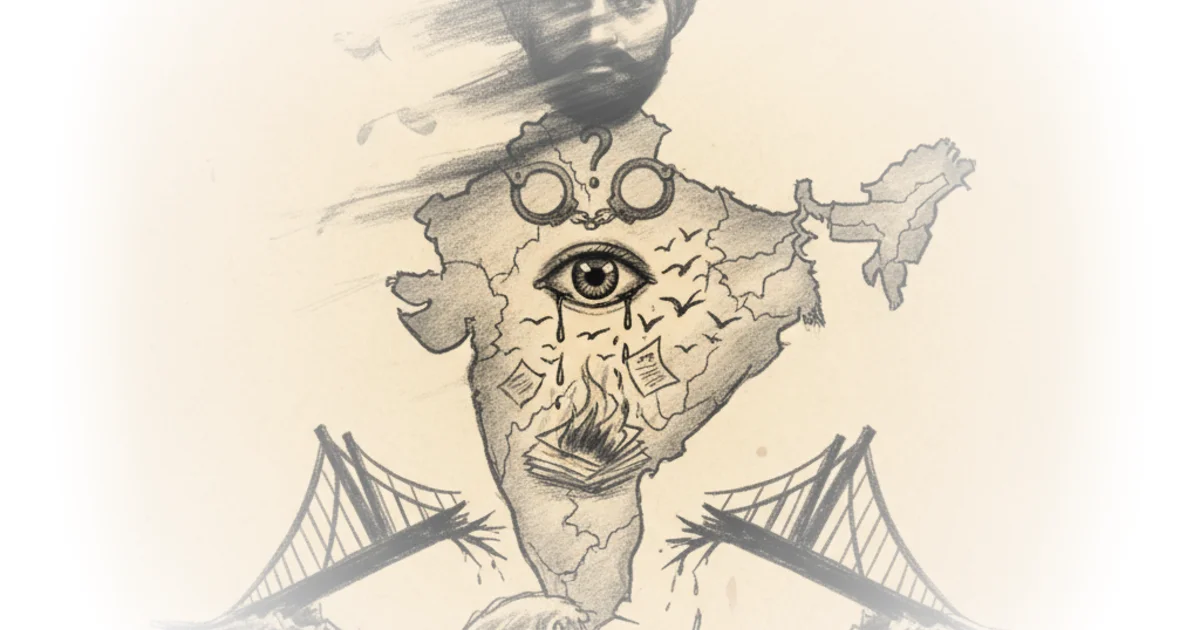
She details how Singh, a man who attended a rally largely out of loyalty to his brother-in-law, was suddenly painted as a mob leader who threw grenades at the Indian high commission in Ottawa. "How could this be possible? I didn't throw a single stone," Singh tells her. "It was a peaceful protest." Berz contrasts this with Canadian police reports, which found the event essentially incident-free, save for a possible smoke canister. This discrepancy is the crux of the piece: the gap between the Indian narrative and the on-the-ground reality in Canada.
The reporting effectively highlights the human cost of this diplomatic friction. While the Indian government claims Singh led a violent mob, Berz notes that the event was so quiet it received virtually no immediate media coverage in Ottawa. The accusation, she suggests, is less about facts and more about intimidation. "The Indian government's false accusations that he is a terrorist are about power and leverage," she observes, framing the charge as a strategic tool to punish political dissent across borders.
"For forty years, we were telling our stories, but no one was listening. Now that the RCMP and the prime minister had spoken openly, it's not conspiracy theories anymore. It's actually the truth."
A Legacy of Violence
Berz weaves in necessary historical context to explain why this fear is so potent for the Sikh community. She connects the current climate to the trauma of 1984, when Indian forces stormed the Golden Temple, killing hundreds, including Singh's great-grandfather. "The bloody attack drove then prime minister Indira Gandhi's Sikh bodyguards to assassinate her in revenge," she notes, illustrating the decades-long cycle of violence that haunts the diaspora. This historical weight makes the current accusations feel less like a new legal battle and more like a continuation of an old war.
The piece also contextualizes Singh's plight within a broader wave of violence against Sikhs in Canada. Berz points to the murder of Hardeep Singh Nijjar and the foiled assassination plot against Gurpatwant Singh Pannun, linking them to the activities of the Bishnoi gang, which Canadian authorities say acted on India's orders. "Amarjot, suddenly branded a terrorist himself, worried he would be next," she writes, emphasizing the psychological toll of living under the shadow of these threats.
Critics might argue that focusing on individual cases obscures the complex security challenges India faces regarding the Khalistan movement, a separatist campaign that has historically involved violence. However, Berz counters this by showing that the Canadian government's own intelligence agencies have validated the community's fears, confirming that agents of the Indian government are indeed involved in criminal activities on Canadian soil.
The Fragility of Protection
The narrative takes a sharp turn as it examines the shifting tides of Canadian diplomacy. While Prime Minister Justin Trudeau initially validated the community's concerns by linking Indian agents to Nijjar's murder, Berz warns that this stance is precarious. She notes that with the election of a new administration, the focus has shifted toward rebuilding ties with New Delhi. "For Amarjot, shaking hands with Modi at the G7 summit felt like betrayal," she writes, capturing the community's anxiety that economic interests will override their safety.
The World Sikh Organization of Canada is now urging Ottawa to make any normalization of relations contingent on India's cooperation in criminal investigations. "I implore the Canadian government to take stronger action to protect Sikhs in Canada from such foreign interference," Singh wrote in a letter to the Foreign Interference Commission. Berz uses this plea to underscore the tension between Canada's obligation to protect its residents and its desire for geopolitical pragmatism.
Bottom Line
The Walrus delivers a compelling, human-centered indictment of transnational repression, proving that the threat of state violence extends far beyond national borders. Its greatest strength is the refusal to let the story remain abstract; by anchoring the geopolitical drama in the life of a truck driver and his family, Berz makes the stakes undeniable. The piece's vulnerability lies in the uncertain future of Canadian-Indian relations, leaving readers with the unsettling realization that the protection of dissenters may be as fragile as the diplomatic ties that threaten them.