This piece does something rare for a historical roundup: it argues that a specific technological innovation—a firearm lighter and more accurate than its European counterparts—was the decisive factor in securing a nation's borders and defining its political identity. Reason doesn't just recount battles; it posits that the American Long Rifle was the physical manifestation of the First Amendment, born from religious freedom and perfected by the practical needs of a frontier society. For busy readers tracking how technology shapes geopolitics today, this deep dive into 18th-century ballistics offers a startling thesis: the shape of the United States was determined not just by treaties or generals, but by the ability of individual citizens to hit a target at three hundred yards.
The Equalizer in the Woods
The article opens with a striking image of James Madison, described as "no bigger than half a piece of soap," yet possessed of a conviction that his fellow Virginians could outshoot the British Empire. Reason reports, "Yet firearms are the great equalizer, and in June 1775... Madison had no doubt that he and his fellow Virginians could take out the British redcoats." The editors use this contrast to set up their central argument: that individual marksmanship compensated for a lack of centralized military power.
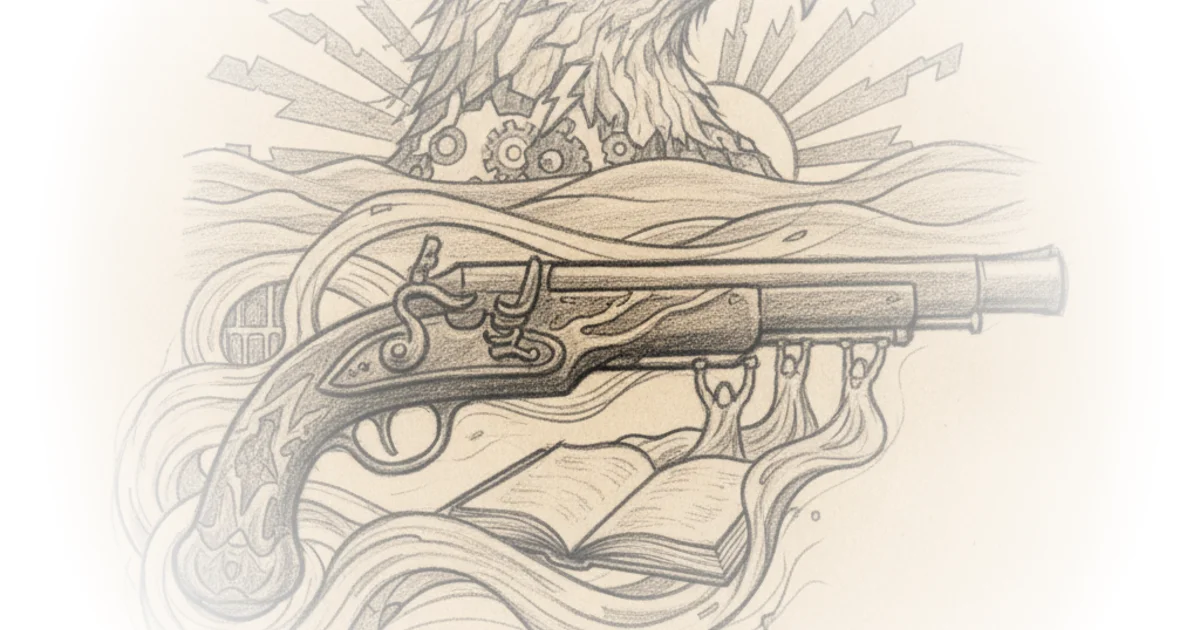
The piece traces the lineage of this weapon back to Pennsylvania, where religious freedom attracted skilled German gunsmiths. These immigrants brought with them the technology of rifling—spiral grooves cut into the barrel to spin the bullet—something largely absent in British smoothbore muskets. Reason notes that while smoothbores were "well-suited for bird hunting but not for long-distance accuracy," the new American Long Rifle changed the physics of warfare. The article argues that this wasn't just a military upgrade; it was an economic and cultural necessity driven by "long hunters" who spent months in the woods, needing to carry more ammunition with less weight.
The most accurate firearm in the world until the early 19th century... the American Long Rifle was ideal for hunting mammals and for the irregular tactics of Indian-fighting.
The editors highlight how this technology forced a shift in military doctrine. While the British relied on massed volleys from smoothbores, American riflemen could pick off officers at distances where enemy muskets were useless. Reason reports that Madison predicted "the most inexpert hands" could hit a man's head at 100 yards, and history proved him right. However, critics might note that the article occasionally romanticizes the "cult of accuracy," glossing over the brutal reality that this same precision was used to clear land for expansion and displace Indigenous populations who also utilized these weapons effectively.
The Turning Point at Saratoga
The narrative shifts from invention to application during the Revolutionary War. Reason argues that while rifles were less common than muskets due to their slow reload times, they delivered the "decisive shot" of the conflict. The piece details the death of British Brig. Gen. Simon Fraser on October 7, 1777.
From the amazing distance of at least 300 yards, an American rifle bullet felled Fraser. This threw the British into panic, broke their offensive momentum, and contributed to the American victory that day.
This moment is presented as the catalyst for French intervention, a crucial pivot in global history. The editors suggest that without this specific advantage in range, the Treaty of Paris might have resulted in a much smaller United States, confined to the Atlantic coast. Reason writes, "The realities on the ground forced the British to surrender their claims to America's interior..." This framing is compelling because it links a single technological capability directly to the geopolitical map we know today.
However, the piece also acknowledges the limitations of the rifle in conventional warfare. It notes that rifles were "too delicate for such usage" as bayonet charges and hand-to-hand combat, which dominated many battles. The argument holds up well here: the Long Rifle was a tool of irregular warfare, not a replacement for the standard army infantryman.
The Second War of Independence
The commentary extends to the War of 1812, specifically the Battle of New Orleans in 1815. Here, Reason emphasizes that the American victory was achieved despite the federal government's inability to supply standardized weapons. Instead, citizens brought their own Long Rifles.
Led by Gen. Andrew Jackson, the American forces were a combination of professional soldiers, militia, irregulars, free black people... lawyers, privateers, farmers, and shopkeepers. Confronted by the best units of the best army in the world, the Americans brought their own guns...
The article suggests that this victory cemented the idea that liberty was tied to the ability to defend oneself. "Americans believed that they were free because they were excellent marksmen," Reason observes. The editors connect this historical moment to the adjacent First Amendment, arguing that both rights are foundational to the American experiment.
It is fitting that the First Amendment and the Second Amendment are adjacent: Both guarantee natural rights, and each amendment safeguards the other.
This connection between religious liberty, which drew the gunsmiths to Pennsylvania, and the right to bear arms is the piece's most provocative theoretical leap. While historically sound in its timeline, it simplifies a complex constitutional debate by suggesting an inherent, unbroken link between faith and firepower that ignores later legal and social evolutions.
Bottom Line
Reason's strongest argument lies in its detailed explanation of how the American Long Rifle's specific design—lighter caliber, longer barrel, and rifling—solved the logistical problems of frontier life and created a tactical advantage that shaped national borders. The piece effectively demonstrates that technology is never neutral; it is forged by cultural needs and political freedoms. Its biggest vulnerability is a tendency to view history through a lens of exceptionalism, where American ingenuity is the sole driver of victory, often minimizing the role of British strategic errors or the contributions of other allies. For readers interested in how tools shape societies, this is a compelling, if narrowly focused, look at the hardware behind the revolution.