Economics Explained challenges a comforting modern myth: that recessions are purely failures to be avoided at all costs. Instead, the channel posits a provocative thesis—that the current economic turbulence, driven by trade wars and geopolitical friction, might be the necessary "cold water" required to sober up a global economy drowning in debt and misallocated capital.
The Debt Trap and the Need for Pain
The piece opens with a stark reality check on the global balance sheet. Economics Explained notes that "the world is now more in debt than it ever has been before," with total obligations reaching $315 trillion, or roughly 300% of global GDP. This isn't just a statistic; it's a structural vulnerability. The author argues that while modern policy has become adept at smoothing out downturns by injecting liquidity, it has failed at the harder task of "taking our foot off the accelerator during good times."
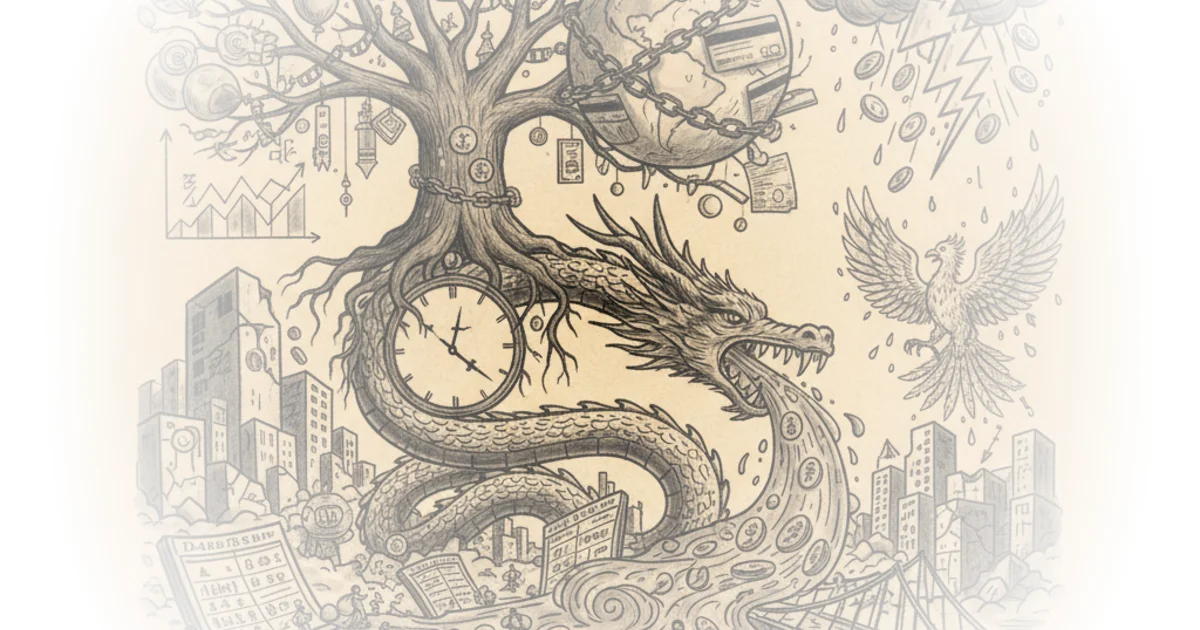
This refusal to let the economy correct itself has created a distorted landscape. Economics Explained writes, "this refusal to let the economy feel pain might be genuinely hurting our long-term prosperity." The commentary suggests that by shielding unproductive entities from failure, we are preventing the natural reallocation of resources. The result is an environment where "meme coins [can be] worth more than centuries old car companies" and capital flows into ventures with "no clear reason" for existence. The argument here is compelling because it reframes the current trade tensions not merely as political posturing, but as a potential, albeit painful, mechanism for market clearing.
"A trade war combined with a growing number of actual wars in globally strategic regions could be exactly that opportunity."
Critics might argue that relying on a trade war to fix structural inefficiencies is a dangerous gamble that could trigger a depression rather than a corrective recession. However, the piece maintains that the alternative—continuing to prop up inefficient sectors—poses an even greater long-term risk.
The Darwinism of Economic Correction
The core of the analysis rests on the historical function of recessions. Economics Explined defines a recession not just as a statistical dip in Gross Domestic Product, but as a vital, if brutal, evolutionary process. "Recessions are brutal, especially for average people who are mostly just unwilling passengers along for the ride," the author admits, yet from a systemic perspective, these downturns serve to "clear out unproductive businesses and offered an opportunity for economies to reallocate scarce resources to more promising areas."
The channel draws a parallel to the dot-com bubble and the 2008 financial crisis. In both instances, the crash eliminated a "glut of really dumb companies riding off easy investor money," freeing up talent and capital for more productive uses. The analogy used is visceral: "a recession really is like a predator thinning the herd." Without this culling, the herd grows too fast, exhausts its food supply, and faces widespread starvation. This framing is effective because it strips away the moral panic often associated with economic downturns, replacing it with a cold, biological necessity.
However, the author is careful to note that this "Darwinism in the social sciences is always a bit ick." The process is inefficient and often indiscriminate. As Economics Explained points out, "recessions don't only kill off underperforming businesses... They also kill off plenty of otherwise healthy businesses, especially new businesses that might only just be getting going." The 2008 crisis, for instance, didn't need to spiral into a full recession if lending regulations had been tighter. The piece acknowledges that while the outcome of clearing dead wood is beneficial, the method of a market crash is a blunt instrument that causes unnecessary collateral damage.
The Illusion of Wealth vs. The Reality of Flow
A crucial distinction is made between GDP as a flow and wealth as a stock. The commentary explains that a recession means we are producing less new stuff, but it doesn't necessarily mean we are destroying existing wealth. "Goods can accumulate, and some last a very long time, providing wealth for their extended existence," the author writes. Yet, the modern economy is increasingly dominated by services—accounting, schooling, trades—which are "consumed as soon as they are made."
This shift explains the acute pain of modern recessions. When the production of services slows, the immediate income of those workers vanishes, creating a feedback loop where they can no longer consume. Economics Explained writes, "Most advanced economies actually produce far more value in services than they do in physical goods. So, a slowdown in these does mean that immediate sacrifices need to be made by someone." The piece suggests that the current uncertainty around tariffs from the US is already creating a "maybe recession" that is correcting an overinvestment in globalization. The argument implies that the global supply chain, once optimized for efficiency above all else, may now require a painful restructuring to prioritize resilience and domestic production.
"Without them in complete isolations, the herd would grow too fast and exhaust all the food in the area leading to widespread starvation and limiting the future growth of the group."
Bottom Line
Economics Explained delivers a sobering, counter-intuitive analysis: the pain of a recession may be the only way to reset a global economy bloated by debt and misallocation. While the argument effectively highlights the necessity of market correction, it arguably underestimates the political impossibility of allowing a "necessary" downturn to play out without intervention. The strongest takeaway is the warning that shielding the economy from all pain may have created a system that is more fragile, not less, and that the current trade friction might be the inevitable, if unwelcome, catalyst for a long-overdue reset.