In an era where mental health is treated as a commodity and social connection is mediated by screens, N.S. Lyons and Freya India offer a startling diagnosis: our collective despair is not a failure of therapy, but a failure of courage. This dialogue cuts through the noise of the "self-care" industrial complex to argue that the very language we use to describe our pain is actively preventing us from healing. For the busy professional seeking to understand the root of modern alienation, this piece suggests that the cure for our anxiety lies not in more introspection, but in the messy, un-optimized reality of human virtue.
The Industrialization of Distress
Lyons opens the exchange by framing the current crisis not as a lack of resources, but as a surplus of misdirection. He notes that despite the ubiquity of therapeutic language, society is becoming more fragile, not less. The authors argue that the modern obsession with "opening up" has been co-opted by market forces that profit from pathologizing normal human reactions. As Freya India puts it, "Girls are genuinely suffering in the modern world, but also, a major part of it is the marketisation and medicalisation of their normal distress. Their despair and disempowerment is making billions."
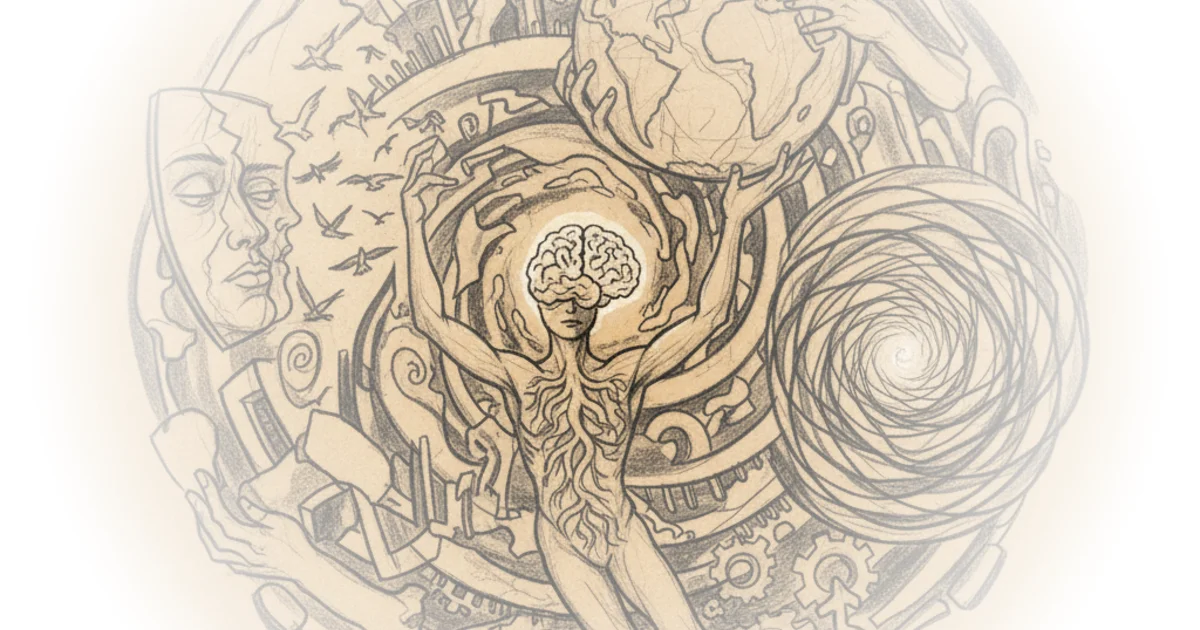
This observation reframes the mental health crisis from a purely medical issue to an economic one. The argument suggests that the "stigma" we are told to fight is actually a convenient narrative used to sell medication and counseling services, rather than addressing the structural causes of unhappiness. Lyons writes, "Modern culture asks young people to accept and excuse more and more behaviour, to adjust to more and more change, and then diagnoses them when they can't cope." This is a powerful critique of a culture that demands resilience without providing community.
Critics might argue that dismissing the rise in diagnoses as merely "marketization" risks invalidating the genuine suffering of those with clinical conditions. However, the authors are careful to distinguish between genuine pathology and the over-application of medical labels to everyday struggles. The core of their claim is that we have lost the vocabulary to describe human sadness, replacing it with a clinical lexicon that isolates the individual.
We are so determined to de-stigmatise mental health issues we've started to stigmatise being human.
The Trap of the Therapeutic Self
The dialogue moves beyond the economics of therapy to examine its psychological toll. India argues that the therapeutic model, particularly when amplified by social media, encourages a dangerous form of narcissism. She suggests that instead of building character, we are building identities based on symptoms. "Therapy culture encourages girls and young women to focus on themselves and their feelings; social media then not only spreads these messages but constantly reminds us that we are each a self," Lyons observes, channeling India's point.
This creates a feedback loop where the self becomes the primary project, and every emotion is a problem to be solved rather than a signal to be understood. The authors contend that this inward turn destroys the capacity for genuine connection. India notes, "People assume that Gen Z feel too much, that we're all too emotional, but I'm starting to think the opposite is true. We don't let ourselves feel anything. We immediately categorise and diagnose and try to control every emotion." This paradox—that we are more obsessed with our feelings yet less able to feel them authentically—is the piece's most unsettling insight.
The authors also touch on the gendered nature of this phenomenon, suggesting that while therapy culture is often seen as feminine, it is particularly damaging to women who are already prone to rumination. "That's the worst advice we could give," India says of the constant push to "unpack your trauma." "Their heads are spinning." The argument here is that the solution to loneliness is not more self-analysis, but more face-to-face interaction, yet the very tools we use to connect are designed to keep us isolated in our digital silos.
The Loss of Moral Clarity
Perhaps the most provocative section of the dialogue is its defense of moral judgment. In a culture that equates judgment with intolerance, Lyons and India argue that the absence of moral standards is what leaves young people adrift. They suggest that without a framework of virtue, young people are left with nothing but the hollow promise of "happiness." Lyons writes, "We stopped appealing to moral character. We got rid of anything more substantial—that was judgemental!—or anything to assure young people that they belong to something bigger—that was superstitious!"
This is a bold move in contemporary discourse, where moral language is often viewed with suspicion. The authors posit that the "deconstruction of authority" has not liberated us, but rather demoralized us. They argue that true freedom comes from adherence to a code of conduct, not from the endless optimization of the self. "What actually matters—our character, our virtue, how we treat other people—is not something easily displayed online," India notes. "That, I think, is the most important thing about who we are, the most important thing for young people to work on and improve, but we can't display it."
A counterargument worth considering is that the "moral character" the authors advocate for has historically been used to exclude and oppress marginalized groups. The piece does not fully address how to define virtue in a pluralistic society without falling into dogmatism. However, the authors seem to be calling for a return to a shared sense of responsibility rather than a specific religious or political code. They argue that the alternative—a world where everyone is their own authority—is a recipe for anxiety.
Bottom Line
The strongest part of this dialogue is its unflinching critique of the "therapy-industrial complex," exposing how the language of healing has been weaponized to sell products and isolate individuals. Its biggest vulnerability lies in its somewhat romanticized view of pre-digital community and its brief treatment of the complex history of moral judgment. Readers should watch for how this argument evolves as the authors connect these insights to their own journeys toward religious faith, a topic that promises to deepen the conversation on where true meaning is found.