Jonathan Rowson does something rare in an era of climate panic: he refuses to treat the heat as merely a meteorological anomaly, reframing it instead as a symptom of a deeper spiritual and political sickness. By weaving Thomas Merton's 1965 meditation on solitude with the visceral horror of "wet-bulb" temperatures, Rowson argues that our collective inability to face ecological collapse is rooted in a "social womb" of conformity that we are too afraid to leave. This is not a standard climate report; it is a philosophical intervention suggesting that the only way to survive the coming "global boiling" is to first survive the gaslighting of our own collective myths.
The Womb of Collective Illusion
Rowson anchors his argument in the work of Thomas Merton, specifically the essay Rain and the Rhinoceros, which he revisits after two decades. The piece is not a nostalgic look back but a diagnostic tool for the present. Rowson writes, "Merton fears that in the absence of the provision and celebration, and discipline of solitude, people will stop thinking because social conventions will overpower us." This framing is crucial because it shifts the blame from individual failure to systemic conditioning. We are not just failing to act; we are actively being prevented from seeing reality by a "collective myth" that demands our participation in our own destruction.
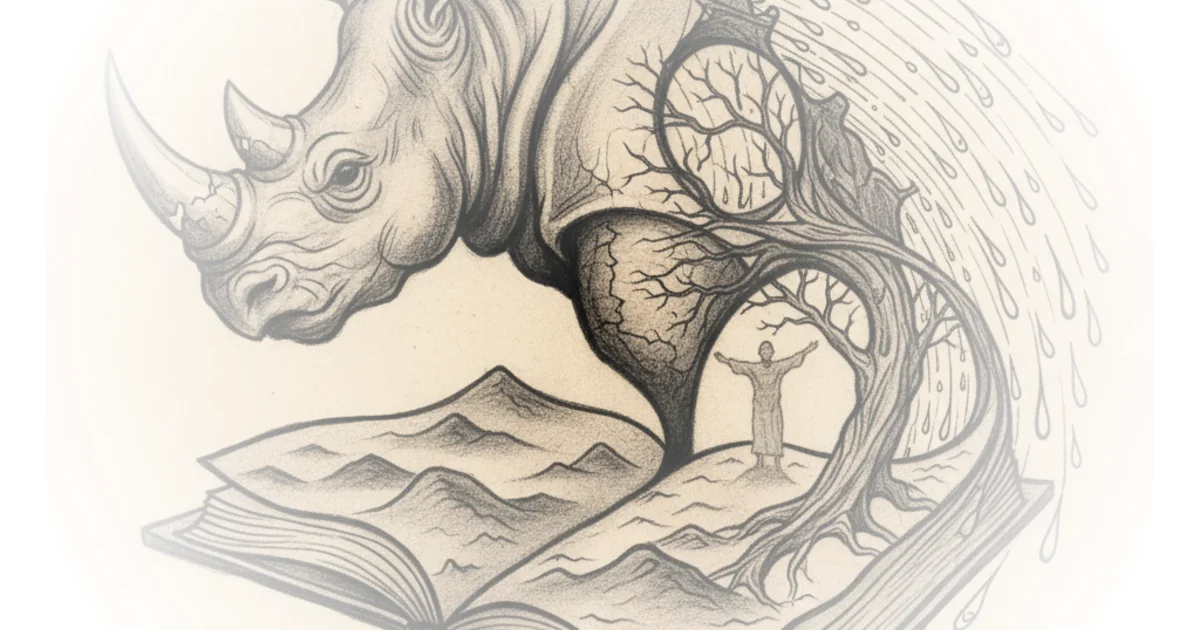
The author draws a sharp parallel between Merton's theological insights and the psychological mechanisms of fascism, referencing Eugène Ionesco's 1959 play Rhinoceros. In that play, townspeople gradually transform into rhinoceroses, a metaphor for the seductive, dehumanizing logic of conformity. Rowson suggests this isn't just historical fiction. He notes that the rhinoceros is "not merely a monster but also a demented utility maximiser, captive to operational logics." This is a devastating critique of modern capitalism and bureaucracy, where efficiency often overrides humanity. Critics might argue that comparing consumer capitalism to fascism is hyperbolic, but Rowson's point is about the mechanism of surrender, not the specific ideology. The danger lies in the ease with which we accept the "unreal" to avoid the vulnerability of truth.
"In order to experience yourself as real, you have to suppress the awareness of your contingency, your unreality, your state of radical need."
Rowson argues that the "social womb" keeps us in a state of arrested development, where we are "prisoners of a process, a dialectic of false promises and real deception ending in futility." The solution, according to Merton and Rowson, is a "discipline of solitude" that allows one to be "born from our social womb." This is not about escaping society in a hermitic sense, but about finding an "invulnerable inner reality" that cannot be co-opted by the collective. As Rowson puts it, "To have an identity, he has to be awake, and aware. But to be awake, he has to accept vulnerability and death." This is a radical call to action: true resistance begins with the willingness to feel the pain of the world without numbing it.
The Physics of Moral Failure
The commentary then pivots from the psychological to the physical, grounding Merton's abstract warnings in the terrifying reality of "wet-bulb temperatures." Rowson explains that this phenomenon, where heat and humidity combine to make sweating impossible, is no longer a theoretical threat but an emerging reality. He cites Kim Stanley Robinson's The Ministry for the Future, describing a scene in Uttar Pradesh where "people were discovering sleepers in distress, finding those who would never wake up from the long hot night." This is not fiction anymore; it is a prophecy being fulfilled in real-time.
Rowson connects this physical reality to a moral crisis, asking, "Did we, the Imperial North, not inflict this avoidable heat death on the Colonised South, also known as the global majority?" He challenges the reader to consider whether the slow-burning heat death of billions constitutes "mass murder by perpetual negligence." This is a bold claim, one that moves beyond the language of "climate change" to the language of "crime." The administration and global powers often disavow responsibility, but Rowson insists that "when wet bulb anguish becomes a new normal, I wonder how long our norms around collective guilt and innocence will hold."
The author notes that UN Secretary-General António Guterres's shift from "global warming" to "global boiling" is not "gratuitous rhetoric or doomerism" but a "descriptive" reality. The evidence is mounting. Rowson writes, "The increasingly deadly heat around the world is still reported as an anomaly, but it is already baked in as pattern, prognosis, and prophecy." This reframing is essential. It forces us to stop treating extreme weather as a surprise and start treating it as a predictable outcome of our choices. The "Imperial North" may claim ignorance, but the data suggests a willful blindness that is becoming increasingly difficult to sustain.
"So when the Secretary-General of the UN, António Guterres, describes the shift from global warming to global boiling he is not guilty of gratuitous rhetoric or doomerism. No, sadly, he is being descriptive."
Rowson also touches on the role of technology, noting that Merton could not have imagined the "algorithmic society" of today. Yet, the monk's warning about "utilities and G.E." entering the cabin "arm-in-arm" feels prophetic. Rowson suggests that our current relationship with artificial intelligence and digital tools is another layer of the "collective illusion," where we are "mortgaged to collective power." He asks if we can forge a "new relationship with emergent intelligences" that is based on "subject-to-subject" respect rather than extraction. This is a difficult question, and Rowson admits that "Merton would be sceptical, to put it mildly." The challenge is to find a way to use technology without letting it erase our humanity.
The Rain as Resistance
In the final section, Rowson returns to the image of rain, not as a weather event, but as a "language" and a "universal memory." He contrasts the "unintelligible, perfectly innocent speech" of the rain with the "fabrications" of human society. "Nobody started it, nobody is going to stop it," he writes of the rain. "It will talk as long as it wants, this rain. As long as it talks I am going to listen." This is a call to re-enchant the world, to find a connection to nature that transcends our "social womb."
The author suggests that the only way to survive the heat is to "let it rain again, far and wide." But this is not just about physical water; it is about the "water" of truth and solitude. Rowson writes, "Let not the drought hasten the flood, but let there be enough water to keep us cool." This is a plea for balance, for a world where we can "sweat" without dying, where we can feel the heat without being consumed by it. The piece ends on a note of hope, but it is a hard-won hope, one that requires us to "be born" from our illusions and face the world as it is.
"Let it rain. Let it rain again, far and wide. Let not the drought hasten the flood, but let there be enough water to keep us cool."
Rowson's argument is that the "rain" is the pulse of unmediated nature, a reminder that we are part of a larger system that does not care for our "fictitious identities." The "rhinoceros" is the monster of conformity, but the "rain" is the antidote. It is a reminder that "the gate of heaven is everywhere," and that we can find "a point of nothingness which is untouched by sin and by illusion" if we are willing to be alone with ourselves. This is the only way to resist the "gaslighting" of the age and to find the "invulnerable inner reality" that can sustain us through the coming storms.
Bottom Line
Rowson's piece is a masterful synthesis of theology, climate science, and political critique, offering a path forward that is both deeply spiritual and urgently practical. Its greatest strength is the refusal to separate the internal work of the soul from the external crisis of the planet, arguing that we cannot solve the climate crisis without first breaking the "social womb" of our collective delusions. The biggest vulnerability is the difficulty of translating this "discipline of solitude" into mass political action, but as Rowson implies, the alternative is a slow, hot death for billions. The reader should watch for how this "new metaphysics" of subject-to-subject relationships with technology and nature begins to take shape in the coming years, as the "wet-bulb" reality forces a reckoning with the "collective myth" of infinite growth.