The best writers on the Stack delivers a year-end curation that defies the standard "best of" list format, arguing instead that the most profound literature of 2025 is defined by its ability to articulate the archaic, elemental feelings awakened by modern isolation and historical trauma. Rather than simply ranking titles, the piece constructs a narrative arc where the pandemic's enforced solitude and the ghosts of the past collide, suggesting that the most vital writing today acts as a bridge between the ancient and the immediate. This is not a celebration of plot, but a manifesto for prose that captures the "strange asceticism" of our current moment.
The Architecture of Isolation
The commentary opens by reframing the global pandemic not merely as a health crisis, but as a collective return to a medieval state of being. The best writers on the Stack writes, "They followed a practice that the ancients called anachoreisis, a retreat from the world, a withdrawal into solitude." This historical framing is crucial; it elevates the modern experience of lockdown from a temporary inconvenience to a spiritual and psychological event with deep roots. By invoking the concept of the anchorite, the author connects the modern reader's isolation to a lineage of mystics who sought meaning in seclusion.
The argument posits that this isolation stripped away the distractions of daily life, forcing a confrontation with the self. "Cut off from their compulsory commutes and their mind-numbing round of distraction from distraction by distraction, they heard silence, or something close to it," the author observes. This silence, the piece suggests, was not peaceful but generative of "extreme experiences of doubt, dereliction, dreams, hypochondria, and hallucination." The prose here is effective because it validates the reader's own disorientation, framing it not as a failure of coping but as a necessary, albeit painful, awakening.
Some of them began to wonder about the nature of these archaic feelings and how they might understand the mysticism that had revived, like some unbidden ghost.
Critics might argue that romanticizing the "hermit-like existence" of the wealthy who fled to the countryside ignores the stark reality that the poor remained trapped in the "domestic cells" with no escape. However, the author acknowledges this disparity, noting that while the rich fled, the poor stayed "hoping for the best while fearing the worst," ensuring the analysis does not slip into pure nostalgia.
The Weight of History and Memory
Moving from the immediate past to the deeper currents of history, the piece weaves together disparate narratives of loss, war, and identity. The author juxtaposes the sensory details of a childhood in a war zone with the rigid formality of a father's refusal to buy a "Bavarian" jacket, a symbol of the "fount of the greatest evil." This section draws a powerful line between personal memory and collective trauma. The best writers on the Stack writes, "The scents of my early teens were barbecued lamb and burning buildings. We listened to yé-yé and explosions, doo-wop and gunfire." This sensory collision forces the reader to confront the absurdity and horror of living through conflict, where the mundane and the catastrophic coexist.
The commentary then shifts to a sweeping timeline, compressing billions of years of cosmic history into a single narrative thread about a "girl." This technique allows the author to explore the continuity of human suffering and resilience across epochs. "13.8 billion years ago . The explosion of a tiny, dense fireball," the text begins, before moving rapidly through the Paleolithic, the Bronze Age, and the Holocaust. The inclusion of the "Pale of Settlement" is particularly potent here. The author describes a "violence where she watches the gendarmerie strangle her father," a visceral depiction of the pogroms that defined life in that region. This specific historical reference grounds the abstract timeline in a concrete, human tragedy, reminding the reader that the "alphabet hangs there in the sky" only after generations of bloodshed.
The piece argues that these stories are not linear but recursive. "Stories succeed stories, just as one human succeeds another, time succeeds time," the author notes, drawing a parallel to the Shahnameh, the Persian epic that did not "commence with the reign of Keyumars, just as it did not end with Yazdegerd III's defeat against the Arabs." This framing challenges the Western obsession with clear beginnings and ends, suggesting instead that literature is a continuous, overlapping dialogue across time.
The darkness was purple and fidgety, opaque, buzzing and speckled, blind and thick, at once gleaming and fathomless.
In a section dedicated to the grotesque and the mundane, the author describes a dying woman with "lizard lids" and a mouth that "sighed, inhaled, and the whole racket started up once more." This unflinching gaze at death, devoid of sentimentality, serves as a counterpoint to the romanticized mysticism of the earlier section. It suggests that the "mysticism" of the plague era was not just about divine connection, but also about the raw, physical reality of the body failing. The author notes that the character Margarida "prayed all through the night" in the hope that God would "gather her up in His paternal arms," highlighting the desperate human need for forgiveness in the face of inevitable decay.
The Ambiguity of the Present
The final sections of the piece grapple with the fluidity of identity and the elusive nature of truth in the modern era. The author introduces a character named Helm, a personification of the weather and the atmosphere, who exists outside of linear time. "Time happens all at once for Helm, more or less, relative to longevity," the text states. This metaphor serves to critique the human obsession with chronology and progress. Helm represents the chaotic, indifferent forces that shape human lives, a "disorder" that is both "maleficence and data and lore."
The piece concludes by returning to the personal, using the image of a photograph and a pair of earrings to anchor the abstract themes in a specific moment. "The long earrings were made of rhinestone, they weren't expensive at all," the author recalls, noting that one gem was blue. This small detail serves as a testament to the power of memory to preserve the ephemeral. The author reflects on the poet Sharon Olds, who "no longer wears make-up is to scare people," suggesting that true visibility requires stripping away the layers of performance. "I am embryonic, she said (and I was reminded of you then), pre-eyebrows, pre-eyelids, pre-mouth," the text quotes, emphasizing the vulnerability of the self before it is constructed by society.
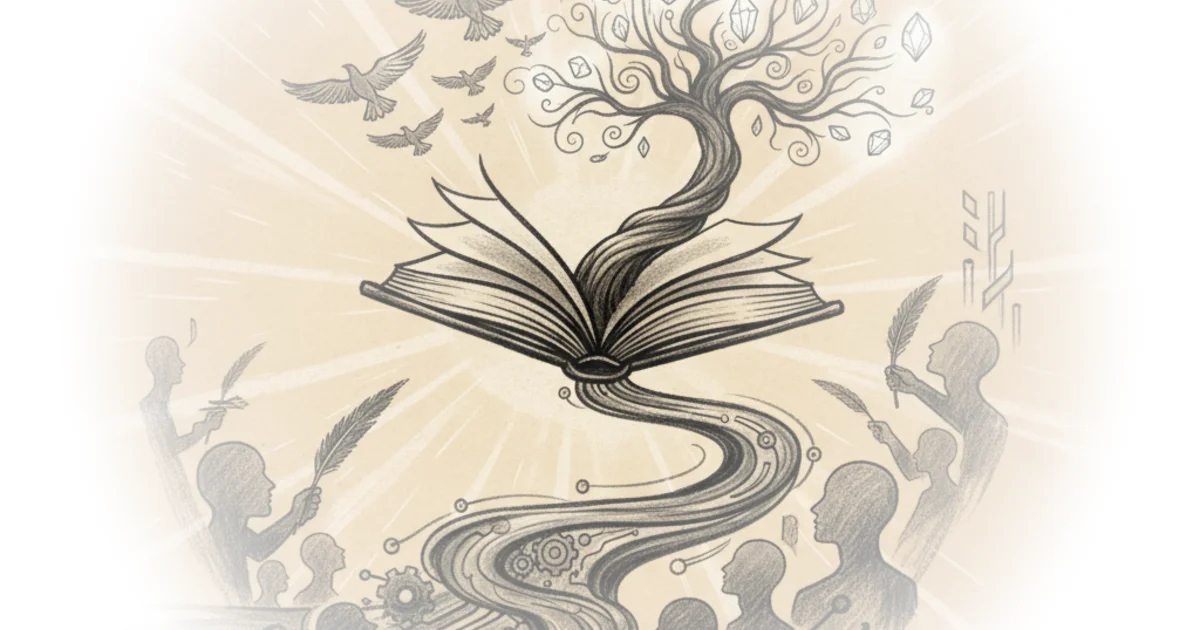
The best writers on the Stack concludes that the best writing of 2025 is that which embraces this ambiguity. "I will begin my story not with poetry, but with ambiguity: the ambiguity of life . . . the ambiguity of the tree," the author declares. This is a call for literature that refuses to provide easy answers, that instead dwells in the uncertainty of the human condition. The piece suggests that in a world of "contagion" and "untrustworthy reality," the only honest response is to acknowledge the "strange asceticism" of our isolation and the "archaic" feelings that persist beneath the surface.
Bottom Line
The strongest element of this commentary is its refusal to treat the year's best books as isolated artifacts, instead weaving them into a cohesive argument about the human response to crisis and the persistence of history. Its vulnerability lies in its heavy reliance on dense, poetic abstraction, which may alienate readers seeking straightforward analysis of plot or character. Ultimately, however, the piece succeeds in its goal: it reminds us that the most powerful stories are those that connect the "unbidden ghost" of the past to the silent, isolated present. The reader should watch for how these themes of isolation and historical recursion continue to shape the literary landscape in the coming year, as the world grapples with the lingering effects of the "plague" era.