Peter Gray delivers a counterintuitive diagnosis for the persistent failure of reading instruction: the methods that work beautifully in the wild collapse completely inside a classroom. While progressive educators have long championed "natural learning"—mimicking how children acquire spoken language—Gray argues that importing these organic processes into a compulsory, age-segregated setting is not just ineffective, but fundamentally mismatched to the environment. This is a crucial distinction for anyone trying to understand why decades of educational reform have struggled to close literacy gaps, suggesting the problem isn't the child's brain, but the architecture of the school itself.
The Myth of the Natural Classroom
Gray begins by dismantling the romantic notion that schools can simply replicate the home environment where children learn to read. He points to the existence of "precocious readers," a small cohort of roughly 1% of children who master fluency by age four without systematic instruction. These children, he notes, are not necessarily geniuses; rather, they are driven by an intense, self-generated interest in a literate home environment. "Precocious reading does not depend on unusually high IQ or any specific personality trait," Gray writes, noting that these children often have average intelligence scores. Instead, they are motivated by curiosity, using context clues and pictures to infer meaning before they ever understand the mechanics of phonics.
This observation is compelling because it validates the "whole language" intuition: that reading is a meaning-centered activity. However, Gray's analysis takes a sharp turn when he examines the conditions required for this to work. He describes his own son, who deduced the phonetic code by age three simply because he wanted to understand the world around him. "[The precocious readers] were not taught the prerequisite skills of reading such as phoneme-grapheme correspondence or letter-naming skills but, instead, learned to read familiar, meaningful sight vocabulary," Gray cites from researcher Olson. The key differentiator here is agency. These children learned because they wanted to, not because they were told to.
Interest, not unusual brain development, is what distinguishes them from others.
The argument holds significant weight because it isolates motivation as the primary variable. In the context of the companion deep dive on Hyperlexia, where children often decode text without comprehension, Gray's emphasis on the drive to understand meaning becomes even more critical. He suggests that without that internal fire, the "natural" method of guessing from context is a dead end for most students.
The Collision of Method and Mandate
The piece then pivots to the historical "Reading Wars," framing the conflict not as a battle between good and bad teachers, but as a clash between two incompatible learning environments. Gray traces the lineage of the "whole language" approach back to Horace Mann in 1852 and John Dewey in the early 20th century, who argued that reading should be taught as a holistic, meaning-driven process. He contrasts this with the "traditionalist" view, championed by figures like Noah Webster and later Rudolph Flesch, who insisted on explicit phonics instruction.
Gray acknowledges that the data has largely settled this debate in favor of phonics. "Overall, children who are taught phonics from the beginning become better readers, sooner, than those who are taught by whole-world or whole-language methods," he states, citing controlled experiments that favor the mechanical approach. Yet, he refuses to let the phonics camp off the hook entirely. He argues that even phonics instruction feels "slow and tedious" in a school setting because the environment itself is the problem. The school is a place of training, not natural learning. "The classroom is a setting where you have a rather large group of children, all about the same age, and a teacher whose primary tasks are to keep order and impart a curriculum—the same curriculum for everyone," Gray explains.
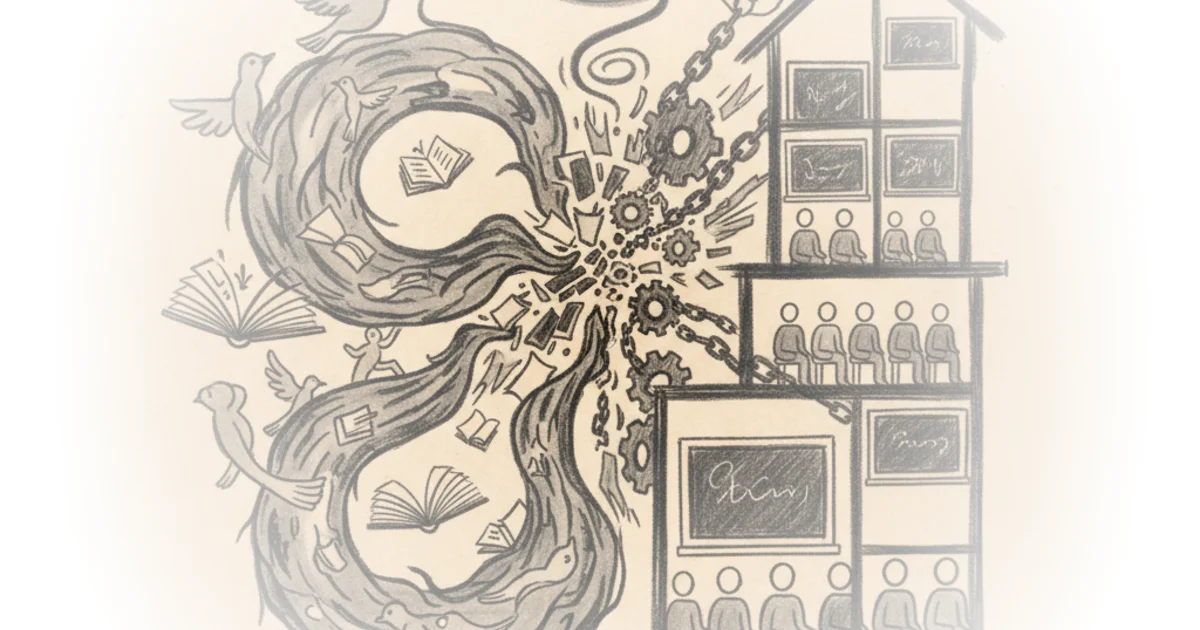
This is where Gray's commentary becomes most incisive. He posits that the failure of progressive methods in schools isn't because the methods are wrong in theory, but because they assume a level of student autonomy that the school system actively suppresses. "In that setting, the teacher decides what to do, not the students," he writes. "If students decided, they would all decide on different things and there would be chaos." This reframes the "Reading Wars" from a pedagogical dispute to an institutional one. The "look and say" method failed not just because it lacked phonics, but because it asked reluctant children to care about meaning in a system designed to enforce compliance.
Critics might note that Gray's dichotomy between "natural" unschooling and "artificial" schooling is somewhat idealized; many unschooling parents do provide subtle, structured scaffolding that mimics phonics instruction without the label. Furthermore, the argument risks downplaying the role of socioeconomic factors that prevent the "literate home" environment from being a universal baseline. However, his core insight remains robust: you cannot force a child to be intrinsically motivated in a setting designed for extrinsic compliance.
The Training Trap
Gray concludes by defining the school experience as "training" rather than learning. "Training is the process of getting reluctant organisms to do or learn what the trainer wants them to do or learn," he asserts. In this context, methods that focus on the mechanical conversion of sight to sound (phonics) are superior simply because they don't require the student to care about the meaning of the text. They require only obedience to the procedure.
He illustrates this with his own family history: he was taught via the "look and say" method and struggled until fourth grade, while his brother, taught with phonics, read fluently by second grade. Meanwhile, his youngest brother, left to his own devices in a literate home, taught himself. The lesson is stark: "The mistake of those who who have pushed for whole-word or whole-language reading in conventional schools... has been to assume that the classroom is or can be a natural learning environment. It isn't, and (except in unusual circumstances) it can't be."
The classroom is all about training. Training is the process of getting reluctant organisms to do or learn what the trainer wants them to do or learn.
This framing challenges the reader to reconsider the very structure of compulsory education. If the goal is literacy, and the environment is one of training, then the most efficient path is the one that requires the least amount of emotional investment from the student. It is a cynical but pragmatic conclusion that aligns with the data showing phonics' dominance in standardized testing, even if it feels unsatisfying to those who believe education should be a joyful, meaning-driven pursuit.
Bottom Line
Gray's strongest contribution is his refusal to let the "Reading Wars" remain a debate about curriculum; he successfully shifts the blame to the institutional constraints of the classroom itself. The argument's biggest vulnerability is its potential to discourage meaningful pedagogical innovation, suggesting that schools are inherently incapable of fostering natural learning. However, the piece serves as a necessary corrective to the idea that simply changing the teaching method will fix a broken system; until the structure of schooling changes to allow for genuine self-direction, the mechanical efficiency of phonics will likely remain the only viable path for the majority of students.