This piece cuts through the political noise to reveal a brutal economic reality: the very policies sold as protectionism are actively dismantling the agricultural backbone of the American Midwest. Bari Weiss does not merely report on falling prices; she amplifies a fifth-generation farmer's testimony that the executive branch's trade strategy has severed decades-old supply chains, turning American soy into a commodity for Brazil while local families face ruin. For the busy professional trying to grasp the tangible cost of geopolitical maneuvering, this is a stark reminder that trade wars are not abstract chess moves—they are calculated decisions that erase livelihoods.
The Human Cost of Trade Policy
Weiss anchors her coverage in the voice of John Bartman, a farmer whose family has worked Illinois soil since 1846. Her framing is deliberate: she strips away the partisan rhetoric to focus on the mechanics of market failure. Bartman explains that the administration's approach was not a shield but a weapon against his own constituents. "Every freaking day, my stress level is up," Bartman tells Weiss, describing a landscape where policy uncertainty has become a constant companion. The author uses this emotional weight to underscore a critical economic point: farmers are "price takers," not price makers. When the executive branch disrupts global trade, these producers cannot simply raise prices to offset losses; they absorb the shock.
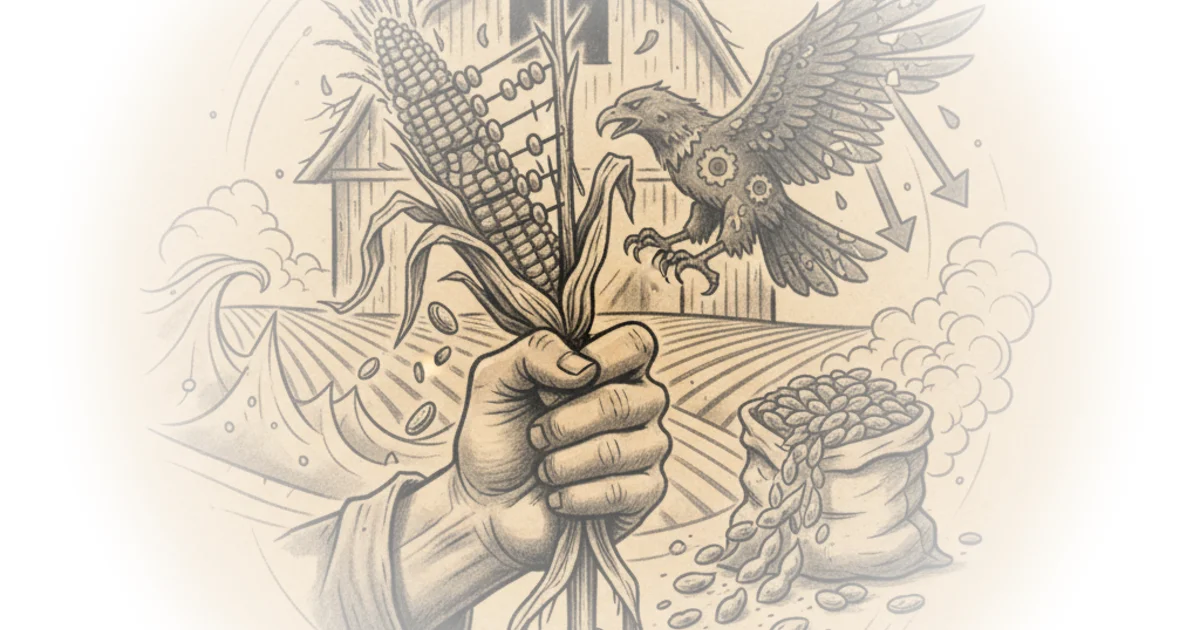
The coverage highlights a specific, devastating irony in the administration's strategy. While tariffs choked off Chinese demand, the White House simultaneously funned billions in aid to Argentina, a direct competitor. "It was adding insult to injury. Trump gave billions of dollars in aid to Argentina when China wasn't buying a single soybean," Bartman says. Weiss presents this not as a gaffe, but as a structural flaw in the administration's logic. The result was a rapid shift in global markets. As Bartman notes, China had already pivoted to South America during the first trade war, investing heavily in infrastructure and land. "China is buying every bean that they can get to Brazil to the tune of four billion bushels," he explains. The administration's failure to anticipate this shift turned American farmers into collateral damage in a game they did not start.
"You say you care about the farmer, and you say you care about the American factory worker, but your policies are destroying both."
Critics of this narrative might argue that tariffs are a necessary long-term lever to force fair trade practices, and that short-term pain is an unavoidable cost of resetting global relationships. However, Weiss's reporting suggests the administration failed to build the necessary domestic buffers—such as biofuel mandates or aviation fuel programs—to cushion the blow. Bartman calls this "Demand Destruction," noting that the administration had eight years to prepare but chose instead to rely on volatile export markets.
The Ripple Effect on Industry
The article's most compelling argument is its rejection of the siloed view of the economy. Weiss illustrates how the agricultural sector is the engine for American manufacturing. When farmers lose money, they stop buying the tractors, combines, and trucks that sustain rural industry. "When we farmers have money and we have a strong agricultural economy, we buy big-ticket items like combines that are made by John Deere in Illinois," Bartman argues. The author effectively connects the dots between a soybean price drop in Illinois and job losses in the factory towns of Iowa and Winnipeg.
Bartman points out that the labor movement itself has roots in this agricultural-industrial complex. "A lot of people don't remember this, but the labor movement in this country started in Chicago at the Cyrus McCormick reaper plant," he says, noting that the farm crisis of the 1980s wiped out millions of farming jobs and the demand that supported them. The administration's current policies, Weiss suggests, are repeating this cycle. By destroying export markets, the executive branch is not just hurting farmers; it is eroding the "backbone of demand" for the entire manufacturing sector. This is a crucial insight for readers who might view trade policy as solely about imports and exports, ignoring the domestic supply chain interdependence.
A Bridge to Nowhere
Weiss also tackles the government's response to the crisis: financial aid. The coverage portrays these subsidies not as a lifeline, but as a Band-Aid on a bullet wound. Bartman describes the aid as a "bridge to nowhere," noting that the $30 an acre provided barely covers a fraction of the seed costs, which can exceed $100 an acre for corn. "I can't take a family of four to McDonald's for $30," he quips, highlighting the absurdity of the math. Furthermore, the article notes the dismantling of USAID programs that once used surplus American food for soft diplomacy and global hunger relief. "That was also soft diplomacy. We were the good guys," Bartman reflects, lamenting the loss of a tool that once projected American strength through generosity rather than coercion.
The piece also touches on the broader geopolitical shift. Countries are no longer waiting for American policy to stabilize; they are building new relationships. "We're not the only supermarket in the world anymore, and that's because of Donald Trump," Bartman states. This observation carries weight given the historical context of the US-China trade war, where China spent years diversifying its supply sources to reduce reliance on the US. The administration's actions have accelerated this trend, making it harder for American agriculture to regain its former dominance.
"When you lose your farm, you don't get it back."
The Stakes for the Next Generation
Ultimately, Weiss frames this as an existential threat to a way of life, not just an economic downturn. Bartman speaks to the demographic crisis facing American agriculture, where the average farmer is now 58 years old. "We're less than 1 percent of the population now," he warns. The fear is that the next generation will be priced out or discouraged from entering the field. "I'm fighting because every kid in America who wants to farm should be able to do so," Bartman says, emphasizing that farming is not a job one can leave and return to like accounting. The loss of a farm is permanent.
The commentary concludes with a call for a different kind of energy policy. Bartman argues that the administration's coziness with Big Oil and reliance on cheap foreign crude undermines the potential for biofuels, which could create domestic demand for crops. "If Trump keeps destroying our demand, we're not going to have anything," he warns. The piece leaves the reader with a sense of urgency: the window to reverse these trends is closing as global markets solidify their new configurations.
Bottom Line
Weiss's strongest move is centering the narrative on the interdependence of the farm and factory, proving that trade wars have no winners in the domestic economy. The piece's vulnerability lies in its reliance on a single, highly critical voice, though the economic data on soybean prices and market shifts supports the farmer's grim assessment. Readers should watch for how the Supreme Court's recent ruling on tariffs impacts future executive actions, and whether the administration can pivot to a strategy that rebuilds rather than destroys domestic demand.