In an era where faith is often dismissed as a crutch or weaponized as a political tool, Anarchierkegaard offers a startling synthesis: the idea that prayer is not an escape from reality, but the very mechanism that makes reality bearable and actionable. This piece does not merely compare Karl Marx and Søren Kierkegaard; it uses the life of Dorothy Day to bridge the gap between the "opiate of the people" and the "opiate" that actually heals, arguing that true faith requires a "wounded consciousness" rather than a comfortable delusion.
The Paradox of the Opiate
The piece begins by confronting the elephant in the room of religious sociology: Marx's famous assertion that religion is the "opium of the people." Anarchierkegaard writes, "In her readings of Marx, where she had broached the infamous passage regarding religion's place as the 'opiate of the people', she made a brave movement that the faithful rarely do—she agreed with him." This is a bold opening move. By having Day agree with Marx, the author dismantles the defensive posture many believers take, acknowledging that for the suffering, religion is often a numbing agent against a cruel world.
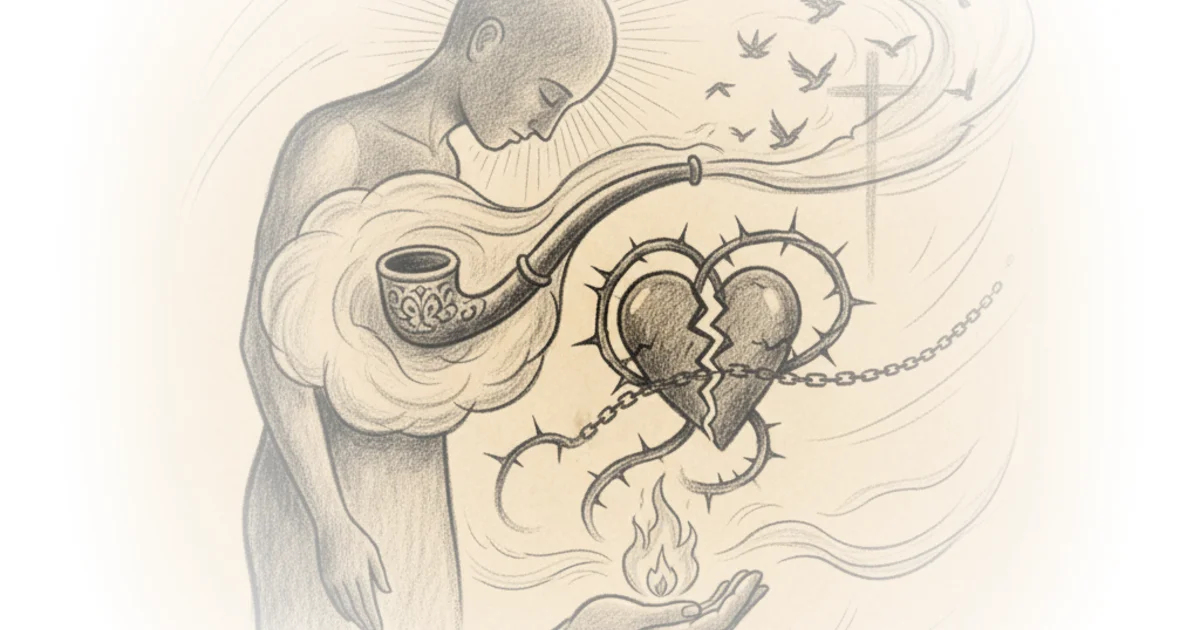
However, the argument pivots quickly. The author suggests that Day's agreement was not a surrender to atheism, but a recognition of the depth of the human condition. Anarchierkegaard notes that Day understood that "in the dark night of the prole, it is absolutely true that those who live and have lived and will continue to live underfoot do indeed grasp for religious mysticism in an effort to escape their condition." This framing is effective because it validates the critic's view of suffering without conceding the final point on the value of faith. It admits the pain before offering the cure.
In the quiet concern for the fealty of one's praying, there must be a position that we can occupy between scrupulosity and a conscious and upbuilding sense of self-judgement—otherwise, prayer is mere fiction in a determinist universe.
The author argues that the danger lies not in the prayer itself, but in the intent. If prayer is just a way to feel better without changing anything, it is indeed a fiction. But if it acts as a "brake" on the machinery of consumption and despair, it becomes transformative. Anarchierkegaard writes, "Prayer changes the prayer," a concise summary of the piece's central thesis: the act of praying alters the pray-er, not just the divine recipient. This shifts the focus from a transactional view of God to an existential one, where the internal state of the believer is the primary site of change.
The Tightrope of Faith
Moving from Day to the Danish philosopher Søren Kierkegaard, the commentary explores the tension between total dependence on God and human agency. Anarchierkegaard highlights a specific theological problem: if God is all-powerful and we are totally dependent, does human action matter? The author quotes Kierkegaard's critique of Schleiermacher, noting that if there is no activity on the part of the self, "Wouldn't prayer have to be regarded as a fiction?" This question cuts to the heart of the modern spiritual crisis—the fear that our efforts are meaningless in the face of divine sovereignty.
The author's resolution is dialectical. Anarchierkegaard explains that for Kierkegaard, the particular and the universal are not divided but are "dialectical partners." This means the individual is not a passive vessel but an active participant who is gifted a "modicum" of divine power to do wonders. The text states, "In the apparent passivity of our condition, activity emerges as the difference-maker for the individual on the backdrop of his universal reality." This is a powerful re-framing of humility. It suggests that true submission to God is not paralysis, but the source of the most potent human action.
Critics might note that this synthesis risks becoming too abstract for those actually living in the "dark night" of poverty or oppression. The philosophical dance between activity and passivity can feel distant when one is struggling to put food on the table. Yet, the author grounds this in the concept of the "wounded consciousness," arguing that the very struggle to discern the Spirit from one's own desires is the evidence of faith's reality.
"For Kierkegaard, the 'night' of religious experience appears only 'as the purely negative horror of darkness or the dazzling nature of the 'sunlight of eternity' 'in the hour of death.'" However, for genuine 'Catholic night-mysticism,' the way of the 'night' issues in an earthly blessedness.
The Reality of the Wounded Self
The piece culminates in a rejection of both vulgar materialism and idealist fantasy. Anarchierkegaard argues that becoming a Christian, or truly becoming a self, requires accepting the life one finds oneself in. The author writes, "No! it is the quiet acceptance that becoming a power that breaches the imposition of the limit first comes in accepting that dynamite may be the most powerful when the fuse is wet." This metaphor is striking: it suggests that the most explosive power comes not from a frantic, loud display, but from a quiet, contained, and perhaps dampened state of being.
The author contrasts the "aesthete" who cries "I am dynamite!" with the person who finds power in the "quiet acceptance" of their finitude. Anarchierkegaard writes, "It is no opium which runs in my veins—it is the reality, the undoubtable realness of my very blood and bones... which grants me my faith." This is the piece's most compelling claim: that faith is not a denial of the material world, but a deeper engagement with it. The "wounded consciousness" is not a sign of failure, but the "evidence that we can indeed be broken over the working of the spirit, moulded again into something new."
The author concludes by addressing the "scoffing of the Flammenzeichen" (the sign of the flame, or perhaps a reference to a specific critic or symbol of intellectual arrogance) who retreat into "petty intellectualism." Anarchierkegaard asserts that the "simple prayer that moves more than the scholar's pen or the policeman's baton ever could" is the true force of change. This is a direct challenge to the idea that political or social change must always come from grand, external systems. Instead, the author posits that the internal shift of the individual is the seed of the external revolution.
There is something caused in me when I pray in earnest that saves me from the panic, the dizziness of the fad and the insecurity and yokes me to a path altogether different from merely what I would desire.
Bottom Line
Anarchierkegaard's piece succeeds in reclaiming the concept of prayer from the charge of escapism by reframing it as the ultimate act of realism. The strongest part of the argument is the synthesis of Marx and Kierkegaard through the lens of Dorothy Day, showing that acknowledging the numbing effect of religion does not negate its transformative potential. The biggest vulnerability lies in the heavy reliance on dense theological concepts that may alienate readers without a background in existentialism or Catholic mysticism. However, for those willing to engage, the piece offers a profound reminder that the most powerful force in the world is not the loud shout of the aesthete, but the quiet, wounded, and active self in prayer.