Asianometry reframes a century of paleontological debate not as a dry academic dispute, but as a dramatic geological detective story centered on a specific region in China that functioned as a "Mesozoic Pompeii." The piece's most striking claim is that the preservation of soft tissue—muscles, eyes, and even ovarian follicles—wasn't an accident, but the result of a unique, lethal combination of volcanic hydrogen fluoride plumes that suffocated entire ecosystems instantly, freezing a moment in time that would otherwise have been lost to scavengers.
The Collapse of the "Cousin" Theory
The narrative begins by dismantling a long-held scientific misconception. For decades, the prevailing view, solidified by Gerhard Heilmann in the 1920s, was that birds and dinosaurs were merely cousins sharing a common ancestor, not that birds were direct descendants. Heilmann's logic rested on the belief that evolution could not reverse itself; since dinosaurs supposedly lacked the clavicles (wishbones) that birds possessed, a direct lineage was impossible. Asianometry notes that this theory "stood as the generally accepted theory for four decades," effectively stalling progress until the 1970s.
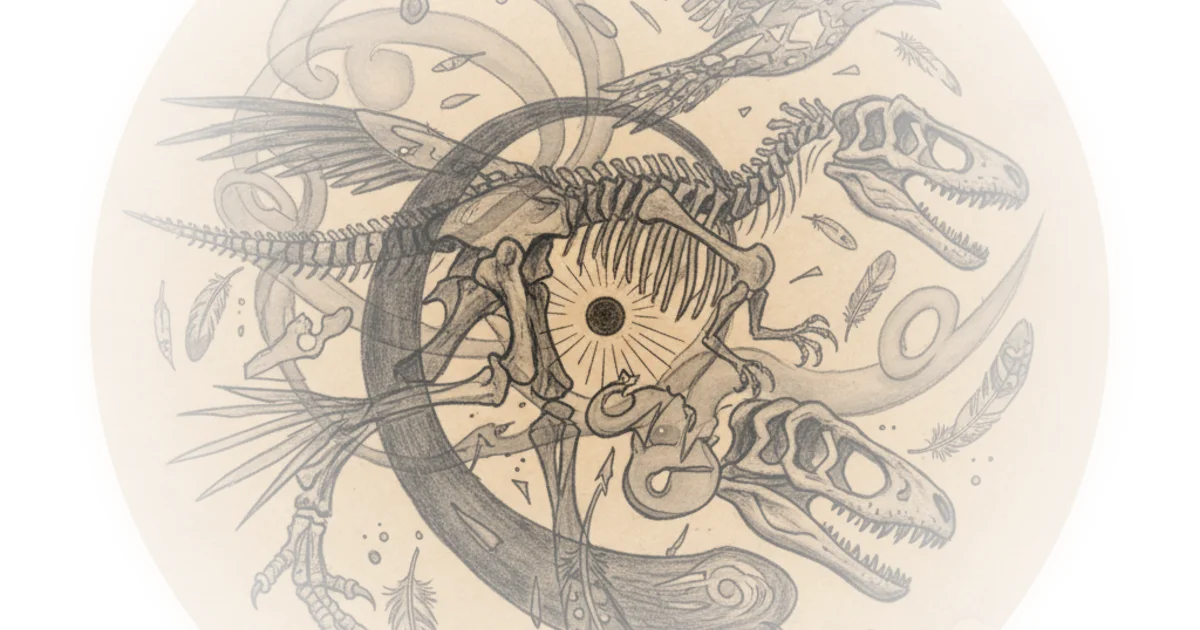
The turning point came with a "dinosaur renaissance" driven by two factors: the discovery of the agile predator Deinonychus by John Ostrom, which forced a re-evaluation of dinosaur physiology, and the adoption of cladistics, a classification method based on shared derived traits. As Asianometry explains, "Together these kicked off the dinosaur renaissance," shifting the academic consensus toward the idea that birds are, in fact, living feathered theropods. This framing is effective because it highlights how scientific progress often hinges on methodological shifts as much as new discoveries.
Critics might argue that the timeline of this acceptance was slower than necessary, given that the anatomical similarities were visible long before the 1970s. However, the author correctly identifies that the intellectual framework required to interpret those similarities was simply missing for a generation.
"Birds are now dinosaurs, feathered theropod dinosaurs, and the only living ones left on earth, which I am still getting used to to be honest. It's the Pluto thing all over again."
The Jehol Biota: A Window into the Cretaceous
The core of the piece focuses on the Jehol Biota, a fossil-rich region in what is now Hebei and Liaoning provinces. Asianometry details how this area, once a resort for Manchu emperors, became a paleontological goldmine after China opened its borders to Western scientists in the 1990s. The preservation quality here is described as unparalleled: "The sudden universal nature of this event means that animals died without being scavenged in ideal preservation circumstances."
The author describes the mechanism of preservation with vivid clarity. Volcanic eruptions to the west released plumes of hydrogen fluoride and sulfur, which "would suffocate huge bunches of animals and cause them to fall into the water in mass die-offs." The resulting ash buried the carcasses instantly, preserving details that usually decay, such as skin texture and stomach contents. This evidence is crucial because it moves the discussion from theoretical lineage to tangible, observable biology.
The discovery of Sinosauropteryx in 1996 serves as the narrative climax. Unlike the earlier Confuciusornis, which was clearly a bird, Sinosauropteryx was a dinosaur with feathers. Asianometry writes, "The fossilized animal had feathers down its spine and sides... declared to be a transitional species between dinosaurs and birds." This finding was revolutionary because it closed a critical time gap; previously, the earliest known birds lived in the Late Jurassic, while the proposed dinosaur ancestors appeared much later, creating a "time paradox." The discovery of a feathered dinosaur from the Early Cretaceous helped "significantly close the gap, pushing back the dino bird transition by millions of years."
The Debate Over Feathers and Fibers
The commentary does not shy away from the controversy that followed. Immediately after the Sinosauropteryx announcement, a vocal minority argued that the filamentous structures were not feathers but degraded collagen fibers. Asianometry captures the intensity of this academic tug-of-war: "They vociferously argued that the fossilized markings were not actually feathers or even protofeathers but rather degraded collagen fibers."
The author notes that this debate raged for a decade until a pivotal 2017 paper settled the matter by demonstrating that the comparison evidence used by skeptics was flawed. The structures previously identified as collagen fibers were, in fact, scratch marks. As Asianometry concludes, "The community has largely accepted this, though the debate on the origin of feathers and how they had been used continues." This inclusion of the skepticism adds necessary weight to the final conclusion, showing that the scientific consensus was earned through rigorous testing rather than mere acceptance of a new trend.
"The discovery of the Jehol biota fossils represent a significant paradigm shift in our understanding of dinosaurs and is rightly recorded as such in history."
Bottom Line
Asianometry's strongest contribution is its ability to synthesize complex geological and biological data into a coherent narrative about how a specific environmental catastrophe created a unique archive of life. The piece's greatest vulnerability lies in its brief treatment of the smuggling issues, noting that many fossils were sold to private collectors without fully exploring the long-term impact of this illicit trade on the scientific record. Ultimately, the article successfully argues that the Jehol Biota did not just add new species to a list; it fundamentally rewrote the evolutionary tree, proving that the line between dinosaur and bird is not a gap, but a gradient.