Then & Now delivers a provocative historical excavation, arguing that the internet wasn't merely commercialized but actively expropriated from its public origins. This isn't just a tech history; it's a forensic account of how a taxpayer-funded infrastructure for academic and military survival was quietly handed over to private monopolies. For a generation that assumes the digital world was born in a garage, this narrative offers a startling correction: the web was built in government labs, funded by the Department of Defense, and designed as a tool for radical democracy before it was sold off as a shopping mall.
The Public Origins of a Private Empire
Then & Now opens by dismantling the myth of the lone inventor, grounding the internet's birth in massive public investment. "The history of the internet has been one of big Capital pilfering from public investment and National infrastructure," they write. This framing is essential because it shifts the blame from inevitable market forces to deliberate policy choices. The piece traces the lineage from the British government funding Charles Babbage's mechanical calculator to the U.S. Department of Defense financing the first modern computers at the University of Illinois.
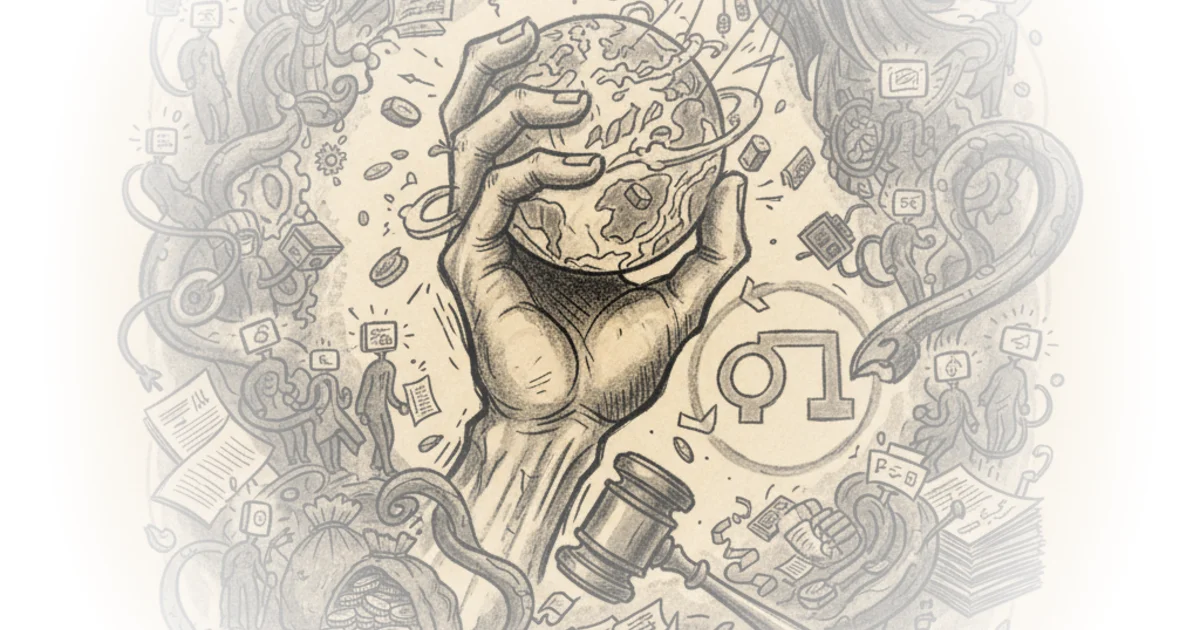
The authors highlight the dual nature of the early network, ARPANET. On one hand, it was a "researcher's dream of a scholarly Utopia" designed to share expensive computing power. On the other, it was a Cold War weapon: "the goal was to exploit new computer Technologies to meet the needs of military command and control against nuclear threats." This duality is often glossed over in popular history, but Then & Now insists both motivations were present from the start. The infrastructure was built to survive a nuclear strike and to democratize access to information simultaneously.
The web as we've come to know it is a great ocean we know that we only swim paddle on its surface never diving beyond the first few pages of search results.
The commentary effectively uses this ocean metaphor to describe our current disconnection from the internet's deep history. We interact with the surface layer of apps and feeds, oblivious to the public engineering beneath. This is a powerful rhetorical move that makes the reader feel the loss of agency. Critics might argue that the "utopia" narrative is romanticized, ignoring the early commercial potential that always existed, but the evidence of the National Science Foundation's (NSF) strict ban on commercial use until the 1990s supports the author's claim that a public-first model was the default for decades.
The Battle for Open Access
The piece then pivots to the cultural ethos of the early internet, where "hackers" were not cybercriminals but activists fighting for open access. Then & Now recounts how researchers at MIT would physically break into locked offices to free terminals, viewing access restrictions as "anti-social." Richard Stallman is quoted recalling how a "big wrench" was left at the AI lab "to be used in case anyone dares to lock up one of the more fancy terminals." This anecdote isn't just color; it illustrates a fundamental clash of values that defined the era.
As the network grew, the tension between public utility and private profit intensified. The National Science Foundation built a backbone connecting universities, carrying traffic "at no cost to institutions." Yet, by the early 1990s, the system was overwhelmed. Then & Now notes that "data was and is measured in packets and in 1988 a million packets of traffic were sent across the network by 1992 just four years later this had increased to 150 billion." The demand was outstripping the public budget, creating a vulnerability that commercial interests were eager to exploit.
The Political Pivot and the Handover
The most critical section of the coverage details the political maneuvering that led to the privatization of the internet. Then & Now argues that the shift wasn't accidental but the result of intense lobbying and a change in administration priorities. Senator Al Gore initially championed a "Middle Road" where 20% of the infrastructure would remain public, modeled on the public broadcasting act. "Senator Daniel Inouye argued that legislation should preserve 20 of the infrastructure for public use to provide quote libraries education non-profits government agencies museums to provide educational informational cultural Civic or charitable Services directly to the public without charge."
However, the narrative takes a sharp turn when the administration met with financial leaders. After the 1992 election, Federal Reserve Chairman Alan Greenspan convinced the new leadership that the network should be a tool for economic speculation and deregulation. The piece notes that "Clinton Gore and the Democratic party received a hundred and twenty thousand dollars in contributions from a Consortium of telecommunications Giants" before Gore reversed his stance. This is a stark claim: that the promise of a public internet was traded for campaign cash and a belief in market efficiency.
The debate has been framed so far by a handful of communications Giants who have been working overtime to convince the American people that the data Highway will be little more than a virtual electronic shopping mall.
The authors describe the transfer of the NSFNET backbone to private corporations as a "covert theft" executed through the 1996 Telecommunications Act. The infrastructure was decommissioned in 1995 "with hardly a whimper of protest," despite the fact that "at least a billion dollars in today's money of public investment in the networks have been transferred with little Fanfare to the private sector." This section is the emotional core of the piece, arguing that the public was dispossessed of a national asset. A counterargument worth considering is that the private sector was necessary to scale the network to the billions of users it serves today, a feat the government might not have achieved. Yet, the authors' point remains that the terms of that scaling were dictated by monopolies rather than public interest.
Bottom Line
Then & Now's strongest asset is its rigorous tracing of the funding trail, proving that the internet's foundation is public property that was systematically dismantled. The piece's vulnerability lies in its somewhat deterministic view of the 1990s political shift, potentially underestimating the genuine ideological belief in deregulation that existed across the spectrum. However, the verdict is clear: the internet we have today is not the one that was built, but a version that was stolen from the public to serve a different set of masters.
The internet was meant to be a new Utopia a tool of Liberty fraternity equality of radical democracy and freedom and it might have had its moment but has a tool celebrated for its openness turned into a bit of a cage.