This piece cuts through the political theater to expose a brutal logistical reality: the federal government is attempting to build a massive detention infrastructure on a timeline and budget that defy basic economic and civic sense. While the administration pledges to halt illegal entry and deport millions, Reason reveals that the machinery to hold these people is being assembled through a real estate spree that is simultaneously overpriced, inhumane, and destined to collapse under the weight of its own infrastructure deficits. The most startling claim isn't the scale of the spending, but the fact that even in politically sympathetic rural towns, local officials are screaming that the math simply doesn't work.
The Warehouse Strategy
The core of the argument rests on the sheer velocity of the Department of Homeland Security's acquisition strategy. To meet a self-imposed goal of 3,000 daily deportations, the executive branch needs to triple its current capacity. The solution? Transforming industrial storage into human holding pens. Reason reports, "It is inhumane to store human beings—people who in many cases have not been convicted or even accused of anything more serious than civil immigration violations—in warehouses like so much freight." This framing is crucial because it strips away the euphemisms. The administration insists these are "detention facilities," but the blueprint is clear: they are buying empty boxes designed for cargo and filling them with people.
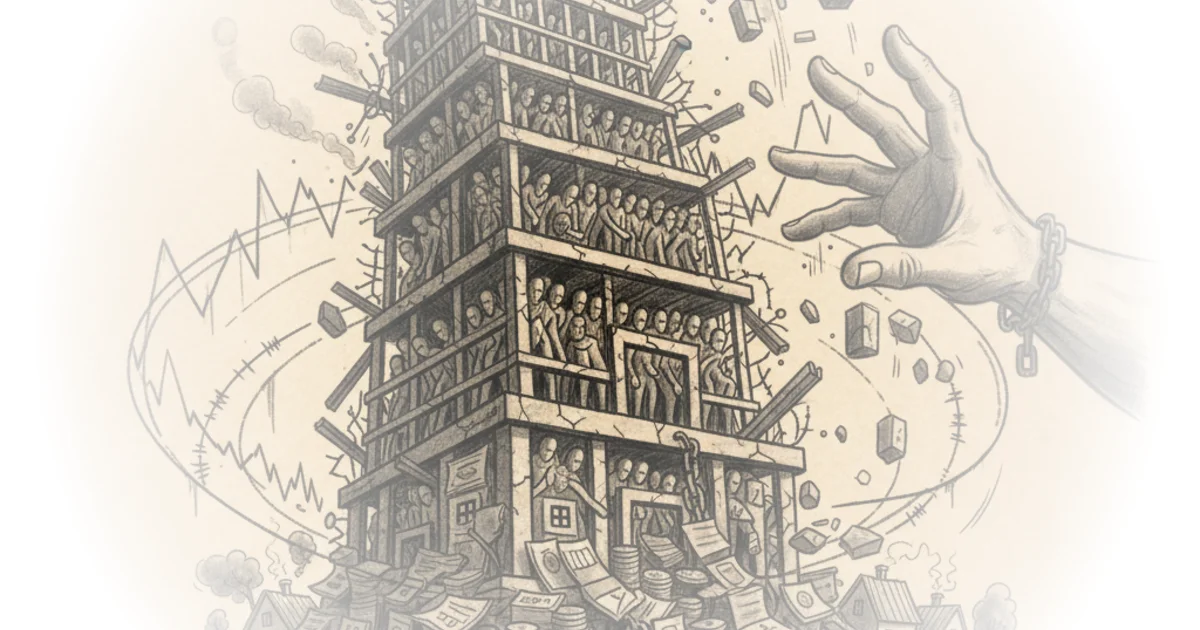
The scale of the investment is staggering. The 2025 "One Big Beautiful Bill Act" allocated $45 billion specifically for this expansion. A Homeland Security press release claimed this would secure 80,000 new beds, yet the execution is already showing cracks. The piece notes that the plan involves streamlining operations to 34 dedicated facilities, with some centers designed to hold up to 10,000 detainees. This echoes the chaotic expansion seen in the early 2010s during the surge of unaccompanied minors, where the rush to build outpaced the ability to ensure basic safety standards. As Reason points out, "ICE acquired industrial properties with empty warehouses designed to store and transport freight, with the intent to use them for storing and transporting people." The dehumanization is baked into the architecture.
It is inhumane to store human beings—people who in many cases have not been convicted or even accused of anything more serious than civil immigration violations—in warehouses like so much freight.
Critics of the current detention regime might argue that the administration is simply fulfilling a mandate to enforce the law. However, the piece counters this by highlighting that the vast majority of those being detained are not violent criminals. Citing data from the Cato Institute, the article notes that as of February 2026, "about 74 percent of the people held in ICE custody... had no criminal convictions." This statistic undermines the narrative that these warehouses are necessary to protect public safety from "the worst of the worst," suggesting instead that the infrastructure is being built for mass civil detention.
The Economics of Overpaying
The financial analysis provided is perhaps the most damning part of the coverage. The federal government is not just buying land; it is buying it at a premium, often ignoring market realities. Reason details a facility in Surprise, Arizona, where the government paid $70 million for a warehouse the tax assessor valued at $46 million, with retrofitting costs estimated at another $150 million. The article argues, "ICE appears to be paying an 11% to 13% premium, with some properties trading at over 30% of recent comparable trades in the market."
This isn't just bad accounting; it's a distortion of the local economy. When the federal government swoops in with unlimited funds, it crowds out private enterprise. In Romulus, Michigan, the government "outbid an auto supplier" to secure a property for detention. This creates a perverse incentive where the federal government becomes the dominant buyer in a market, driving up prices for everyone else while removing potential tax revenue from the local base. As the piece observes, "The federal government is exempt from paying property taxes, so each of those properties will become an empty spot on the town's balance sheet." The promise of economic boom is a mirage; the reality is a loss of local revenue and a displacement of productive industry.
Infrastructure and Local Pushback
The most compelling evidence in the piece comes from the ground, where the logistical fantasy collides with physical reality. In Social Circle, Georgia, a town of 5,500 residents, the plan is to build a center for 10,000 detainees. The wastewater implications are catastrophic. The city's current system is already operating at capacity, yet the new center would generate 1 million gallons of wastewater daily. Reason highlights the frustration of local leaders, quoting Rep. Mike Collins, a staunch ally of the administration, who stated, "Social Circle does not have the sufficient resources that this facility would require." This is a critical moment: even political allies are forced to admit that the federal plan is unworkable.
The article also exposes the disconnect between federal projections and local needs. ICE claims the Oakwood facility will bring 1,520 jobs and $159.2 million in GDP. Local officials are skeptical. "The numbers they toss out are a little like economic forecast numbers, which can be massaged," says City Manager B.R. White. The piece supports this skepticism with academic evidence, noting that while prisons create public sector jobs, they "generate little spillover effects on private sector employment and fail to provide a major boost to local economic activity." The jobs created are temporary construction roles or low-wage guard positions, all funded by federal taxes that ultimately drain from the national pool rather than generating organic local growth.
The Legal and Constitutional Impasse
Perhaps the most unsettling conclusion is the lack of recourse for these communities. The Supremacy Clause of the Constitution effectively renders local zoning laws moot. Reason quotes Eric Taylor, city manager of Social Circle, who explains, "Our zoning code doesn't allow a detention facility anywhere in the city... But since the federal government is not subject to zoning, you can't go after them." This creates a scenario where local democracy is suspended in favor of federal fiat. Even if a town votes unanimously to oppose the facility, as Romulus did, the federal government can proceed regardless.
The piece suggests that the only remaining check is litigation, which could delay but not necessarily stop the project. M. Nolan Gray, a zoning expert, notes that a small town could "waste the federal government's time going to court," but this is a costly and uncertain strategy. The administration's ability to bypass local consent underscores a broader trend of executive overreach, where the urgency of the deportation mandate overrides the practical and legal constraints of local governance.
Our zoning code doesn't allow a detention facility anywhere in the city, to start with. But since the federal government is not subject to zoning, you can't go after them and say, well, we don't allow that here.
Critics might argue that national security and immigration enforcement are federal prerogatives that must supersede local concerns. While true in principle, the piece effectively argues that the manner of execution—buying up industrial real estate at inflated prices and ignoring infrastructure limits—undermines the very goals of the policy. A system that cannot house its detainees without bankrupting local utilities or violating federal safety standards is not a system of enforcement; it is a system of failure.
Bottom Line
The strongest part of this argument is its grounding in the mundane, unglamorous details of plumbing, tax assessments, and real estate valuations, which collectively dismantle the administration's grand narrative of a swift and efficient deportation machine. The piece's biggest vulnerability is its reliance on the assumption that local opposition will hold; history suggests that federal power, once mobilized, often bulldozes local resistance regardless of the cost. The reader should watch for the inevitable lawsuits and infrastructure failures that will likely follow as these warehouses open their doors, turning the administration's $45 billion gamble into a national embarrassment of wasted resources and human suffering.