In a political landscape where the prevailing wisdom insists that the only path to survival is retreating to the center, Eric Blanc presents a startling counter-narrative: a working-class, anti-elite insurgency can not only win but dominate in the most expensive city in America. This piece cuts through the noise of conventional punditry to argue that Zohran Mamdani's mayoral victory was not a fluke of demographics, but a direct result of a political strategy that explicitly rejected the status quo in favor of bold, unfunded mandates for the poor. For listeners navigating a world of deepening inequality and authoritarian drift, this analysis offers a rare blueprint for how to channel frustration into power.
The Anatomy of an Upset
Blanc begins by dismantling the assumption that the political tide had irrevocably turned rightward following the recent national election. He notes that when the campaign launched in late October 2024, even Mamdani's most optimistic supporters viewed a respectable loss as the best-case scenario. Yet, the outcome defied these expectations. "Tonight's historic win proves the skeptics wrong," Blanc writes, highlighting that New Yorkers rejected billionaire-backed attack ads and the pressure to support establishment figures. The author argues that the victory was not merely about Mamdani's charisma or social media savvy, but about the specific content of his platform. Unlike centrist consultants who peddle "kitchen-table issues" as a vague panacea, Mamdani offered concrete, transformative plans: free childcare, fast and free buses, and frozen rent.
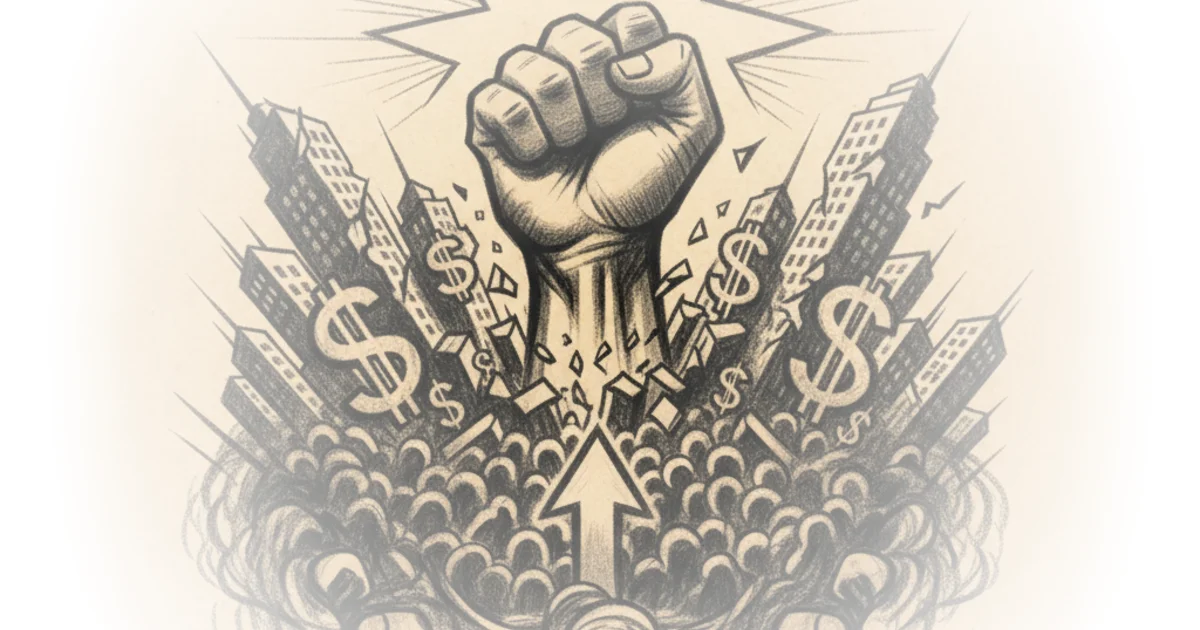
The core of the argument rests on the idea that these policies were funded by a specific mechanism—taxing the rich—which Blanc describes as "Clintonism this was not." This framing is effective because it isolates the economic populism from the cultural wars that often derail progressive campaigns. Blanc emphasizes that Mamdani's credibility stemmed from his refusal to be beholden to corporate cash or the "decrepit Democratic establishment." He draws a sharp parallel to the 2016 presidential campaign, noting that "Like Bernie Sanders before him... when Zohran talked about workers versus the billionaires, you knew he meant it." This comparison grounds the local victory in a broader national movement, suggesting that the energy of the Sanders era has finally found a successful municipal vehicle.
You can't have Zohranism without Zohran's politics. His excellently run campaign was a necessary condition for victory, but it couldn't have gotten nearly this far had it not coincided with seismic popular opinion shifts.
Blanc points out that the campaign built an unprecedented canvassing machine of over 100,000 volunteers, largely driven by the Democratic Socialists of America (DSA). This organizational depth allowed the candidate to win decisively among demographics that the national party has recently struggled with, including young men and workers of all backgrounds. The author suggests that the victory was a referendum on the future of the Democratic Party, where the establishment lost badly to a candidate who refused to compromise on principle. However, a counterargument worth considering is whether this model is replicable outside of New York City, a deep-blue outlier with a unique political culture. Blanc anticipates this criticism, arguing that while the specific form of populism may vary by region, the fundamental message of economic security and dignity against elite greed is universal.
From Election to Movement
The commentary shifts from the mechanics of the election to the challenges of governance. Blanc warns that a successful administration poses a "serious threat to establishment leaders in both parties," predicting that elites will attempt to block the implementation of the agenda. He highlights the tension between the movement's electoral success and its organizational strength, noting that while DSA has grown to over 11,300 members, this is still a small fraction of the one million voters who supported Mamdani. Blanc draws on historical precedent to illustrate the gap, referencing Milwaukee's "sewer socialists" who won the leadership of organized labor a decade before capturing the mayoral office in 1910, and Fiorello La Guardia, who succeeded in the 1930s because he was backed by a vibrant union movement.
The author argues that the path forward requires "reverse engineering" a working-class movement powerful enough to transform the city, rather than relying solely on the elected official. He urges New Yorkers to plug into united-front campaigns to win free childcare and affordable housing, and to protect undocumented neighbors through mass disruption. Blanc is critical of the current leadership's limitations, pointing out that Governor Kathy Hochul's refusal to support taxing the rich illustrates "just how far we still have to go." This section is particularly strong in its refusal to treat the election as the finish line. Instead, it frames the victory as a "strong shot of raised expectations" in a period defined by fear.
Despair is the chief opponent of progress. Our greatest need is hope.
Blanc concludes by invoking Victor Berger, a Milwaukee socialist from 1907, to remind readers that the earth is large enough to supply good things to everyone, but only if people work and fight for it. The author's tone here is urgent, suggesting that the battle has only just begun. While the piece is optimistic, it avoids naive triumphalism by acknowledging that billionaires and authoritarian forces will not cede power easily. Critics might note that the reliance on mass disruption and nonviolent mass walkouts carries significant risks of backlash or suppression, which the article touches on but does not fully detail. Nevertheless, the central thesis remains compelling: the only way to sustain the momentum is to build a movement that is larger and deeper than the electoral coalition that elected the candidate.
Bottom Line
Eric Blanc's analysis succeeds in reframing a local political upset as a national signal that economic populism can overcome both corporate power and party establishment inertia. The argument's greatest strength is its refusal to separate the candidate's personal appeal from the specific policy demands that mobilized the base. Its primary vulnerability lies in the immense difficulty of translating a municipal victory into a sustained movement capable of withstanding the coordinated opposition of state and federal elites. Readers should watch to see if the proposed mass organizing efforts can bridge the gap between the campaign's 100,000 volunteers and the broader electorate required to enact these transformative policies.