In an era obsessed with efficiency, L. M. Sacasas offers a startling counter-intuitive truth: the very things we automate to save time are the things that make life worth living. This piece does not merely critique technology; it diagnoses a specific bargain we have unknowingly signed, one where we trade the messy, fullness of human experience for the sterile comfort of a perfectly managed existence. As we face a new wave of artificial intelligence agents promising to streamline our days, Sacasas argues that the cost of this convenience is the delegation of our own humanity.
The Magnificent Bribe
Sacasa anchors his argument in the work of historian Lewis Mumford, specifically a 1964 essay that feels eerily prescient today. He introduces Mumford's concept of the "magnificent bribe," a social contract where we surrender our agency in exchange for material abundance. "The bargain we are being asked to ratify takes the form of a magnificent bribe," Sacasas writes, noting that we are offered "every material advantage, every intellectual and emotional stimulus he may desire." The catch, however, is severe: we must accept everything "dually processed and fabricated, homogenized and equalized, in the precise quantities that the system, rather than the person, requires."
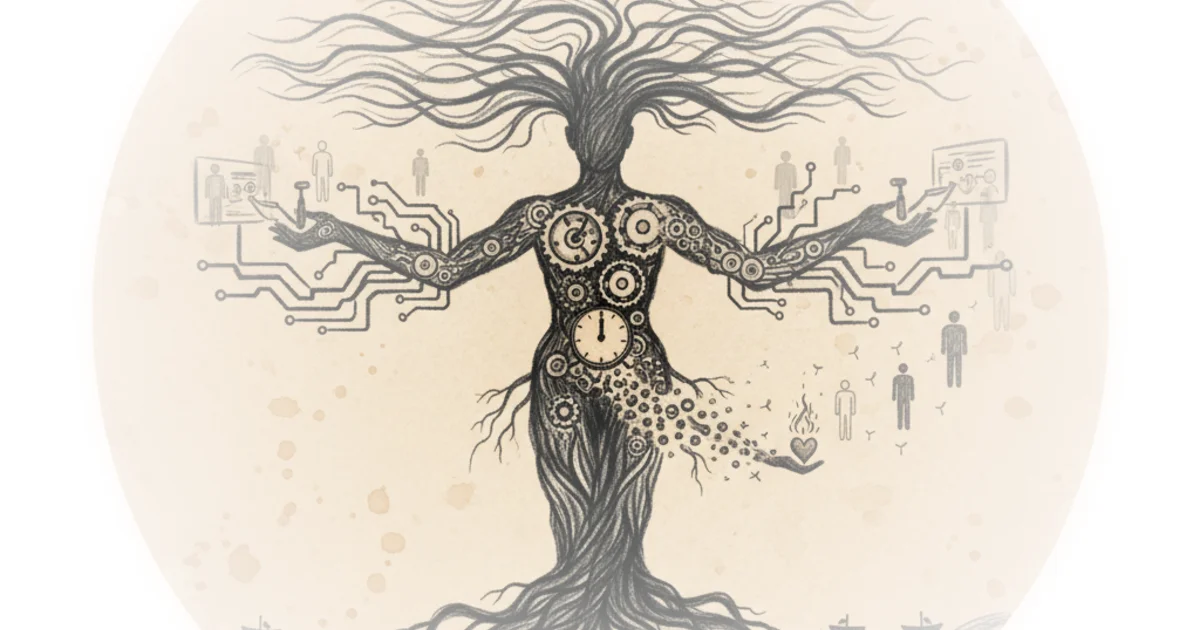
This framing is powerful because it shifts the blame from individual laziness to a systemic trap. Sacasas suggests that once we opt into this system, "no further choice remains." The danger is not that the technology fails, but that it succeeds too well at removing friction, thereby removing the very struggles that define our character. Critics might argue that this view romanticizes struggle and ignores the genuine relief that automation brings to those burdened by poverty or disability. Yet, Sacasas is careful to distinguish between relief and the total outsourcing of the self, warning that "if one surrenders one's life at source, authoritarian technics will give back as much of it as can be mechanically graded."
Life cannot be delegated.
The Threshold of Delegation
Moving from historical warning to practical application, Sacasas introduces the core principle of his commentary: "Life cannot be delegated." He clarifies that this is not a rejection of tools, but a warning against crossing a threshold where tools cease to serve us and begin to replace us. Drawing on the work of Ivan Illich, he suggests that technologies become destructive when they exceed certain scales of intensity. "We must all think for ourselves, and in conversation with each other, so that we can arrive at sound judgments under our particular circumstances," Sacasas argues, rejecting the idea of a universal rulebook for technology use.
The author identifies specific domains where delegation is particularly perilous: care, skill cultivation, moral judgment, and responsibility. He posits that we often mistake the mundane for the trivial, failing to see that "even our mundane everyday work might be exactly how we care, develop skill, exercise judgment, and embrace responsibility." This is a crucial distinction. When we delegate the act of caring for a child, the work of a meeting, or the maintenance of a home to an algorithm, we are not just saving minutes; we are eroding the "fullness and wholeness" of our lives. Sacasas notes that the etymology of "mundane" refers to "of this world," suggesting that to flee the mundane is to flee reality itself.
Implication and the Path of Reality
To counter the allure of delegation, Sacasas offers a complementary principle: "To live is to be implicated." Citing Steven Garber, he argues that a meaningful life requires us to be deeply entangled in the world, for love's sake. He reinforces this with a quote from poet Gary Snyder, who reminds us that "reality-insight says … master the twenty-four hours. Do it well, without self-pity." Snyder's insight—that changing a filter or wiping a nose is as virtuous as chanting sutras—serves as a grounding force against the abstract promises of digital efficiency.
Sacasa's argument here is that the "path" of life is not a destination we reach by skipping the boring parts; the path is the boring parts. "Don't let yourself think these are distracting you from your more serious pursuits," Snyder writes, a sentiment Sacasas elevates to a moral imperative. The piece concludes by suggesting that the "magnificent bribe" of modern technology is the promise of a life without friction, but the price is a life without depth. As Sacasas puts it, "We ought to be especially careful in the cases where what we delegate to a device, app, agent, or system is an aspect of how we express care, cultivate skill, relate to one another, make moral judgments, or assume responsibility for our actions in the world."
Bottom Line
Sacasa's most compelling contribution is his reframing of "convenience" not as a virtue, but as a potential trap that strips life of its necessary friction. The argument's greatest vulnerability lies in its idealism; for many, the "mundane" tasks he champions are not opportunities for virtue but crushing burdens of survival. However, as a guide for the privileged and the busy, his warning is vital: if we automate our way out of every difficulty, we may find we have automated ourselves out of life entirely.