Fred Mills doesn't just recount the history of a London landmark; he reveals a brutalist fortress disguised as a communications hub, built to survive a nuclear apocalypse. While most histories focus on the tower's role in the telecommunications revolution, Mills uncovers the chilling reality that its cylindrical shape was a deliberate defense against the shockwaves of a thermonuclear blast, rendering it invisible on official maps and illegal to photograph under the Official Secrets Act.
The Architecture of Survival
Mills anchors his narrative in the post-war desperation of the 1950s, where London's infrastructure was crumbling under the weight of a modernizing society. He writes, "The London of the 1950s and 60s was very different to the London of today. Decimated by the Second World War, entire districts and neighborhoods had been flattened by bombing, and the infrastructure that had survived was outdated and creaking under the demands of a rapidly modernizing society." This context is crucial; it explains why the General Post Office needed a solution that was not merely functional but revolutionary. The author effectively argues that the tower was the only viable answer to the limitations of copper cables and the line-of-sight requirements of microwave transmission.
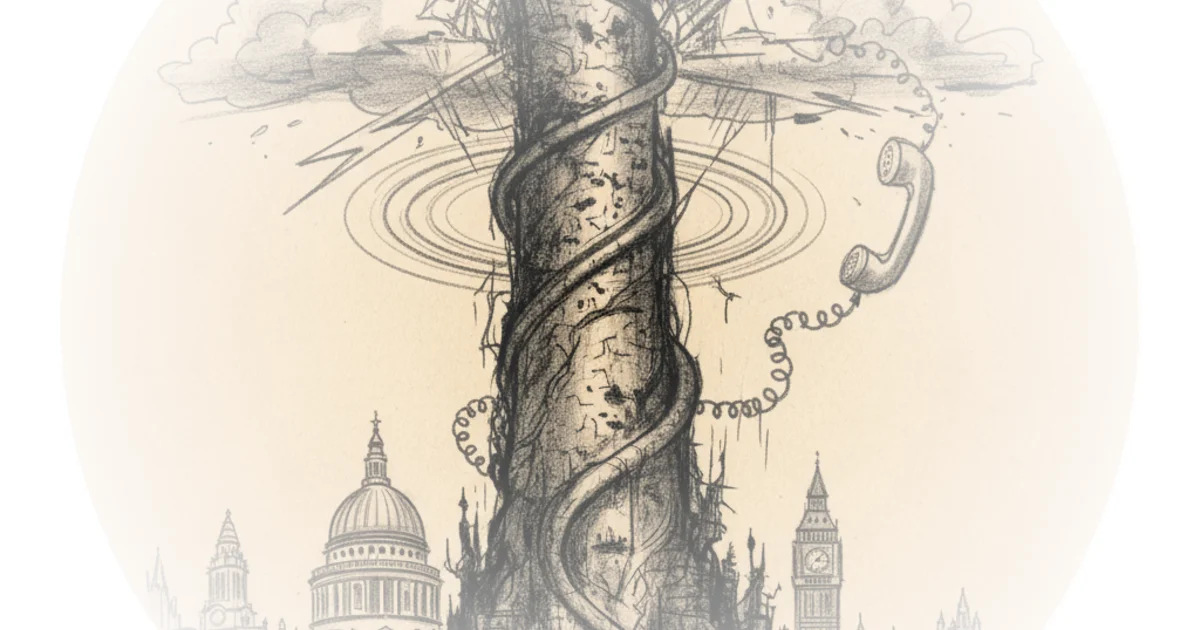
The design choice of a cylinder is presented not as an aesthetic whim, but as a matter of survival. As Fred Mills puts it, "Unlike square or octagonal towers, this circular form offered the best wind resistance, ensuring that gusts would sweep around its surface rather than battering flat walls." He goes further to explain the structural necessity: "A structure that swayed, even slightly, could cause connections to fail." This precision engineering is the backbone of the piece, transforming the tower from a mere skyscraper into a piece of high-stakes military hardware. The author's focus on the "massive foundations" sunk into the hard chalk, or lack thereof, adds a layer of engineering drama that elevates the story beyond a simple timeline.
Its narrow cylindrical form, apart from reducing wind loads, was also designed to lessen the impact of a blast wave. The heavily reinforced concrete shaft at its core would remain standing even if much of the structure around it was obliterated.
Critics might note that Mills slightly overstates the tower's invincibility; he admits a direct hit would still reduce it to rubble, yet the framing suggests a near-mythical resilience that captures the Cold War paranoia of the era. This tension between the tower's intended purpose and its actual vulnerability is where the narrative gains its emotional weight.
A Secret in Plain Sight
The most compelling aspect of Mills' coverage is the revelation of the tower's dual identity: a glamorous public venue and a classified military asset. He notes that "the tower couldn't appear on any official maps, and parliamentary questions about it were stonewalled." This secrecy created a unique dynamic where the public could dine in a revolving restaurant on the 34th floor while the building itself was a target for the very enemies it was built to withstand. The author highlights the irony that the tower's most public feature—the restaurant—was also the site of its greatest vulnerability, citing the 1971 IRA bombing that forced its permanent closure.
Mills writes, "But behind the glamour, there was a darker reality. The post office tower was also a piece of cold war infrastructure. Its microwave links were vital for defense." This juxtaposition serves as a powerful reminder of the era's geopolitical tensions. The author's decision to detail the "unusual brief to withstand the unthinkable" shifts the reader's perspective from viewing the tower as an eyesore or a relic to seeing it as a monument to a specific, terrifying moment in history. The fact that the tower's design meant it could "endure the peripheral shock waves of an attack better than most other structures" is a detail that recontextualizes its entire existence.
The Legacy of a Ghost
As the narrative moves to the present day, Mills explores the paradox of the tower's survival. While its original purpose—microwave transmission—was rendered obsolete by fiber optics, its physical form has protected it from demolition. He observes, "If it can survive a nuclear blast, then it can survive modern London developers. It can't just be taken apart to make way for a shiny new skyscraper." This argument is particularly strong because it reframes the tower's "indestructible" nature from a military asset to a preservationist one. The author suggests that the very features that made it a Cold War fortress now make it a protected heritage site, immune to the rapid redevelopment that has swallowed other parts of London.
The piece concludes by looking at the tower's transformation into a hotel, a project by Heatherwick Studio. Mills writes, "However the future may shape it, this indestructible cylinder is a towering monument to postwar Britain and its indestructible spirit." This final sentiment ties the technical, historical, and emotional threads together. It acknowledges that while the technology has changed, the building's spirit remains. A counterargument worth considering is whether turning a former nuclear-proof bunker into a luxury hotel trivializes its historical gravity, but Mills' tone suggests that adapting the structure is the only way to honor its endurance.
If it can survive a nuclear blast, then it can survive modern London developers.
Bottom Line
Fred Mills delivers a masterclass in architectural storytelling, successfully reframing the BT Tower from a controversial concrete cylinder into a vital piece of Cold War history. The strongest element of his argument is the revelation of the tower's nuclear-proof design, which provides a compelling reason for its unique shape and enduring presence. The piece's only vulnerability is a slight romanticization of its invincibility, but this serves the narrative's emotional arc rather than undermining its factual core. Readers should watch how this "indestructible" landmark navigates the tension between its brutalist past and its gentrified future.