Fred Mills doesn't just describe a new building; he exposes a radical gamble in an industry obsessed with sterile, multi-purpose cash machines. While the National Football League is currently rolling in record-breaking franchise values, with the Dallas Cowboys alone worth $13 billion, the league's newest project in Buffalo bucks every modern trend. Instead of a glass-walled, climate-controlled dome designed to host concerts year-round, the Buffalo Bills are betting on a sub-zero, open-air facility that embraces the very weather that usually drives teams away. This is not a story about real estate; it is a story about identity, and why a $2.1 billion investment in "old school" brick might be the smartest play in the league.
The Economics of Staying Put
Mills anchors his argument in the staggering financial disparity between the National Football League and its global competitors. He notes that of the top 20 most valuable sports teams in the world, 13 are NFL franchises, and 30 of the top 50 are as well. This financial dominance creates immense pressure to modernize, yet the path to a new stadium in Buffalo was fraught with the threat of relocation. The author highlights the dilemma: renovating the aging Highmark Stadium would be "extortionate," citing Real Madrid's $2 billion renovation as a cautionary tale of merging modern amenities into an old structural skeleton.
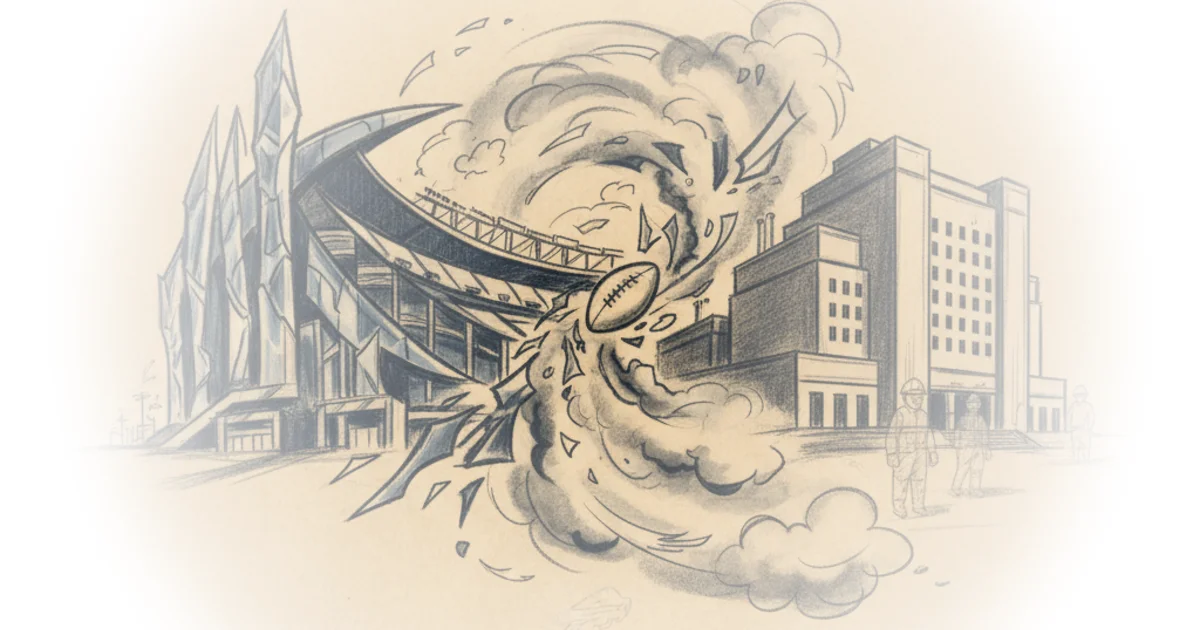
The decision to build anew, despite the $850 million public subsidy, was driven by a simple ultimatum. As Mills puts it, "until these plans were confirmed, Buffalo Bills were looking to leave Buffalo." This framing is crucial because it shifts the narrative from a taxpayer burden to a retention strategy. Critics might note that research consistently shows such stadium investments rarely generate the promised economic gains for local residents, yet Mills acknowledges this friction while emphasizing that the alternative—losing the team entirely—was a non-starter for the community. The argument holds weight because it prioritizes the preservation of a 60-year legacy over abstract economic projections.
It's one of the biggest investments ever made by the public into an NFL stadium, and it doesn't even have a roof.
Rejecting the "Avengers" Aesthetic
The most striking element of Mills' coverage is his critique of the league's recent architectural trend. He observes that the last four major stadiums look like "not so secret headquarters of the Avengers," featuring glass facades, artificial turf, and massive roofs designed to maximize revenue during the six months football isn't being played. These venues are described as "really big marketing and cash generating machines" rather than places for pure sport.
In stark contrast, the new Highmark Stadium is designed with a singular, almost purist focus. Mills quotes the design philosophy directly: "From day one, it was all about football first, Bills Mafia, designing for the team, designing for the fans, and we never wavered off of that." This is a bold claim in an era where sports venues are increasingly trying to be everything to everyone. The author argues that by rejecting the roof and the artificial turf, the Bills are doubling down on the "home field advantage" that comes from playing in the snow and wind. The engineering here is not about eradicating the elements, but manipulating them.
Mills details how the stadium's steel facade features thousands of perforations shaped like the team's charging buffalo logo. These aren't just decorative; they are functional wind deterrents. As the author explains, "When wind hits the perforations, it enters the gaps and slows, becoming kind of confused. This stops the air flowing over the top of the stadium and circling inside the bowl." This clever bit of aerodynamics protects fans from the worst of the gusts while allowing quarterback Josh Allen to throw with minimal interference. It is a rare instance where architectural design serves the specific tactical needs of the game rather than just the comfort of the spectator.
Engineering the Atmosphere
The coverage shifts to the technical marvels that make an open-air stadium viable in one of the snowiest regions in the United States. With Buffalo seeing nearly 95 inches of snowfall annually, the structural challenges are immense. Mills describes a "hydronic system" where hot water circulates through pipes in the canopy to melt snow as it lands, preventing the massive weight of accumulation from crushing the structure.
Perhaps more importantly, the design addresses the acoustic problem of open-air stadiums, which often lose the roar of the crowd. The steel canopy is angled specifically to trap noise, bouncing it back into the bowl. "It's all part of this mission to create the most intimidating atmosphere anywhere in the NFL," Mills writes. This focus on atmosphere extends to the seating configuration. By reducing capacity to 60,000 and introducing standing sections, the design aims for continuity and intimacy. The upper deck is positioned closer to the field than in any other NFL stadium, ensuring fans are right in the action.
The author suggests that this intimacy creates a visceral experience that modern, sterile arenas cannot match. "Years down the line, you might forget the score of a particular game, but you'll remember the way you felt when you were there," Mills observes. This emotional resonance is the core of the project's value proposition. However, a counterargument worth considering is the limitation this imposes on the stadium's utility. Without a roof, hosting major events like the Super Bowl becomes nearly impossible, as the weather is simply too unpredictable. Mills admits this, noting that drawing people to non-major cities for such events is a "challenge," but he frames this limitation as a feature, not a bug. The stadium is not built for the world; it is built for Buffalo.
This place looks like it's set to combine the best of the old stadium with new modern tech to very gently and delicately preserve the soul of the game.
Bottom Line
Fred Mills successfully argues that the new Highmark Stadium is a defiant rejection of the NFL's corporate homogenization, proving that a venue can be technologically advanced without sacrificing its soul. The piece's greatest strength is its ability to reframe the lack of a roof from a financial failure into a strategic masterstroke for fan experience and team identity. Its only vulnerability is the unavoidable reality that this purist approach may permanently exclude the franchise from hosting the league's biggest spectacles, but for a city that nearly lost its team, that trade-off appears to be exactly what the doctor ordered.