This isn't just a corporate squabble over ice cream; it is a high-stakes legal test of whether a company's social conscience can survive a hostile takeover by its own parent. Reason reports a startling detail that reframes the entire narrative: the conflict centers on a 2000 merger agreement that was specifically designed to "preserve[ ] Ben & Jerry's authenticity and autonomy," yet the parent company is now using the very machinery of corporate law to dismantle it. For busy readers tracking the erosion of corporate social responsibility, this case offers a rare, granular look at what happens when a "social mission" becomes a liability on a balance sheet.
The Contract as a Shield
The piece argues that the core of this dispute is not about ice cream flavors, but about the rigid interpretation of a governance structure that was once hailed as a model for ethical capitalism. Reason notes that the 2000 Merger Agreement provided that Ben & Jerry's would have an Independent Board with "primary responsibility" over "the objectives of the historical social mission." This wasn't a vague promise; it was a binding contract that dictated how directors were appointed and, crucially, how they could be removed.
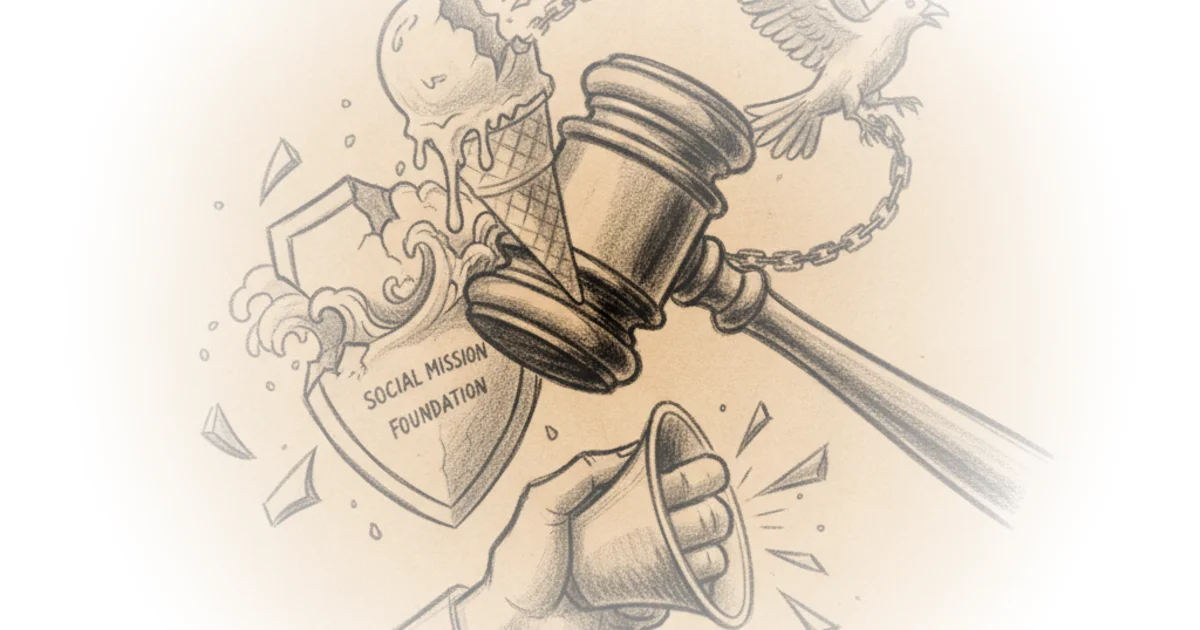
The coverage highlights a specific, chilling allegation: that the parent company, Unilever (and later its spin-off, Magnum), threatened to "dismantle the Independent Board and sue the board members individually" simply for calling for a ceasefire in Gaza. This moves the conflict from a disagreement over strategy to a potential violation of free speech rights within a corporate entity. The article details how the board was accused of "repeatedly acquiesc[ing]" to the social mission, a phrase the parent company used to justify ousting the CEO, David Stever, despite the fact that "Ben & Jerry's outperformed Unilever's ice cream portfolio" under his tenure.
The core of the argument is that the parent company is using the merger agreement's "plain meaning" not to protect the brand's mission, but to strip the board of its power to enforce it.
Critics might argue that a parent company has a fiduciary duty to its shareholders that supersedes a subsidiary's social activism, especially when that activism risks alienating a global customer base. However, the piece effectively counters this by pointing out that the original deal was struck precisely because the founders demanded a structure that would insulate the brand from such market pressures. The 2000 agreement was a deliberate choice to prioritize social impact over pure profit maximization, a choice the courts are now being asked to honor.
The Human Cost of Legal Technicalities
Where the coverage becomes most compelling is in its examination of the financial and humanitarian consequences of this legal battle. The article details a 2022 settlement regarding the brand's operations in the Occupied Palestinian Territories, which required Unilever to "make two $2,500,000 payments to Ben & Jerry's" and support Palestinian almond farmers through Canaan Fair Trade. This supplier relationship is not merely a business transaction; it is a lifeline. As the piece notes, Canaan Fair Trade has provided ingredients for "nearly a decade," and the settlement amendment specifically mandated $2 million annually for the "direct benefit of Palestinian almond farmers."
The text reports that Unilever "failed to disburse Canaan's 2025 funds," insisting on conditions that did not exist in the amended agreement. This delay has tangible human consequences. The article draws a parallel to the broader concept of a benefit corporation, where the legal obligation to consider stakeholders extends beyond shareholders. By withholding funds meant for farmers, the parent company is effectively using a contract dispute to cut off resources to a vulnerable community in a conflict zone. The piece emphasizes that the board designated groups like Jewish Voice for Peace as potential recipients of other funds, only to be blocked by a parent company claiming a desire to remain "neutral" while simultaneously making donations to organizations that "act as an auxiliary service to the Israeli Defense Forces (IDF)."
"Unilever failed to disburse Canaan's 2025 funds or engage in the review process, insisting upon conditions which do not appear in the Settlement Amendment."
The narrative also touches on the personal toll on the leadership. Chair Anuradha Mittal was allegedly presented with an ultimatum: resign and drop the lawsuit, or face public allegations of "ethical malpractice" that were later found to be unfounded by an internal audit. The piece suggests that the "integrity investigation" was a pretext to remove a leader who was unwilling to compromise on the company's stated values. This mirrors the historical struggle of benefit corporations, which often face pressure to dilute their mission when they become part of larger, profit-driven conglomerates.
The Institutional Dynamics of a Spin-Off
The final layer of the story involves the recent demerger of Magnum from Unilever, which brought Ben & Jerry's under the control of a new, publicly traded entity. Reason reports that Magnum moved quickly to "amend Ben & Jerry's bylaws and articles of incorporation to impose a nine-term limit on directors' one-year terms," a move that effectively purged the independent directors who had been fighting to uphold the social mission. The article notes that Magnum claimed authority under the Merger Agreement to control the Foundation's "governance, policies, and practices," despite the agreement explicitly stating that the board "shall have the responsibility for allocating" charitable contributions.
This shift highlights a critical institutional dynamic: the creation of a new corporate entity can be used as a legal loophole to bypass previous commitments. The piece argues that Magnum's actions, such as rejecting the nomination of Chris Miller—a "Ben & Jerry's veteran"—were part of a coordinated effort to "conclude that the Foundation no longer seeks funding" unless it submitted to new, restrictive conditions. The coverage suggests that the "plain meaning" of the contract is being weaponized to achieve what a direct breach of contract could not.
"Magnum purported to remove Chair Mittal 'effective immediately'... and remove directors... should they not resign before that date."
A counterargument worth considering is that the new corporate structure of Magnum necessitates a streamlined governance model to satisfy public market investors. However, the piece makes a strong case that the speed and aggression of these changes suggest a premeditated effort to neutralize the independent board rather than a necessary corporate restructuring.
Bottom Line
The strongest part of this argument is its revelation that the legal mechanisms designed to protect a company's social mission are being systematically dismantled by the very entities that promised to uphold them. The biggest vulnerability in the parent company's position is the stark contradiction between their public commitment to social responsibility and their private actions to silence dissent and withhold funds from humanitarian causes. Readers should watch for the court's interpretation of the 2000 Merger Agreement, as the outcome will set a precedent for whether corporate social missions are legally binding or merely marketing slogans.