Henry Oliver makes a provocative claim that cuts through the noise of contemporary literary criticism: the most vital fiction today isn't found in the minimalist, self-obsessed "International Style," but in the immersive, expansive world-building of Kiran Desai. In an era where many critics prize the "perfectly polished" short story or the confessional novel, Oliver argues that Desai's willingness to prioritize the atmosphere of a place over the strict interiority of a single character is not a flaw, but a revolutionary act of cultural preservation. This is essential reading for anyone feeling exhausted by the current trend of fiction that feels more like a tweet thread than a lived experience.
The Case for Immersion Over Isolation
Oliver begins by dismantling the rigid hierarchy that often separates "high" literary fiction from "immersive" storytelling. He notes that while some writers craft beautiful sentences, others build entire worlds. "In The Loneliness of Sunny and Sonia, as in her previous two novels, Kiran Desai is squarely the second type of author," Oliver writes, immediately establishing that Desai's strength lies in her ability to sustain a mood rather than just a moment. He acknowledges that her prose can be imperfect, noting, "One feels, too, the lack of craft in some of her sentences. But that is no matter: indeed, much of the time, it is part of how she makes her immersive pages."
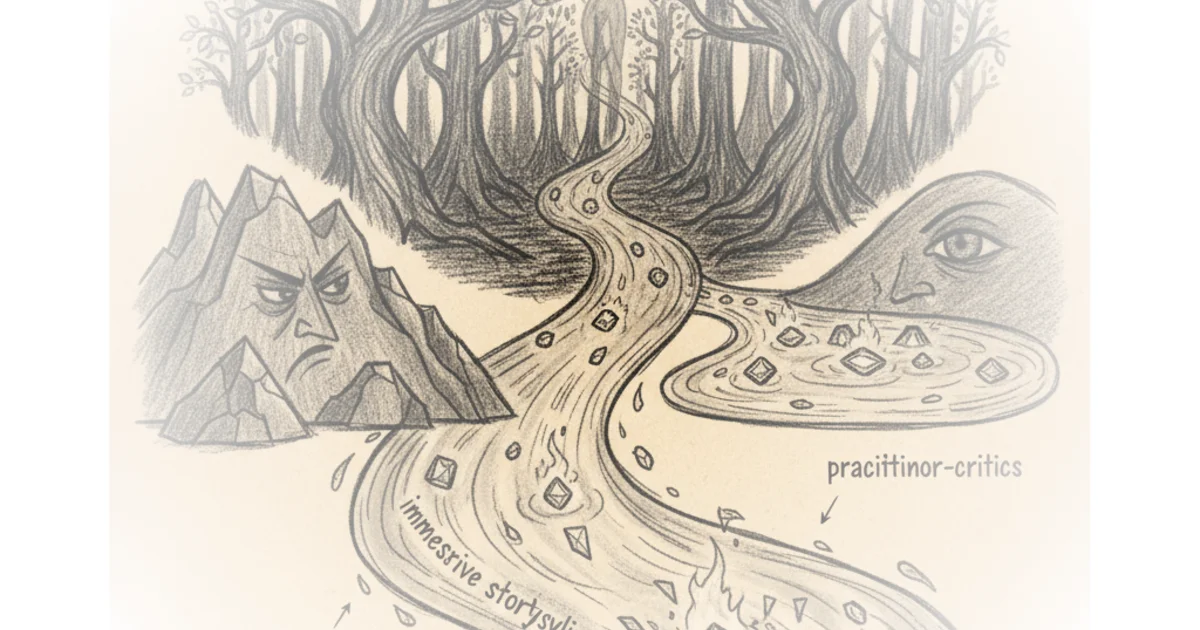
This is a bold defense of imperfection in service of atmosphere. Oliver suggests that the "flatness" of modern minimalist prose often fails to capture the chaotic reality of the world. He contrasts Desai's method with the "International Style" of writers like Rachel Cusk or Lauren Oyler, arguing that their focus on the isolated self creates a narrative dead end. "The narrative mode of the isolated individual author who will not fictionalize has no answer to modernity," Oliver asserts, "no ability to depict the decentralized kaleidoscope of the world today." This framing is powerful because it elevates a stylistic choice into a moral and political necessity. If the world is becoming more complex and interconnected, a narrative style that shrinks the world to fit a single consciousness is inherently limiting.
The International Style is not capable of writing a novel like Sunny and Sonia. It has reached a dead end, ideologically, stylistically, narratively.
A Camera, Not a Mirror
Oliver's most insightful observation is his description of Desai's narrative voice as cinematic rather than psychological. He argues that her narrator acts like a camera, moving freely to capture the environment as much as the character. He illustrates this with a passage from The Inheritance of Loss, where the rain in Kalimpong is described not just as weather, but as a force that alters reality: "A white scurf sifted down from the beams, a fungus spun a shaggy age over everything... Sai, pulling open her underwear drawer, found a bright pink jelly scalloping the layers of dreary cotton."
This technique, Oliver explains, allows Desai to establish a "peace of knowing that communication with anyone was near impossible." By focusing on the decay of the physical world—the mold, the broken phones, the failing modernity—she creates a sense of isolation that feels more profound than any internal monologue could. He draws a parallel to Walter Scott, noting that while Scott recreated a social order lost to history, Desai immerses us in a world-view that is "across the street, in our train, next to us at the office, but out of which we remain, too often, locked." This connection to Scott, a master of historical sweep, suggests that Desai is doing something similar for the contemporary immigrant experience, grounding the personal in the vast, often overwhelming context of place.
Critics might argue that this approach risks losing the reader in the details of the setting, sacrificing character depth for environmental description. However, Oliver counters that this is exactly the point: for the immigrant, the self is never separate from the environment. "Wherever you go, you take the inheritance of your upbringing and your culture with you," he writes, noting that the characters are "not displaced, but rather that cannot not take India with them wherever they go."
The Rejection of "The Truth"
The commentary takes a sharp turn when Oliver analyzes the conflict between Desai's characters and the modern literary establishment. He highlights a moment where the protagonist, Sonia, rejects her own childhood stories as "oriental nonsense" because she has been taught to value "the truth, plain and simple." Oliver sees this as a direct critique of the auto-fiction trend. "Sonia's use of 'oriental' here shows how she has subordinated her creative impulse to ideas of criticism, theory, and politics," he observes.
This is a crucial distinction. Oliver argues that the demand for "truth" in fiction often serves to sanitize the messy, magical, and culturally specific aspects of life. He contrasts this with Desai's approach, which embraces the "making things up" aspect of fiction as a way to access a deeper reality. "You have to live enough life for a book," Sonia's mother tells her, a line Oliver uses to underscore the difference between a life of observation and a life of experience. The "International Style," with its focus on the isolated self, cannot capture the "decentralized kaleidoscope" of the diaspora. Desai's expansive, quest-like narrative, by contrast, allows for the "loneliness of being immigrants" to be felt not as a personal failing, but as a shared, structural condition.
Bottom Line
Henry Oliver's defense of Kiran Desai is a timely and necessary intervention in a literary landscape that has become increasingly narrow. His strongest argument is that the "International Style" of minimalism is ill-equipped to handle the complexity of the modern world, particularly the immigrant experience, which requires a narrative mode that is as expansive and interconnected as the lives it depicts. While some may find his dismissal of contemporary auto-fiction too harsh, his core insight—that fiction must be able to hold the weight of a world, not just a single consciousness—resonates deeply. Readers should watch for how this argument plays out in the next generation of diaspora literature, which will likely either double down on the immersive, place-based storytelling Oliver champions or retreat further into the safety of the self.