Matt Taibbi delivers a blistering, satirical autopsy of congressional accountability, arguing that the political class treats sexual misconduct not as a career-ending crisis, but as a manageable PR problem until the evidence becomes physically undeniable. The piece is notable not for breaking new allegations, but for its ruthless cataloging of how institutions—from the House Ethics Committee to the media—systematically fail to protect victims while allowing powerful men to navigate their way out of consequences. Taibbi's central claim is that the only thing that truly stops a congressman is the undeniable presence of the "p-word" in the headlines, a reality that renders decades of public service instantly irrelevant.
The Speed of Implosion
Taibbi opens by dissecting the rapid collapse of California Democrat Eric Swalwell, framing the speed of his downfall as a direct result of the specific nature of the allegations rather than a sudden moral awakening among his peers. He notes that while members of Congress are infamous for insider trading and even homicide, the male species has a peculiar propensity for "caught-with-pants-down scandals." The author highlights the sheer velocity of the fallout: "Within 24 hours of report Swalwell lost all 21 Democratic Congressional endorsements for governor; within 48 hours, gubernatorial campaign dropped; within 72, Swalwell resigned from the House." This timeline suggests that the political establishment is willing to discard its own only when the scandal threatens to become a permanent stain on the brand, not because of a commitment to justice.
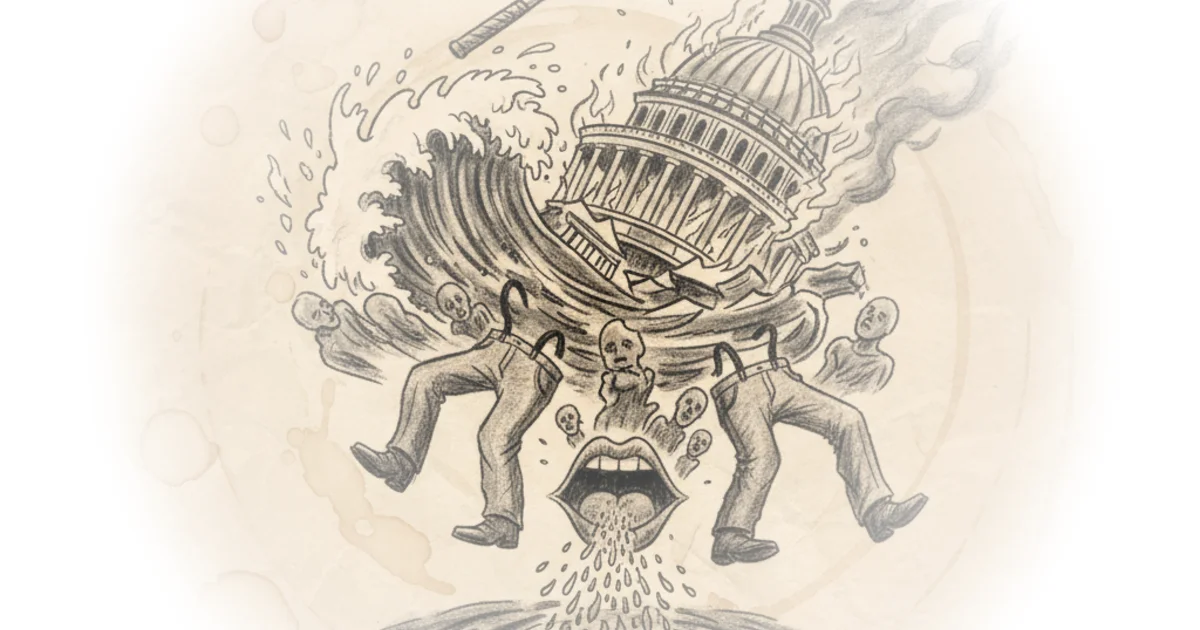
The author contrasts Swalwell's initial denial with the grim details provided by accusers, noting that CNN reported the congressman "raped her when she was heavily intoxicated and left her bruised and bleeding." Taibbi points out the dissonance between Swalwell's legal team sending cease-and-desist letters and the former staffer's description of the behavior: "There was Eric the Snapchatting guy, and then there was Eric my boss. It was like two different people completely." This duality is the core of Taibbi's argument: the public persona is a carefully constructed fiction that shatters only when the private reality becomes too loud to ignore. Critics might argue that due process is being bypassed by the court of public opinion, yet Taibbi counters that the system only offers due process to those who can afford to wait, while the accused are often left with no choice but to flee.
"Members of Congress are famed for all sorts of behaviors, from legalized insider trading to innovating a customer-friendly 'bribe menu' to the occasional homicide, but the males of the species have a propensity for caught-with-pants-down scandals."
The Pattern of Denial and Deflection
Moving beyond the immediate news cycle, Taibbi constructs a historical ledger of these scandals to show that the playbook has remained unchanged for decades. He examines the case of Anthony Weiner, who initially claimed his account was hacked before admitting, "To be clear the picture was of me and I sent it." Taibbi uses this to illustrate the predictable arc of denial followed by a reluctant confession once the evidence is irrefutable. The author notes that despite Weiner taking "full responsibility" for his "personal mistakes," the damage was total, leading to incarceration for subsequent offenses involving a minor.
The commentary then shifts to the hypocrisy of moral posturing, citing Republican Joe Barton, who held a 100% rating from conservative groups while allegedly sending nude selfies and threatening women who refused his advances. Taibbi highlights the chilling nature of Barton's recorded threat: "I will be completely straight with you. I am ready if I have to, I don't want to, but I should take all this crap to the Capitol Hill Police and have them launch an investigation." This reveals a darker dynamic where the abuse of power extends beyond sexual misconduct to the weaponization of law enforcement against victims. The author observes that Barton's exit statement made no mention of infidelity, simply stating he was "very proud of my public record," a testament to the compartmentalization that allows politicians to separate their personal conduct from their professional legacy.
The Institutional Shield
Perhaps the most damning section of Taibbi's analysis focuses on John Conyers, a House veteran and founding member of the Congressional Black Caucus, whose career ended only after BuzzFeed obtained signed affidavits detailing years of harassment. Taibbi points out that Conyers initially claimed his office resolved allegations "with an express denial of liability," a move designed to silence victims through confidentiality agreements funded by the congressional budget. The author notes the stark reversal in leadership support, where Nancy Pelosi went from calling Conyers "an icon" to demanding his resignation once the narrative became unmanageable.
Taibbi also touches on the case of Mark Foley, whose scandal involving explicit messages to pages was known to leadership long before it became public. The author writes that officials "didn't feel they had enough information to go public," a euphemism for the institutional desire to protect the party over the safety of young staff. This historical context, including the 2006 scandal, underscores Taibbi's point that the system is designed to absorb these shocks and continue operating, only reacting when the pressure becomes existential. The inclusion of Adam Kuhn, a chief of staff whose career ended over a photo posted by a former partner, further illustrates that while the Congressman might survive, the staff often bears the brunt of the fallout, or conversely, the Congressman survives while the aide is sacrificed.
"It was like two different people completely."
Bottom Line
Taibbi's strongest argument is that the political ecosystem treats sexual misconduct as a reputational risk rather than a moral failure, only acting when the "p-word" becomes unavoidable in the press. The piece's greatest vulnerability is its reliance on a cynical view that assumes no genuine reform is possible, potentially overlooking the slow, grinding work of internal accountability that happens without fanfare. Readers should watch for whether the current administration's response to these allegations signals a genuine shift in how the executive branch handles internal investigations, or if it remains a cycle of denial and damage control.