This piece delivers a devastating indictment of modern foreign aid, arguing that the very mechanisms designed to save lives are systematically dismantling the local institutions that make survival possible. Scott Alexander, reviewing Masooda Bano's Breakdown in Pakistan, exposes a paradox where "capacity-building" actually hollows out the social trust required for communities to function. For busy readers tracking global development, this is not just a critique of efficiency; it is a warning that our current model of altruism may be accelerating the collapse of the societies we aim to help.
The Rabbit and the Fire Hose
Alexander opens with a visceral image from a Kabul aid worker that perfectly encapsulates the violence of well-intentioned intervention. He writes, "It's like gluing a rabbit mouth-first to a fire hose. You blast its guts right out of its ass…but as long as the water keeps running, it looks like you've taught the rabbit to dance." This metaphor sets the stage for Bano's central thesis: external funding does not simply supplement local efforts; it often replaces the organic, messy, but resilient systems of mutual aid with brittle, donor-dependent structures.
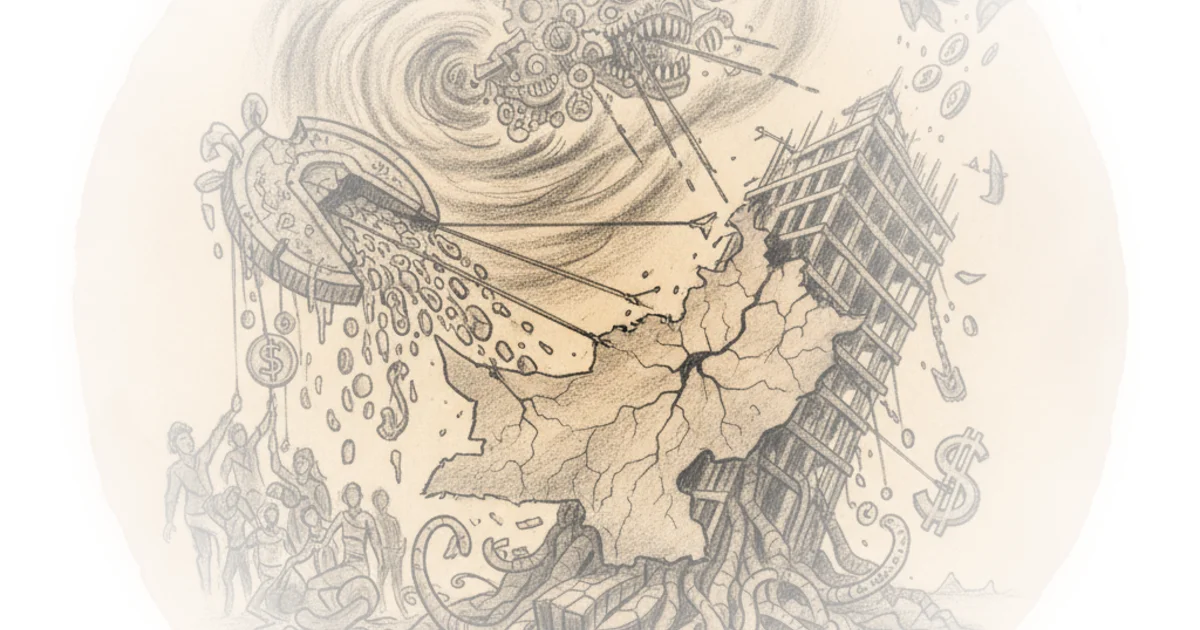
The author draws a powerful parallel to the history of forestry to explain why this happens. He notes that Western donors, like 18th-century German "scientific foresters," treat local institutions as mechanisms to yield measurable outcomes. Just as those foresters planted uniform spruce grids that eventually succumbed to disease due to a lack of biodiversity, aid agencies have replaced diverse "old-growth institutions" with "legible NGO plantations." Alexander observes that while this makes projects easier to monitor and report on, it strips away the natural variability that allows communities to adapt to shocks. The result is a landscape that looks productive on paper but is ecologically and socially fragile.
Over the last four decades, we've been systematically replacing diverse old-growth institutions with more legible NGO plantations worldwide.
This framing is compelling because it shifts the blame from individual incompetence to systemic design. However, critics might argue that in contexts of extreme state failure, the "monoculture" of professional NGOs is the only viable alternative to chaos. Alexander addresses this by showing that the alternative—the professionalized NGO—often fails to deliver when the money stops, leaving a vacuum worse than the one it filled.
The Death of the Volunteer
The core of Bano's argument, as presented by Alexander, is that the shift from Voluntary Organizations (VOs) to Non-Governmental Organizations (NGOs) destroys the engine of civil society: the volunteer. In Pakistan, where the state is often captured by a military and landholding elite, these VOs emerged organically to fill the gap. Alexander cites the example of the Anjuman-Faizul-Islam, established after a famine in Bengal to care for orphans, or the All Pakistan Women's Association, founded in 1948 to promote rights and literacy. These were not created to chase grants; they were created to solve problems.
When Western donors arrived in the 1980s, they sought to "train" these groups in grant management. The outcome was catastrophic for community cohesion. Alexander recounts an Oxfam case in Sindh province where six organizations, after receiving training and initial funding, became "visibly more dysfunctional." They were consumed by factionalism and legal battles, and crucially, they lost their volunteers. An Oxfam official noted that teams of thirty shrank to "three or four people who had become workshopias," a term for those who mastered the art of attending donor workshops but lost touch with the community.
The distinction is sharp: voluntary membership organizations are the ideal type of civil society, funded by donations and driven by shared causes. In contrast, the aid-funded model operates like a corporate contractor. Alexander writes, "The foreign aid industry uses 'civil society organization' as a virtual synonym for NGO. In reality, aid-funded groups tend to operate rather more like corporate and/or government contractors: paid service providers with comfortably salaried staff, focused on the goals of faraway clients." This professionalization demotivates the very people who kept the lights on when the state was absent.
Voluntary membership organizations, like these VOs had been, are the ideal type of what we call civil society: institutions funded by donations (rather than sales or taxes), operating based on people freely coming together for some shared cause.
The evidence suggests that this model is not just inefficient; it is actively corrosive. A survey of forty Pakistani civil society organizations found that those implementing foreign-aid projects could not mobilize local volunteers or raise local funds. The community no longer saw them as their organization, but as an extension of the donor. This mirrors the dynamic seen in other regions; for instance, the Three-Self Patriotic Movement in China was designed to create a state-sanctioned religious structure that severed ties with foreign influence, yet here the foreign influence itself severs the local ties that make the organization viable.
The Tragedy of the Commons Revisited
Alexander grounds the critique in political theory, referencing the work of Garret Hardin, Mancur Olson, and Elinor Ostrom. He explains that while states can impose rules to solve collective action problems, they often fail in authoritarian or corrupt contexts. Voluntary institutions, however, can manage common-pool resources effectively through social trust. He points to 1980s Nepal, where community forestry committees successfully reversed deforestation by managing local benefits, doubling forest cover between 1990 and the present.
In contrast, he highlights a USAID project in Bolivia that encouraged quinoa farmers to maximize individual yields, ignoring traditional institutions that regulated planting to protect the soil. The result was a short-term spike in production followed by soil degradation and social feuding. Alexander writes, "Once people saw their neighbors profiting at their expense, ignoring traditional norms and institutions, the fear of being exploited hung over every subsequent interaction." The damage was not just ecological; it was the erosion of the trust required to rebuild.
Institutions for voluntary collective action always rest—not solely, but significantly—on social trust. And once trust is lost, it's exceedingly hard to rebuild.
This is the most haunting part of the argument. The destruction of trust is often irreversible. Alexander notes that even VOs in Zimbabwe that had not taken foreign aid began to struggle with recruitment because the "NGO culture" had changed community expectations. When a religious VO in Zimbabwe accepted emergency funds during a drought, they eventually faced rejection from their traditional donors who asked, "You're an NGO now. Why do you want our help?" The group had become a service provider, and the community no longer felt a sense of ownership or obligation to support it.
The Bottom Line
Scott Alexander's review of Breakdown in Pakistan offers a necessary corrective to the assumption that more money and better management always equal better outcomes. The strongest part of the argument is the demonstration that professionalization often kills the volunteer spirit that sustains civil society in the absence of a functional state. The biggest vulnerability, however, is the lack of a clear alternative: if the state is corrupt and the NGO model destroys trust, what is the path forward for development? The piece leaves the reader with a sobering realization that the current aid architecture may be building a house on sand, and that the storm of institutional collapse is already upon us.
The foreign aid industry uses 'civil society organization' as a virtual synonym for NGO. In reality, aid-funded groups tend to operate rather more like corporate and/or government contractors.
The verdict is clear: until donors stop treating local institutions as delivery vehicles for their own metrics and start respecting the organic, trust-based networks that actually hold societies together, the "rabbit" will continue to dance on the edge of the fire hose, only to be gutted when the water stops.