Forget everything you think you know about cosmic speed limits. Sabine Hossenfelder isn’t just questioning physics orthodoxy—she’s declaring that the entire scientific establishment is committing a species-level error by treating light speed as an absolute barrier. Her evidence? A devastating takedown of circular reasoning hiding in plain sight for decades, with implications for everything from interstellar travel to why we haven’t heard from aliens.
The Sacred Cow
Hossenfelder writes, "I think it’s the biggest mistake that physicists are making that our entire species is making." She connects this dogma directly to real-world stagnation: our resigned acceptance of multi-generational space travel and the Fermi paradox. The core of her argument isn’t new math—it’s exposing how physicists conflate Einstein’s incomplete classical model with ultimate reality. As she puts it, "We’re missing a theory of quantum gravity. So why should the limitation of the nonquantum theory continue to hold when we know it ultimately isn’t correct?" This lands because it reframes a technical debate as a failure of scientific imagination. Critics might note that practical engineering constraints already limit near-light travel—but Hossenfelder’s point is deeper: we’ve stopped even looking for loopholes.
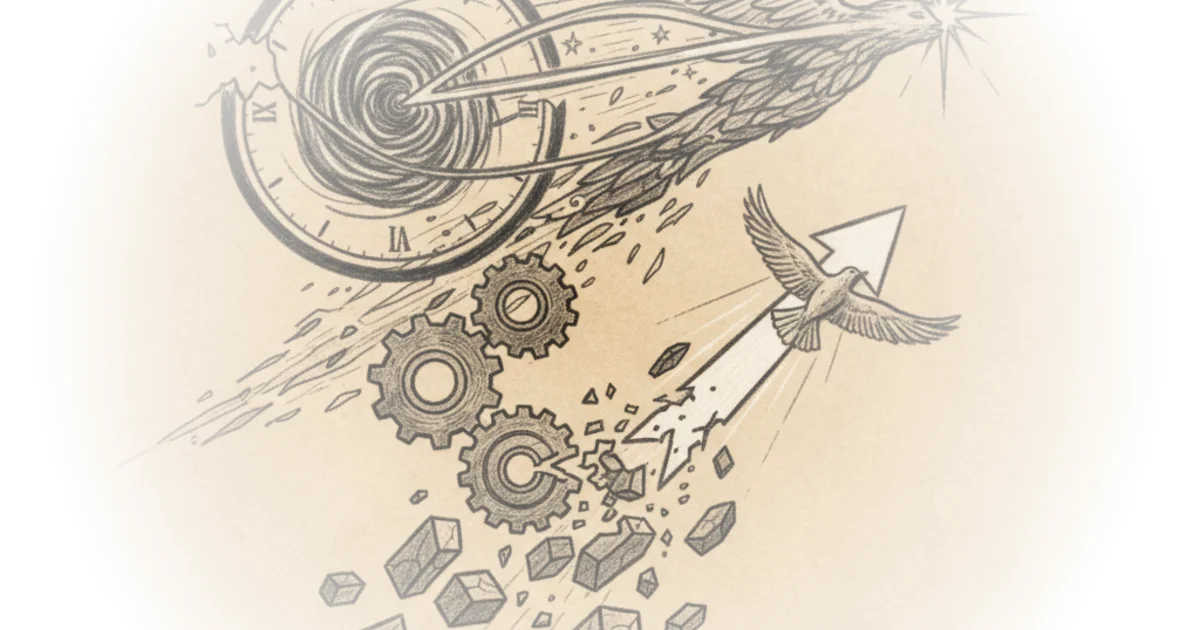
Time’s Arrow Solves Causality
The author demolishes the classic "time travel paradox" objection to faster-than-light (FTL) signaling. She argues that acknowledging time’s inherent direction—the fact your video-watching minutes never return—resolves all supposed causality violations. "Without [a preferred slicing], the entire causality problem disappears," she states, noting that cosmic microwave background radiation already provides this universal time-ordering in our models. This reasoning is elegant, but overlooks how messy quantum gravity might make "preferred slicings." Still, her 2024 perspective gains depth from historical context: Arnold Sommerfeld’s 1904 Tachyonic antitelephone thought experiment already showed FTL messaging could enable time loops if time lacked direction—a flaw Hossenfelder definitively patches.
"I think it’s the biggest mistake that physicists are making that our entire species is making."
Quantum Myths and Hidden Variables
Hossenfelder then eviscerates pop-science quantum misunderstandings. "When you do something to one particle of an entangled pair, what happens to the other is nothing," she insists—correcting the "spooky action" myth. Her frustration with editors who kept reinserting errors in her Nature piece reveals how deeply these misconceptions run. The Reeh–Schlieder theorem’s 1961 insight—that quantum fields allow non-local correlations without signaling—supports her view that quantum "non-locality" is about information retrieval, not physics. But here’s her boldest pivot: if quantum mechanics isn’t fundamental (as Einstein believed), superdeterminism could enable FTL signaling through deviations from standard quantum predictions. "The speed of light limit must hold. Therefore quantum physics is fundamental. Therefore the speed of light limit must hold," she identifies the circular logic. Critics rightly note superdeterminism lacks experimental pathways—but Hossenfelder’s point is that we’ve stopped seeking them because of this loop.
Bottom Line
Hossenfelder’s masterstroke is exposing physics’ self-reinforcing dogma—a circular argument masquerading as settled science. Her biggest vulnerability? Superdeterminism remains untested speculation. Watch for whether quantum gravity approaches like Causal Dynamical Triangulation find evidence of deeper layers where FTL signaling becomes plausible.