Most viewers assume the crisp, professional audio of educational videos is a byproduct of expensive gear or innate talent. Crash Course dismantles that myth, revealing instead that high-fidelity sound is the result of a rigorous, almost surgical workflow where invisible tools like noise gates and de-essers do the heavy lifting. This behind-the-scenes look at the "Learnathon" event offers a rare glimpse into the technical ear training that separates amateur recordings from broadcast-quality production.
The Invisible Architecture of Sound
Crash Course host Callie opens the discussion by demystifying her role, noting that she "basically just been sitting in a room doing stuff and no one knows what I do they just know that it magically sounds better when it goes through my office." This admission highlights a critical truth in media production: the best work is often the work that goes unnoticed. The team's approach is not about adding effects, but about subtraction. As Crash Course explains, the most vital piece of advice for audio is to "cut out everything below 60 Herz or 100 Hertz and everything above 18,000 cuz nobody will be able to hear any of that stuff and you don't want it clogging up the rest of your chain."
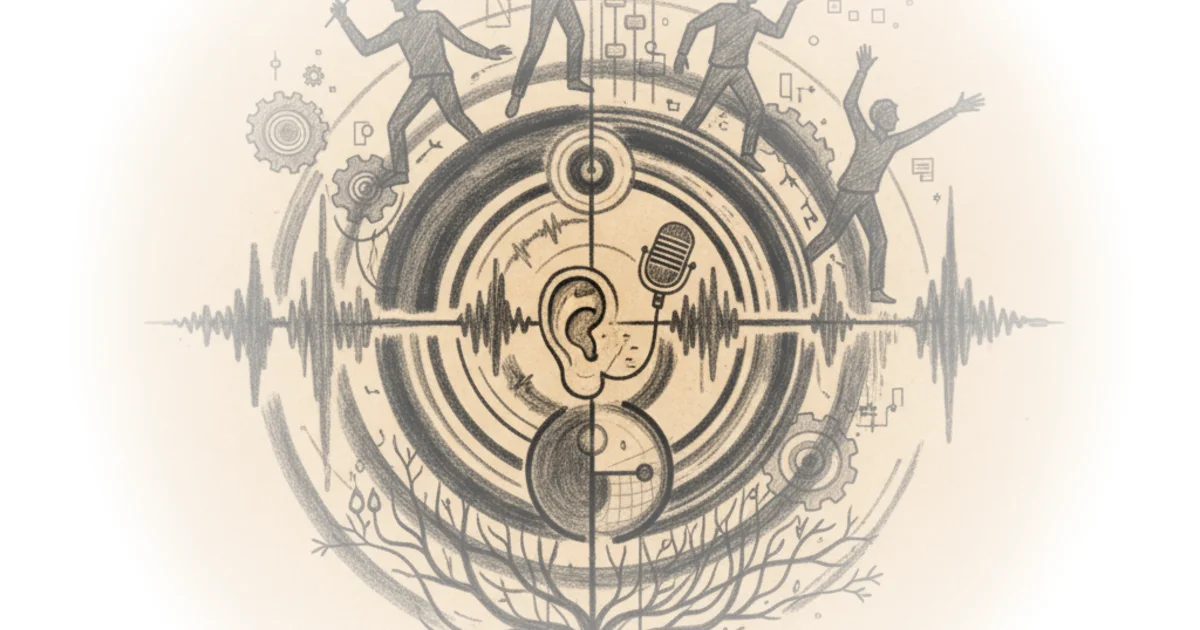
This strategy of aggressive filtering is the foundation of their sound design. By removing frequencies that human ears cannot perceive, the team prevents these inaudible signals from interfering with dynamic processors like compressors. The result is a cleaner signal path that allows the listener to focus entirely on the educational content. Critics might argue that such aggressive EQ cuts could strip a voice of its natural warmth or character, but the team's reliance on technical ear training suggests a calibrated balance between clarity and fidelity.
"The best advice I can give anyone wanting to do audio is cutting cut out everything below 60 Herz or 100 Hertz and everything above 18,000 cuz nobody will be able to hear any of that stuff."
The Signal Chain and the Human Voice
The commentary shifts to the specific tools used to tame the human voice, a notoriously difficult instrument to record consistently. Crash Course details a standard signal chain involving an equalizer, a noise gate, a compressor, and a de-esser. The noise gate is particularly fascinating; it is described as a plugin that "when a sound is loud enough it will open and it will allow the sound to go through but if it is not loud enough the gate will close and it will cut off that sound." This automated silence is crucial for removing the distracting "mouth sounds" and breaths that occur between phrases.
However, the team acknowledges the trade-offs involved in automation. Callie admits that the noise gate is "the one thing that gets cut if I am rushing for time," suggesting that in a crunch, the raw humanity of a recording might be preserved over the sterile perfection of a gated track. This highlights a tension in modern production: the pursuit of flawless audio versus the retention of organic presence. The team also addresses the challenge of sibilance—the harsh "S" sounds that can fatigue a listener. As Crash Course notes, a de-esser "super super helps with sibilance which is the S sounds that you hear in people's voices," especially for hosts with higher registers.
The discussion reveals that compression is less about making things loud and more about consistency. It "takes audio where it has really loud noises and really quiet noises and helps crunch them closer together so that the loud noises are not quite as loud and the quiet noises are not so quiet." This is vital for educational content where a host might whisper a crucial detail and then shout an exclamation in the same sentence. The goal is to ensure the viewer never has to adjust their volume.
The Art of the Clean Recording
Ultimately, the piece argues that post-production is a safety net, not a cure-all. The team emphasizes that the quality of the final mix is heavily dependent on the initial recording. "If the recording is super clean then it does not take very long which is very nice," Crash Course observes, noting that the host Sarah's voice required minimal EQ because the source material was already pristine. This underscores a fundamental principle of audio engineering: you cannot fix a bad recording with a good mix.
The editors also contribute to this process before the audio even reaches the sound designer. Video editor Bridgid mentions that she will "manually go in and remove like especially noticeable mouth sounds" using the pen tool in Premiere, creating a redundant layer of quality control. This collaborative friction ensures that the final product is polished from multiple angles. While some might view this redundancy as inefficient, it reflects a culture where the audience's listening experience is the ultimate metric of success.
Bottom Line
Crash Course successfully reframes audio production from a mysterious art into a disciplined science of subtraction and precision. The strongest element of their argument is the emphasis on source quality; no amount of processing can fully compensate for a poor recording. The biggest vulnerability in their approach is the reliance on automated tools like noise gates, which can sometimes feel overly sterile if not manually overridden. For busy professionals consuming content via text-to-speech or audio, this breakdown serves as a reminder that the clarity they enjoy is the result of deliberate, invisible labor.