This piece delivers a chilling indictment of a bureaucratic machine that operates in plain sight, arguing that the Office of Foreign Assets Control (OFAC) inflicts more suffering per employee than any military unit in history. It forces a confrontation with the idea that economic warfare is not a bloodless alternative to conflict, but a direct cause of death, disease, and destitution for millions of innocent civilians.
The Bureaucracy of Suffering
The article opens by locating the epicenter of this economic violence in the Freedman's Bank Building, a nondescript structure overlooking Lafayette Square. Stark Realities reports, "Behind its walls, bureaucrats are quietly inflicting poverty, illness and death on innumerable innocents around the world." The piece draws a powerful, if controversial, parallel to Hannah Arendt's concept of the "banality of evil," originally formulated after observing Adolf Eichmann. Just as Eichmann was not a monster but a "terrifyingly normal" bureaucrat focused on career advancement, the editors argue that OFAC employees are often "congenial coaches" and "friendly faces" who nonetheless execute policies that result in mass victimization.
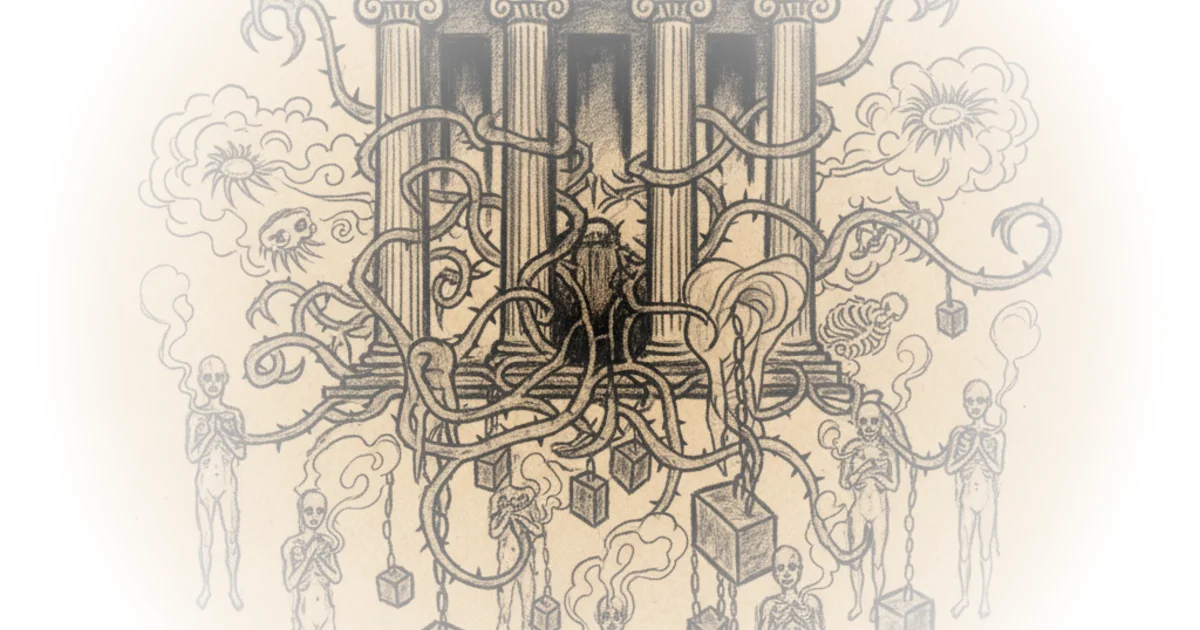
The core of the argument rests on the sheer efficiency of this harm. While the Pentagon is often cited as the primary source of 21st-century civilian casualties, the piece contends that OFAC, with a staff of only 300, is the leader on a "harm-per-employee basis." This framing is effective because it shifts the blame from the abstract concept of "war" to specific administrative actions. The editors note that sanctions are frequently sold to the public as a humane alternative to airstrikes, yet the reality is starkly different. "Sanctions are often perceived as a welcome alternative to war. In fact, they are merely a different form of war — one that can also produce dead bodies and misery on a grand scale," the piece argues.
"The deeds were monstrous, but the doer – at least the very effective one now on trial – was quite ordinary, commonplace, and neither demonic nor monstrous."
Critics might note that the comparison to Eichmann risks oversimplifying the moral landscape of national security, where officials are tasked with containing rogue regimes and terrorist networks. However, the article's strength lies in its refusal to let the "national security" label absolve the human cost of the methods used.
The Mechanics of De-Risking
The commentary then dissects the mechanism of this suffering, explaining how the dominance of the US dollar turns the Treasury Department into a global gatekeeper. The power of these sanctions is amplified by "secondary sanctions," which punish non-American entities for doing business with targeted nations. This creates a climate of fear among international banks, leading to "de-risking," where financial institutions refuse to process any transactions involving a sanctioned country to avoid massive fines.
Stark Realities highlights that even when "humanitarian carveouts" exist on paper for food and medicine, they fail in practice due to this bureaucratic paralysis. The article cites a chilling admission from former OFAC director Robert McBrien, who stated of sanctions, "They make people suffer. They hurt. They can destroy." This quote is particularly damning because it suggests an awareness of the suffering rather than a blind adherence to procedure. The piece further illustrates this with the case of Iraq in the 1990s, where the US blocked the import of water pumps and chlorine as "dual-use" items. The result was a collapse in sanitation that led to a dramatic rise in child mortality, a tragedy that UN Ambassador Madeleine Albright infamously dismissed by saying, "We think the price is worth it."
The argument here is bolstered by historical context: the International Emergency Economic Powers Act of 1977 grants the executive branch broad, unilateral power to define what constitutes a threat, a power that has been used with increasing frequency. The editors point out that the number of designated entities exploded from 912 in 2000 to over 9,400 by 2021. This expansion is driven by a "bipartisan sanctions compulsion" in Congress, where legislators introduce hundreds of bills annually to curry political favor, leaving OFAC staff overwhelmed. A former Senate staffer is quoted calling the system "way, way overused" and noting that OFAC employees are victims of this political pressure, yet the article insists this does not excuse the outcome for the civilians on the receiving end.
The Human Cost in Iran and Syria
Moving from theory to specific case studies, the piece details the devastation in Iran and Syria. In Iran, the sanctions have blocked access to essential medicines for patients with rare diseases, such as epidermolysis bullosa, a condition causing painful blistering of the skin. The editors describe how a European producer ceased business in Iran, leaving patients with inferior, painful alternatives. The argument extends to the macroeconomic level, noting that inflation has forced families to buy rotting food and driven young people into poverty.
The situation in Syria is presented as perhaps the most egregious example of policy failure. The article focuses on the Caesar Civilian Protection Act of 2020, a law with an Orwellian title that explicitly bars the reconstruction of war-torn areas. Stark Realities reports that Syria's GDP crumbled from $68 billion before the war to just $9 billion by 2021, leaving 90% of the population impoverished. The piece argues that these measures have inadvertently fueled the drug trade, as desperate citizens turn to the production of Captagon to survive. "The 2020 sanction law's titular 'civilian protection' promise falls flat both inside and outside the target country," the editors conclude.
"They are good professionals who have all this political work being shoved on them. They want relief from this relentless, never-ending, you-must-sanction-everybody-and-their-sister, sometimes literally, system."
While the article acknowledges that OFAC staff may feel stress from this relentless workload, it refuses to let that empathy dilute the primary focus: the "mass victimization of people who've done no harm." The editors contrast the grim reality of the sanctions with the cheerful demeanor of former OFAC Director John Smith, who once declared his "love of economic sanctions" on a podcast. This juxtaposition serves to underscore the disconnect between the policymakers and the consequences of their work.
Bottom Line
The strongest element of this argument is its unflinching focus on the human cost of "clean" economic warfare, effectively dismantling the myth that sanctions are a bloodless tool of statecraft. Its biggest vulnerability lies in the potential lack of viable alternatives for containing hostile regimes without causing civilian suffering, a dilemma the piece acknowledges but does not fully resolve. Readers should watch for how this growing body of evidence influences the debate on reforming the International Emergency Economic Powers Act and the future of US foreign policy.