In a field obsessed with the next physics breakthrough, this piece from Chipstrat makes a startlingly pragmatic claim: the solution to the AI infrastructure bottleneck isn't a new invention, but a 25-year-old technology refined to meet a new standard. While competitors race toward exotic single-mode lasers, the editors argue that Gallium Arsenide Vertical-Cavity Surface-Emitting Lasers (VCSELs) offer the only viable path to scaling because the supply chain already exists to ship millions of units. This is a rare moment where the most boring answer—the one that doesn't require building new factories—is presented as the most critical strategic advantage.
The Engineering Mindset vs. The Science Lab
The piece distinguishes itself by rejecting the typical narrative of "disruptive innovation" in favor of hard-nosed engineering constraints. Chipstrat reports that Al Yuen, CEO of PicoJool, views the industry through a specific lens: "If you need a Prius, you certainly don't design a Ferrari — that's overkill." This analogy cuts through the hype often surrounding high-performance computing. The argument posits that hyperscale data centers do not need the longest reach or the highest theoretical bandwidth; they need a solution that fits the physical reality of a 30-meter rack-to-rack connection without breaking the bank or the power budget.
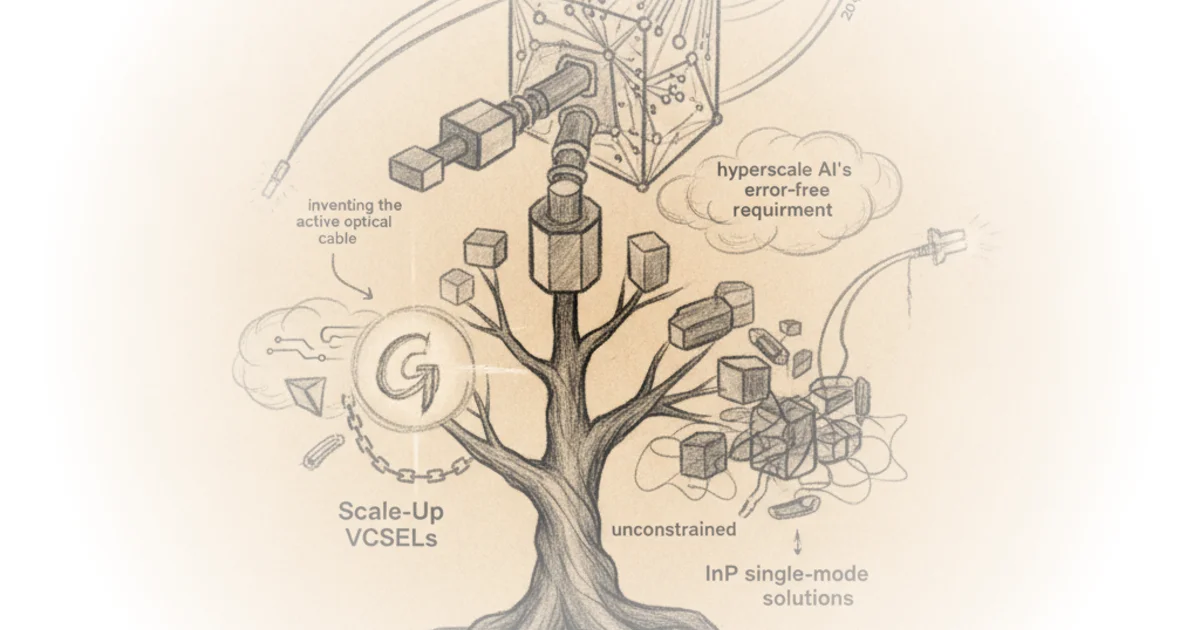
The coverage highlights a critical shift in the physical limitations of copper. As speeds climb, copper cables are shrinking to a mere 3 to 4 meters of effective reach. The piece notes that "racks and racks of GPUs... are getting very hot because they're packing more and more GPUs per rack, because they can't exit the rack." This forces a transition to optics, but not just any optics. The editors emphasize that the goal is to "exit the rack" using a technology that doesn't require reinventing the wheel. By anchoring the discussion in the physical constraints of heat and distance, the article avoids getting lost in abstract specs and focuses on what actually works in a server farm.
"To ship in volume, millions per month, you need this whole ecosystem: the connector, the transceiver, the sockets — everything has to be millions per month."
This focus on volume is the piece's strongest argument. While Silicon Photonics and Indium Phosphide (InP) solutions are often touted for their performance, the article points out a fatal flaw for mass deployment: supply chain fragility. The editors note that VCSELs have been shipping in the millions since 1996, whereas newer technologies often require building new foundries or waiting for new machines. The piece argues that "there's no invention of a technology, capacity, or foundries needed — we already have that." This is a compelling counter-narrative to the industry's obsession with the cutting edge, suggesting that the bottleneck isn't physics, but manufacturing capacity.
The Error-Free Imperative
The article tackles the elephant in the room: why didn't VCSELs dominate the AI era sooner? The answer lies in a fundamental shift in how data is processed. In traditional cloud computing, a dropped packet or a nanosecond of latency was negligible. However, the piece explains that "for hyperscale systems, which are literally thousands of GPUs acting as one brain... that latency is super critical." The requirement for a bit error rate to drop from 10⁻¹² to below 10⁻¹⁸, effectively "error-free," has historically favored single-mode lasers.
Chipstrat reports that this new requirement "allowed these high-cost single-mode solutions... to come into the data center." Critics might argue that this simply validates the move toward more expensive, power-hungry InP solutions for short-reach applications. However, the piece pushes back, suggesting that VCSELs can meet this new bar. The editors highlight that PicoJool has pushed VCSELs to 200 gigabits per lane while maintaining the necessary error rates. The argument is that the technology didn't change, but the tolerance for error did, and the industry must adapt the old tool rather than discard it.
The historical context provided adds depth here. The piece reminds readers that the "active optical cable" concept, where optics are embedded directly into the connector, was invented 25 years ago to solve a similar copper bottleneck. By drawing a parallel to the early days of 10 gigabit Ethernet, the article suggests a cyclical nature to infrastructure challenges. Just as the industry moved from bulky copper to optical connectors then, it is now returning to that same pragmatic approach for 1.6 terabit speeds.
The Capacity Argument: One Oven vs. Five Thousand Pizzas
The most distinctive section of the coverage uses a vivid metaphor to explain the supply chain crisis. Chipstrat reports that while competitors are trying to scale up with technologies that have limited manufacturing capacity, the VCSEL ecosystem is ready to go. The piece argues that relying on single-mode solutions for short-reach interconnects is like trying to bake 5,000 pizzas in an oven designed for one. The sheer volume required for AI clusters—millions of interconnections per month—cannot be met by technologies that are still in the R&D or early production phase.
The editors note that the "VCSEL supply is unconstrained" compared to the substrate-constrained nature of Indium Phosphide. This distinction is crucial for investors and engineers alike. The piece states that "any one of those bill-of-material parts, if it's missing, then you can't ship in millions per month." This reframes the problem from a technical specification war to a logistics war. The winner isn't the one with the fastest chip, but the one who can actually deliver the chips.
"We design the latest VCSEL — today it's 200 gigabit... put it into the whole ecosystem, they package it together, and voila, we can build millions per month without waiting for machines, or even buildings, to be built up."
This section effectively dismantles the allure of the "new and shiny." The article suggests that the path to 3.2T and 12.8T speeds lies not in inventing new physics, but in leveraging bi-directional arrays and existing manufacturing lines. The argument is that the "pragmatic answer" is often the one that ignores the hype cycle. By focusing on the fabless model and the capacity of partners like WIN Semiconductors, the piece grounds its optimism in industrial reality rather than theoretical potential.
Bottom Line
The strongest part of this argument is its ruthless focus on manufacturing reality over theoretical performance; it correctly identifies that the bottleneck for AI scaling is not the speed of light, but the speed of production. The piece's biggest vulnerability is its reliance on the assumption that VCSELs can consistently hit the "error-free" 10⁻¹⁸ standard across all environmental conditions without a power penalty that negates their cost advantage. Readers should watch for independent verification of these error rates in real-world, high-temperature data center environments, as that will be the true test of whether the "old" technology can truly carry the "new" load.
"We're not very cognizant if there's an error drop or some delay... But for hyperscale systems, which are literally thousands of GPUs acting as one brain... that latency is super critical."