This piece from Works in Progress does more than recount a scientific milestone; it exposes a profound historical blind spot where the entire global scientific community bet on the wrong molecule for decades. While pop culture often credits Watson and Crick with discovering DNA's importance, this editorial argues that their fame rests entirely on the overlooked, painstaking work of microbiologists who proved genes were made of DNA long before the double helix was visualized. For a reader navigating a world increasingly defined by genetic engineering, understanding why the "right" answer was once dismissed as a "party trick" offers a crucial lesson in how scientific consensus can be dangerously rigid.
The Protein Delusion and the Bacterial Clue
The article opens with a sharp cultural hook, using the fictional chemist Elizabeth Zott from Lessons in Chemistry to illustrate the very real skepticism that greeted early DNA research. In the show, colleagues dismiss her claim that DNA is life's foundation as a "dead end," a sentiment that mirrors reality until the late 1940s. Works in Progress notes that "until the late 1940s it was a fringe idea" to think genes were made of anything other than protein. This framing is effective because it humanizes the scientific process, showing how even brilliant minds can be blinded by prevailing assumptions.
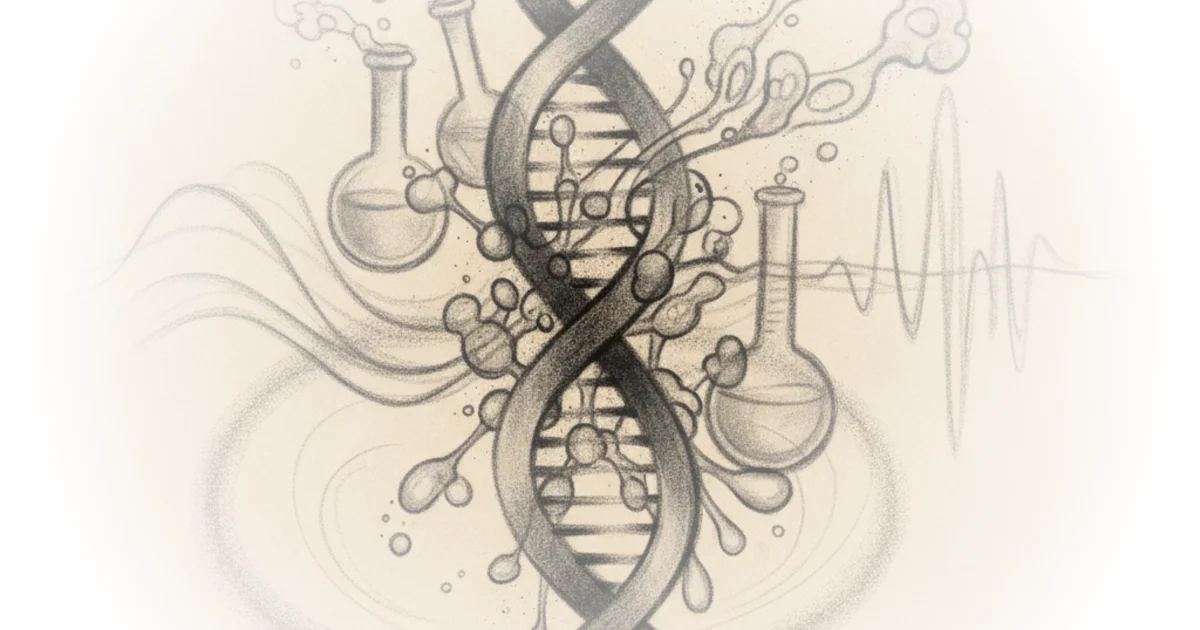
The piece explains that proteins seemed like the obvious candidate for genetic material due to their complexity. With twenty different amino acids acting as an alphabet, they offered "an astronomical number of combinations," whereas DNA's four nucleotides appeared too simple to carry complex information. The editors highlight the dismissive attitude of the era, quoting physicist-turned-biologist Max Delbrück, who derided DNA as "so stupid a substance." This quote perfectly encapsulates the intellectual arrogance that stalled progress for decades.
"The scientists who made this more fundamental discovery have often been overlooked."
However, Works in Progress argues that the breakthrough came from an unlikely source: bacteria. At the time, even microbiologists doubted these organisms possessed genes, viewing them merely as "tiny bags of enzymes." The article connects this historical confusion to the broader struggle to understand heredity since Darwin, noting that while farmers had exploited inheritance for centuries, the mechanism remained a mystery until Gregor Mendel's work on pea plants was rediscovered in 1900. Yet, even after the term "gene" was coined in 1909, the physical nature of these factors remained undefined, with geneticist Thomas Hunt Morgan admitting in his Nobel lecture that there was "no consensus of opinion amongst geneticists as to what the genes are."
The narrative shifts to Frederick Griffith's 1928 experiment, a pivotal moment where the focus moved from abstract theory to concrete bacterial observation. Griffith discovered that harmless bacteria could be "transformed" into deadly ones by mixing them with heat-killed virulent strains. The piece describes this as a shock to researchers who believed living things could not simply absorb genetic material from their environment. This historical pivot is vital; it reminds us that the tools of discovery often appear in fields we consider unrelated, challenging our modern silos between disciplines.
The Transforming Principle and the Cost of Caution
The core of the article details how Oswald Avery, along with Colin MacLeod and Maclyn McCarty, spent years isolating the "transforming principle" responsible for Griffith's observations. Works in Progress vividly describes the grueling nature of their work, noting they needed "75 liters of broth teeming with bacteria to obtain just 10 to 25 milligrams" of the substance. The editors emphasize the danger involved, recounting how the team had to adapt a kitchen cream separator to handle pathogenic pneumococci, filling the lab with an "invisible mist of potentially lethal" bacteria.
"It touches genetics, enzyme chemistry, cell metabolism and carbohydrate synthesis, etc."
The article highlights Avery's internal conflict between scientific excitement and professional caution. While his private letters overflowed with the implications of his discovery, his public paper published in 1944 was remarkably restrained. The editors point out that the word "gene" does not appear in the title or conclusion of the landmark paper. Instead, the team acknowledged that minute contaminants could still be the true source of activity. This hesitation, while scientifically rigorous, arguably cost Avery the recognition he deserved.
Critics might note that this narrative risks romanticizing the lone genius struggling against the establishment, yet Works in Progress balances this by acknowledging the structural barriers Avery faced. The piece suggests the Nobel committee's failure to award him a prize was due to their expectation of "restraint and self-criticism bordering on the neurotic," a trait that ultimately prevented the immediate acceptance of his findings. This is a poignant reminder that scientific truth does not always win immediately; it often requires a second generation of scientists, like Watson and Crick, to validate the work before history takes notice.
The article concludes by listing the cascade of discoveries that followed Avery's work, from Joshua Lederberg's studies on bacterial DNA exchange to the Hershey-Chase experiment which finally settled the debate beyond doubt. Yet, the editors insist that "Avery however never received a Nobel Prize," despite being nominated 38 times. The piece argues that his legacy is not in awards, but in the foundation he built for seventy-five years of biomedical research.
"The molecule that changed everything... made it possible to ask a hundred more."
Bottom Line
Works in Progress delivers a compelling correction to the standard history of genetics, proving that the discovery of DNA's role was not a sudden flash of insight but a grueling, decades-long battle against institutional bias. The strongest element is its detailed reconstruction of Avery's cautious methodology, which serves as a timeless case study in how scientific progress often stalls due to the very rigor meant to advance it. Readers should watch for how this historical pattern of overlooking "simple" molecules or "unlikely" organisms continues to shape modern research priorities today.