Eric Blanc dismantles the comforting myth that Martin Luther King Jr. was a solitary moral genius who simply woke up one day as a radical socialist. Instead, the piece argues that King's most transformative ideas were the product of a deliberate, decades-long apprenticeship within a network of socialist organizers, labor unions, and movement schools that treated racial and economic justice as inseparable. For anyone trying to understand how to build power today, this reframing is essential: it shifts the focus from waiting for a savior to understanding the mechanics of the collective apparatus required to create one.
The Architecture of Radicalism
Blanc challenges the "Great Man" theory of history that dominates popular memory, suggesting it obscures the very tools needed to replicate King's success. "King's radicalism wasn't a private attribute," Blanc writes. "It was the outcome of apprenticeship inside an organized tradition—a network of socialists, labor radicals, and movement educators who did the unglamorous work of training leaders, building institutions, writing drafts, running logistics, teaching strategy, and connecting civil rights demands to bread-and-butter class politics." This is a crucial distinction. It suggests that the "radical King" of his later years was not a sudden evolution but the result of a specific political education that has been systematically scrubbed from the historical record.
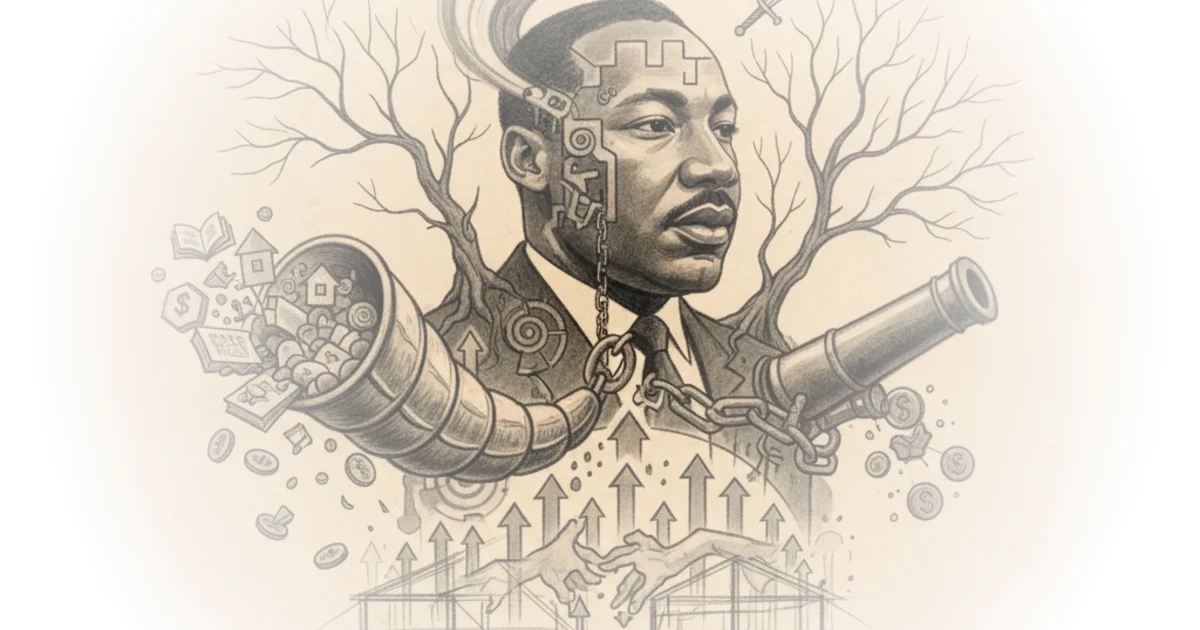
The author points out that this erasure is reinforced by a convenient caricature: the idea that early American socialists were inherently racist and therefore irrelevant to the Black freedom struggle. Blanc pushes back hard on this simplification. "There's a kernel of truth there (the history includes shameful racism and exclusion), but it's also a caricature that turns a complex tradition into a straw man," he notes. By acknowledging the flaws while highlighting the contributions, Blanc restores the nuance that allows us to see the Socialist Party and labor radicals as active participants in the fight against white supremacy, not just bystanders. Critics might argue that emphasizing the socialist roots of the movement risks alienating moderate allies who view socialism as a toxic label, but Blanc's point is that the substance of the movement was always about economic redistribution, regardless of the branding.
King's radicalism wasn't a private attribute. It was the outcome of apprenticeship inside an organized tradition.
The Highlander School and the Discipline of Organizing
The piece moves from theory to the ground level, spotlighting the Highlander Folk School in Tennessee as the crucible for the modern civil rights movement. Blanc argues that treating the Montgomery bus boycott as a spontaneous act of defiance ignores the years of preparation that made it possible. "Highlander, based in Tennessee, was a radical training ground born out of the labor left of the 1930s," Blanc explains, noting that its founder, Myles Horton, viewed it as a place to build power from below. The school's pedagogy was radically democratic, insisting that "the best teachers of poor and working people are the people themselves," and that the goal was not adjustment to an unjust society but its transformation.
Rosa Parks is often flattened into a symbol of a tired seamstress, but Blanc reminds us she was a serious organizer who attended a two-week intensive at Highlander just months before her historic refusal to move. "At Highlander, I found out for the first time in my adult life that this could be a unified society," Parks recalled, a sentiment that underscores the school's role in fostering interracial solidarity. This evidence is powerful because it humanizes the strategy; it shows that the courage displayed in Montgomery was cultivated, not innate. The movement didn't just happen; it was engineered by people who understood that organization must precede disruption.
The Socialist Architects: Rustin, Randolph, and Levison
Blanc then introduces the key figures who served as King's political tutors, arguing that their socialist backgrounds were the scaffolding for the movement's most effective tactics. Bayard Rustin, often reduced to the event planner of the 1963 March on Washington, is repositioned as a strategist who viewed nonviolent mass organizing as a "technology of power." "Rustin treated nonviolent mass organizing as a technology of power. It was something you trained for, drilled, organized, and executed with precision," Blanc writes. This framing elevates nonviolence from a moral stance to a tactical discipline, one that required the same rigor as any military operation.
Similarly, A. Philip Randolph is highlighted for his insistence that civil rights could not be won without economic power. His Brotherhood of Sleeping Car Porters served as a training ground for a generation of organizers who understood how to pressure institutions. "Randolph's socialism was a way of reading power and a way of building it," Blanc argues, noting that Randolph believed democracy required economic power for working people. This connects the dots between the labor movement and the civil rights movement, showing that the demand for "jobs and freedom" was not a slogan but a strategic necessity.
Perhaps the most surprising figure discussed is Stanley Levison, a wealthy Jewish businessman and former Marxist who served as King's ghostwriter, fundraiser, and ethical compass. Blanc notes that Levison "counseled, raised funds for, ghostwrote articles and speeches for, did the accounting of, and often bailed out King" from 1955 to 1968. Levison's influence is evident in King's refusal to take lucrative lecture tours, with Levison snapping, "Because the kinds of people that you will be preaching to about nonviolence are too poor to pay for your lectures." This anecdote illustrates how personal virtue in the movement was often the result of political discipline and collective accountability.
The movement didn't just happen; it was engineered by people who understood that organization must precede disruption.
The Cost of Erasure
Why has this history been so effectively erased? Blanc points to a combination of state repression and a cultural preference for individual heroes over collective action. J. Edgar Hoover and other officials targeted figures like Levison and Rustin, labeling them as Communist infiltrators to discredit the movement. "Levison, Rustin, and others were targeted by the FBI and by politicians who believed civil rights could be discredited by association with socialism," Blanc writes. Beyond the political attacks, Blanc suggests that the "Great Man" narrative is comforting because it lets people admire King without asking what kind of collective apparatus is needed to produce more leaders like him.
This erasure has real consequences for today's left. If we believe change comes from exceptional individuals, we fail to invest in the institutions that make change possible. "If we care about the kind of politics he practiced—mass organization, movement discipline, and democratic socialism—we have to pay attention to the scaffolding that made it possible," Blanc concludes. The argument is compelling because it offers a roadmap: the path forward isn't waiting for the next King, but building the schools, unions, and networks that can train the next generation of organizers.
Bottom Line
Eric Blanc's strongest contribution is his forensic reconstruction of the institutional web that made King's radicalism possible, effectively debunking the myth of the self-made moral hero. The piece's greatest vulnerability lies in its potential to understate the unique, irreplaceable charisma King brought to the table, which cannot be fully replicated by training alone. However, the verdict is clear: if the left wants to achieve the economic redistribution King demanded, it must stop looking for saviors and start building the socialist infrastructure that created him in the first place.