In a landscape saturated with quick-fix wellness hacks, Scott Alexander cuts through the noise by treating the desire to drink coffee at 5 PM and sleep by 10 PM not as a lifestyle failure, but as a solvable biochemical puzzle. This piece is notable because it refuses to dismiss the "absurd fantasy" of late-day caffeine, instead mapping the exact enzymatic levers the liver uses to process stimulants and questioning whether we can safely pull them. For the busy professional who relies on alertness but pays the price in lost sleep, Alexander offers a rare blend of metabolic rigor and skeptical pragmatism.
The Enzyme Lever
Alexander begins by dismantling the standard model of caffeine metabolism. He explains that caffeine is converted into paraxanthine by a liver enzyme called CYP1A2, a process that takes about five hours, followed by a further three hours to clear the metabolite. "Over the course of hours, the liver converts caffeine into paraxanthine," he writes, noting that the total effective half-life is closer to ten hours than the commonly cited five. This reframing is crucial; it suggests that for many, the "afternoon crash" is a myth, and the real problem is a lingering stimulant effect that sabotages the next day's rest.
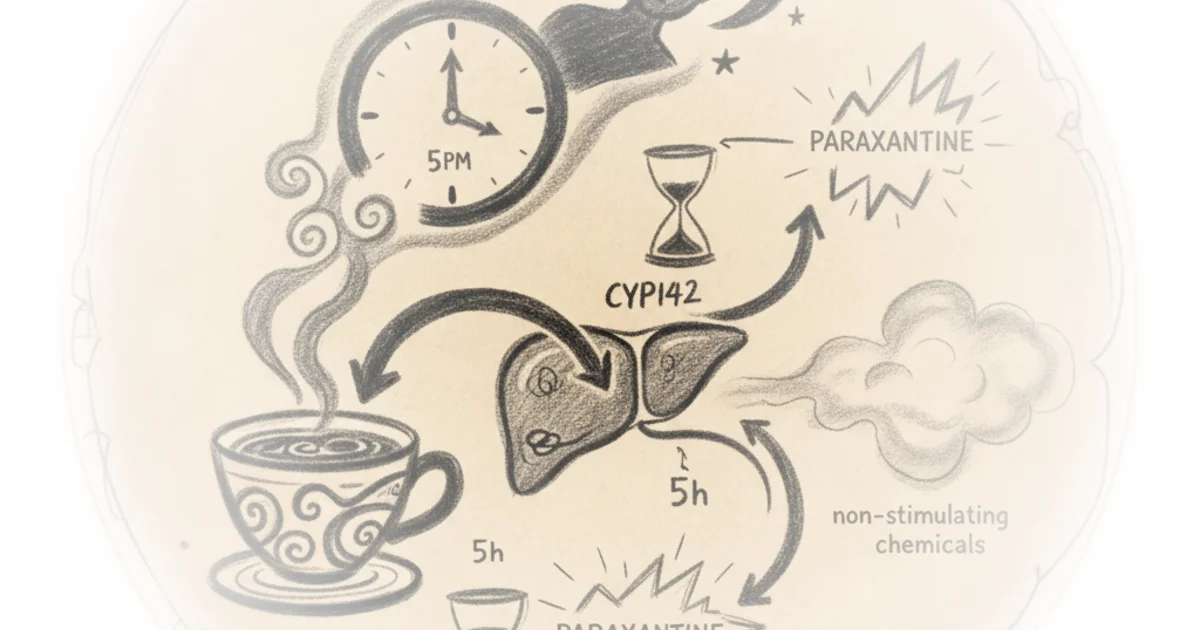
The author then introduces the first potential solution: manipulating the liver itself. He points to a chemical found in the Chinese tree Tetradium ruticarpum called rutaecarpine. Historically, this compound has been used in traditional medicine, but its modern application relies on a specific mechanism: "Feed it to rats, and their livers will go into overdrive, producing more and more CYP1A2 to tear up the intruder." By inducing the liver to produce more of the enzyme that breaks down caffeine, rutaecarpine theoretically slashes the effective half-life from ten hours to four.
"At last, our goal of drinking coffee at 5 and falling asleep at 10 appears to be in sight!"
Alexander's tone here is characteristically dry, immediately undercutting the excitement with a warning about the leap from rodent studies to human consumption. He notes that while Amazon sells the supplement for roughly $27, the human data is thin. He cites a study showing CYP1A2 levels triple within three hours of dosing, but he is quick to add a critical counterpoint regarding the duration of the effect. "The half-life of CYP1A2 itself is about two days," he warns. This means that inducing the enzyme doesn't just clear today's coffee faster; it alters your metabolism for the next 48 hours, making subsequent caffeine doses unpredictable. A user might drink twice as much coffee to compensate, only to find themselves "bouncing off the walls" because the metabolic curves are non-linear.
The Safety Paradox
The most compelling section of the piece addresses the elephant in the room: the safety of forcing the liver to work overtime. Alexander does not shy away from the potential toxicity. He highlights that rutaecarpine's mechanism is to "provoke the liver so strongly that the liver builds lots of new metabolic enzymes to destroy it extra fast." This aggressive stimulation raises the specter of liver injury, a risk that traditional Chinese medicine practitioners have long acknowledged by advising against long-term use.
He presents a nuanced view of the evidence, balancing mouse studies that show protective effects against anecdotal reports of liver failure. "Three Amazon reviews (out of ~300) mention liver problems," he notes, including one case of severe enzyme elevation that resolved after stopping the supplement. This is a vital distinction for the reader: the risk may be rare, but it is real and potentially severe. Alexander's conclusion is sobering: "all of this fits a common pattern of a medication which is 'safe' for most people over a few days, but can cause some people drug-induced liver injury when taken consistently for weeks or longer."
Critics might argue that relying on user reviews from Amazon and Reddit is methodologically weak, as these sources are prone to the post hoc ergo propter hoc fallacy. However, Alexander uses these anecdotes not as proof, but as a signal to exercise extreme caution. He admits his own trial of the substance was inconclusive, reinforcing the idea that individual variation in metabolism makes this a high-stakes experiment for the average person.
The Metabolite and the Alternative
Shifting gears, Alexander explores a second lever: bypassing caffeine entirely by taking its primary metabolite, paraxanthine, directly. The logic is elegant: if paraxanthine is the active stimulant with a shorter half-life, why not skip the conversion step? "Instead of superimposed half-lives of 5 hours + 3 hours before becoming inactive chemicals, you just get the half-life of 3 hours!" he argues. Capitalism has already responded, with manufacturers claiming paraxanthine is "cleaner" and produces fewer jitters.
"Paraxanthine works only for a subset of the people who caffeine works for."
However, the data here is messy. Alexander aggregates reviews and user reports, finding a split between those who find it a "game changer" and those who feel nothing or even become sleepy. He offers two plausible explanations: either people with fast metabolisms clear paraxanthine too quickly to feel it, or the molecule interacts with adenosine receptors differently than caffeine, affecting people based on their specific genetic makeup. This variability undermines the promise of a universal solution. As he puts it, "some people will get liver injury much faster, and other people can take it for years without getting it at all," a sentiment that applies equally to the efficacy of these supplements.
The piece concludes by briefly touching on methylliberine, another caffeine analogue with a purported 1.5-hour half-life. Yet, even here, the reviews are polarized, with users complaining of jitters or a lack of the "dopamine high" associated with coffee. Alexander's analysis suggests that while the science of tweaking half-lives is sound, the biological reality is far more complex than a simple equation.
Bottom Line
Scott Alexander's exploration of the "quest for caffeine you can have at night" is a masterclass in skeptical bio-hacking, successfully separating the allure of a quick fix from the messy reality of human metabolism. The strongest part of his argument is the relentless focus on the unintended consequences of manipulating liver enzymes, particularly the risk of liver injury and the unpredictability of metabolic feedback loops. The biggest vulnerability of these solutions remains the lack of robust, long-term human data, leaving the reader with a compelling hypothesis but a dangerous lack of certainty. For the busy professional, the verdict is clear: the science is fascinating, but the cost of experimentation may be higher than the benefit of an extra hour of alertness.