The Spiritual Triangle
Maria Popova returns to Wassily Kandinsky's 1910 treatise Concerning the Spiritual in Art with the kind of close reading that treats philosophy as lived experience rather than academic artifact. What makes this piece notable is Popova's refusal to let Kandinsky remain safely historical — she presses his century-old insights against the commodification of contemporary art, where purchasing power has replaced spiritual hunger.
Popova writes, "To harmonize the whole is the task of art." This sentence, deceptively simple, anchors Kandinsky's entire argument: art's purpose transcends technique, skill, or market value. As Maria Popova puts it, Kandinsky offers "a meditation on how art serves the soul" — one that predates the consumer society and somehow survives it.
The Triangle of Genius
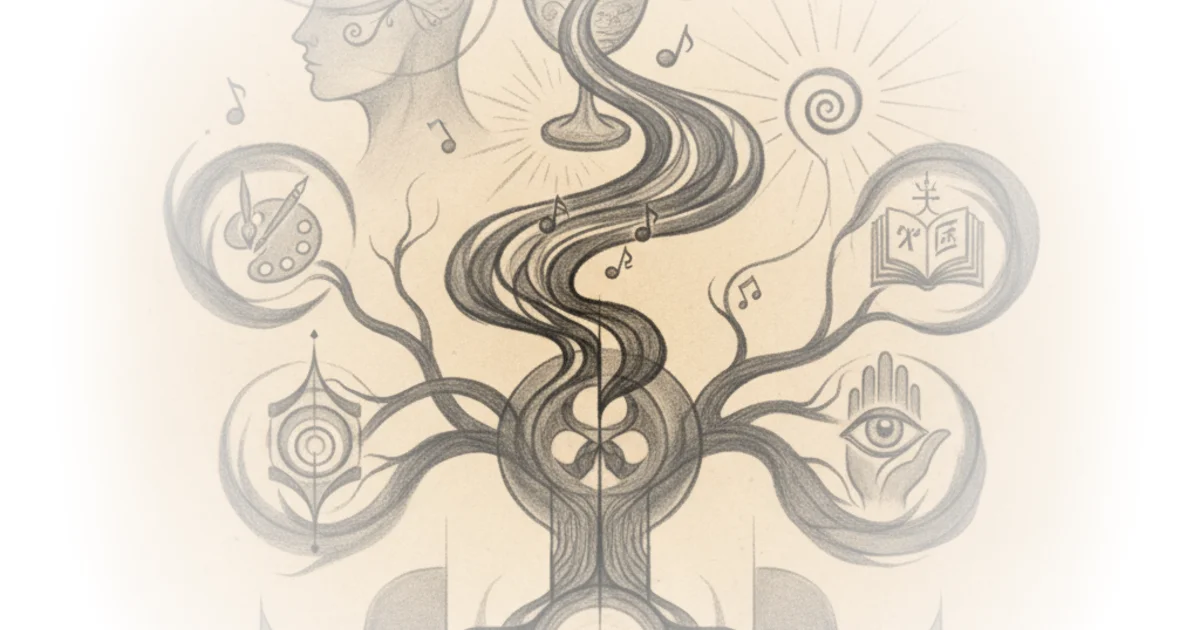
Kandinsky's central metaphor pictures spiritual progress as a triangle moving slowly upward through time. The apex holds the genius — misunderstood, insulted, solitary. Those below cannot comprehend what the visionary sees. Maria Popova writes, "Where the apex was today the second segment is tomorrow; what today can be understood only by the apex and to the rest of the triangle is an incomprehensible gibberish, forms tomorrow the true thought and feeling of the second segment."
This framing echoes Susan Sontag's diary observation that "Art is a form of nourishment (of consciousness, the spirit)." Popova connects Kandinsky to Sontag and Alain de Botton across centuries, suggesting art's promise of "inner wholeness" remains constant even as materialism intensifies.
"Color is a power which directly influences the soul. Color is the keyboard, the eyes are the hammers, the soul is the piano with many strings."
Three Responsibilities
Kandinsky itemizes the inner need driving artists into three elements. Maria Popova writes, "Every artist, as a creator, has something in him which calls for expression (this is the element of personality). Every artist, as child of his age, is impelled to express the spirit of his age (this is the element of style). Every artist, as a servant of art, has to help the cause of art (this is the element of pure artistry, which is constant in all ages and among all nationalities)."
Only the third element survives. Personality and style fade; pure artistry speaks across millennia. An Egyptian carving reaches modern viewers more directly than it reached its contemporaries because we judge it without the hampering knowledge of period.
Popova emphasizes Kandinsky's warning about spiritual food mismatched to its audience. Art can become poison when forced upon those unprepared — or when artists flatter lower needs rather than serving higher ones. As Maria Popova puts it, Kandinsky argues that art used for material ends "does not help the forward movement, but hinders it, dragging back those who are striving to press onward, and spreading pestilence abroad."
Critics Might Note
Kandinsky's triangle assumes spiritual progress is linear and upward — a Victorian optimism that modern skepticism challenges. Critics might note that genius isolated at the apex risks becoming elitist mythology rather than observable reality. The metaphor privileges individual visionaries over collaborative cultural evolution.
Critics might also note Kandinsky's dismissal of style and personality as temporary overlooks how these elements often carry the very cultural specificity that makes art resonate across time. An Egyptian carving speaks to us because of its period markers, not despite them.
Color as Soul
Popova returns to Kandinsky's synesthetic observations on color with particular care. He describes colors as rough or sticky, soft or hard, scented or sounding. Maria Popova writes, "The artist is the hand which plays, touching one key or another, to cause vibrations in the soul."
This piano metaphor extends to nature itself — surroundings set the soul's strings vibrating through objects with their several appeals. Kandinsky insists form and color interplay creates spiritual effect. A yellow triangle differs spiritually from a blue triangle. Geometry carries meaning before interpretation begins.
The Freedom of Art
Kandinsky rejects obligation. Maria Popova writes, "There is no 'must' in art, because art is free." Art springs from inner need, not external requirement. When religion, science, and morality shake, humans turn inward — and literature, music, and art register the revolution first.
Popova connects Kandinsky to Leo Tolstoy's notion of emotional infectiousness as art's true measure. The spectator feels a corresponding thrill. Harmony or contrast of emotion cannot be superficial. Works of art preserve the soul from coarseness; they key it up like a tuning-key on musical strings.
Bottom Line
Maria Popova's reading rescues Kandinsky from museum placards and returns him to urgent contemporary relevance. His warnings about art commodified as transaction rather than experience ring louder in an age of NFTs and gallery speculation. The verdict: Kandinsky's spiritual triangle remains the most coherent defense against art's reduction to merchandise — but his genius-at-apex mythology risks privileging isolation over the collaborative cultural work that actually moves the triangle forward.