Rohit Krishnan challenges the prevailing narrative that artificial intelligence is simply a tool for prediction, arguing instead that we are on the cusp of a new era where AI serves as the developmental machinery for genuine artificial life. By reframing the history of computing not as a failure to replicate biology, but as a failure to replicate the environment in which biology evolves, Krishnan offers a startlingly fresh synthesis of two decades of stalled research. This is not just a technical deep dive; it is a philosophical pivot that suggests the next breakthrough in AI won't come from bigger models, but from evolving small agents inside the rich, chaotic substrate of a trained foundation model.
The Historical Dead End
Krishnan begins by dismantling the romanticized history of "playing god" with code, tracing the lineage from ancient golems to the mid-20th-century dreams of John von Neumann. He notes that while von Neumann conceived of a "universal constructor" capable of building other machines, the subsequent attempts to simulate life often fell into a trap of oversimplification. The early focus on cellular automata, like Conway's Game of Life, relied on the belief that "simple rules applied repeatedly are enough to make complexity." Krishnan writes, "We learnt about self-organisation, emergence and some of the principles that underlie evolution. But the dream of creating life remains very much a dream."
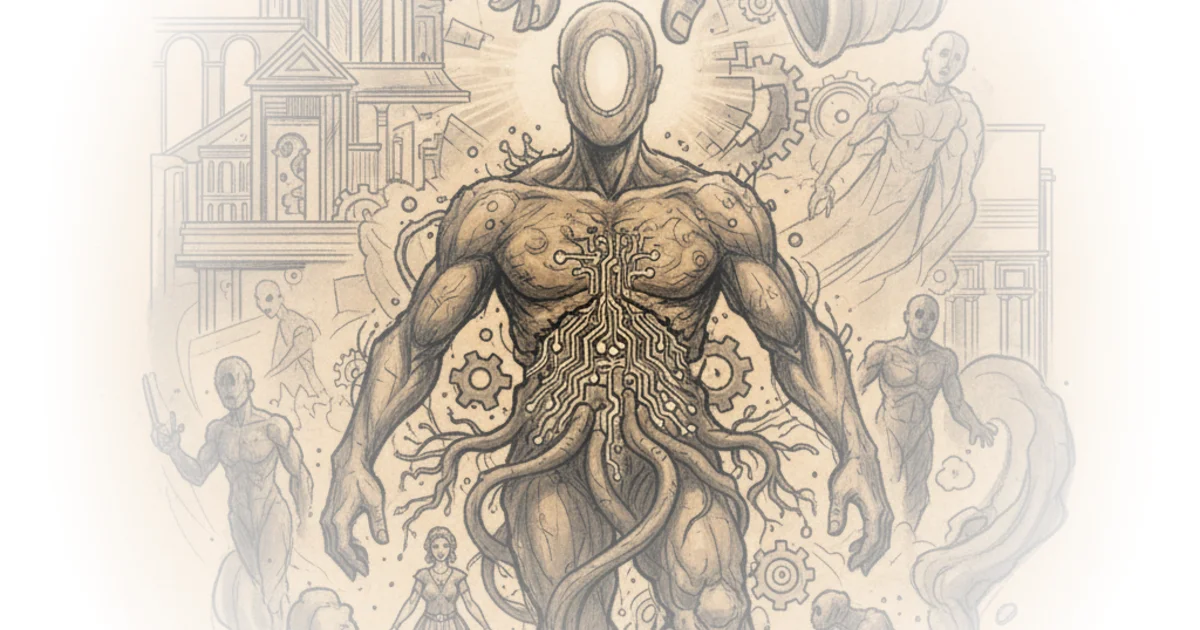
This historical context is crucial because it highlights a recurring blind spot: the assumption that complexity is purely a function of rule iteration. Krishnan points out that while we mastered the math of chaos, such as the Navier-Stokes equations governing weather, we failed to capture the richness required for life to take root. He draws a parallel to Stephen Wolfram's work on computational complexity, noting that while staggering complexity can emerge from simple starting points, "seeing the final form it's not easy to figure out what the initial rules were." The lesson here is that rule-based systems, no matter how elegant, lack the messy, unstructured depth of reality.
The Thinness of Digital Evolution
The argument shifts to evolutionary algorithms, which attempted to solve the design problem by letting the search do the work. Krishnan acknowledges their success in finding "strange hacks, controllers that make simulated bodies walk, antennae and circuits and neural network weights that no engineer would have written on purpose." Yet, he delivers a stinging critique of why these systems never achieved true autonomy. The problem, he argues, was not the mechanism of evolution, but the poverty of the world in which it occurred.
"These worlds were very thin!" Krishnan asserts. "The genomes were short, mutations were simple, the 'bodies' were simple, the ecologies too narrow, and the objective functions not nearly complex or expressive enough." He suggests that evolutionary strategies were actually "too strong" for their environments, finding clever shortcuts in narrow pockets rather than developing robust, generalizable life. This is a profound insight: evolution needs a world that is rich enough to punish cleverness and reward genuine adaptation. As Krishnan puts it, "Maybe you needed evolution to happen inside an entire world, not just a pocket universe. Artificial life had evolution, but not enough world."
Artificial life had evolution, but not enough world. Modern AI has world, at least enough of it, but no directed evolution.
Critics might argue that this distinction between a "thin" simulation and a "rich" environment is merely a matter of scale, not kind. If we simply make the digital world large enough, won't the complexity emerge naturally? Krishnan anticipates this, implying that the issue is structural—the lack of a robust developmental machinery that can interpret tiny genetic changes into coherent, large-scale phenotypic shifts.
The Missing Machinery of Biology
To understand why previous attempts failed, Krishnan turns to the staggering complexity of real biology, describing it as "obscene in richness." He highlights the gap between a gene and a trait, noting that even the most stripped-down synthetic cell, JCVI-syn3.0, contained 149 genes with unknown functions. "You do not get a human by reading off a list of genes like ingredients on a cereal box," he writes. Instead, biology is a loop of interpretation: DNA becomes RNA, proteins regulate other proteins, and tissues constrain cells, all while the environment constantly modifies the organism.
This section serves as the bridge to modern AI. Krishnan argues that foundation models, despite not being alive, possess a unique quality: they are a "learned prior over the traces of the real world." They have absorbed the statistical residue of language, code, images, and physics. In this view, a foundation model acts not as the organism, but as the "developmental machinery"—the complex, inherited structure that allows a small mutation to result in a coherent change. "Maybe this was the key difference," Krishnan suggests, proposing that modern AI finally provides the "baroque" substrate that previous simulations lacked.
The Synthesis: Evolving Inside the Model
The piece culminates in a bold proposal: combining the pattern-recognition power of deep learning with the generative pressure of evolution. Krishnan describes deep learning as a process where a network "absorbs" patterns from examples, settling into a configuration that can generate behaviors consistent with those patterns. However, he warns of the "tautology" of this approach, quoting Douglas Adams: "a tautology is something that if it means nothing, not only that no information has gone into it but that no consequence has come out of it." The risk is that these models compress the world in ways we don't understand, potentially creating epicycles that don't scale.
To break this cycle, Krishnan introduces his own experiment, "Evolora," which freezes a large model as the "world" and lets small LoRA adapters live inside it as organisms. "Charge them energy for tokens, pay them for useful behavior, let bankruptcy mean death, profit mean reproduction, and successful adapters merge into offspring," he explains. This creates a "semantic Game of Life" where evolution operates within a rich, learned environment. The result is not a single perfect creature, but an ecology of specialists, niches, and mergers. "Maybe we have to evolve an entire ecology learning to survive inside a world we trained but do not really understand, not just one artificial creature," Krishnan concludes.
Bottom Line
Rohit Krishnan's strongest contribution is the reframing of AI not as a competitor to biology, but as the necessary substrate for it, solving the "thin world" problem that plagued decades of artificial life research. However, the argument's biggest vulnerability lies in the assumption that a statistical model of human data is a sufficient proxy for the physical and biological laws that govern real-world evolution. The reader should watch for whether these "semantic ecosystems" can truly exhibit open-endedness or if they remain confined to the biases of their training data. The dream of creating life may finally be within reach, but only if we stop trying to build a creature and start building a world.
Maybe we have to evolve an entire ecology learning to survive inside a world we trained but do not really understand, not just one artificial creature.