A President at War with His Own Court
The Supreme Court struck down Donald Trump's tariffs imposed under the International Emergency Economic Powers Act as unconstitutional. Rather than accept the ruling, Trump escalated. Within hours he announced a 10% tariff on foreign imports, raised it to 15% the next day via social media post, and launched a sustained attack on the legitimacy of the court itself.
"The supreme court (will be using lower case letters for a while based on a complete lack of respect!) of the United States accidentally and unwittingly gave me, as President of the United States, far more powers and strength than I had prior to their ridiculous, dumb, and very internationally divisive ruling."
The lowercase spelling was deliberate. So was the message: Trump views judicial review not as a constitutional check but as a personal affront to be punished.
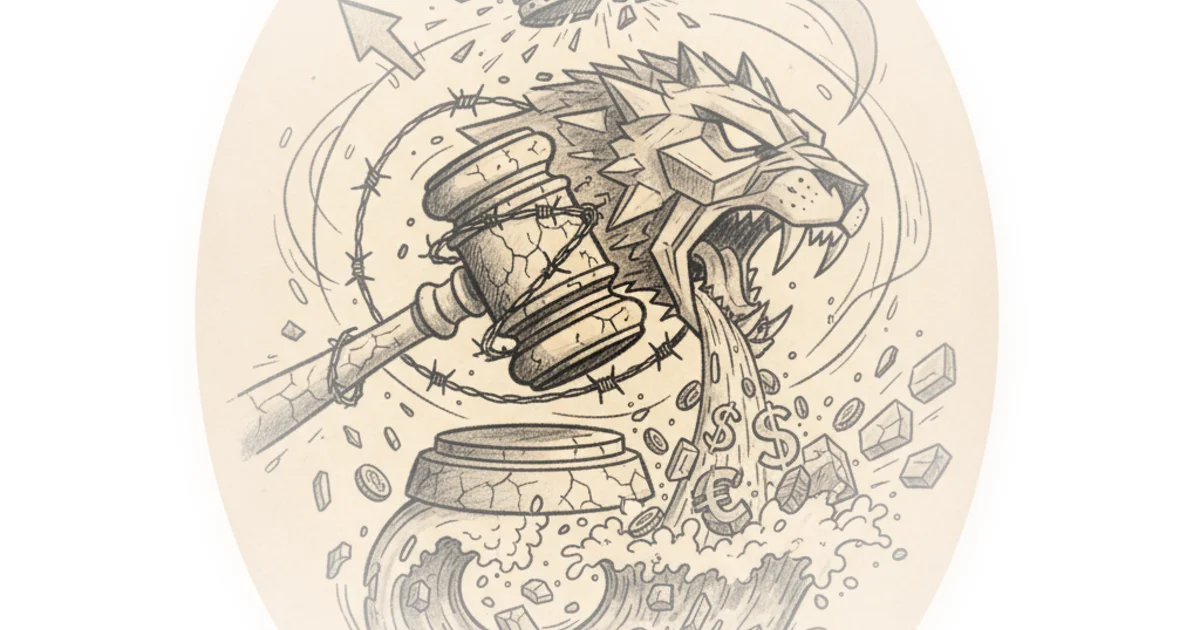
He went further, claiming he could "do absolutely 'terrible' things to foreign countries" and that other tariff authorities "can all be used in a much more powerful and obnoxious way, with legal certainty." The word "obnoxious" is not typically part of presidential trade rhetoric. It signals that the goal is leverage through disruption, not coherent economic policy.
International Fallout, Immediate and Concrete
The chaos registered overseas almost instantly. Bernd Lange, head of the European Parliament's international trade committee, captured the reaction plainly:
"Pure tariff chaos on the part of the US government. No one can make any sense of it anymore -- just open questions and growing uncertainty for the [European Union] and other US trading partners."
Lange proposed pausing the European Union's trade deal with the United States pending a legal assessment and clear commitments. The European Parliament agreed. India postponed a trip to finalize its own trade deal with Washington. Meanwhile, India and the European Union completed a separate agreement creating the largest free trade zone in the world.
The pattern is worth noting. America's trading partners are not simply retaliating. They are routing around the United States entirely, building economic relationships that exclude Washington from the table. That may prove more consequential than any tariff rate.
The Numbers Tell a Clear Story
Heather Cox Richardson assembles a damning set of polling figures. An ABC News/Washington Post/Ipsos poll found that 64 percent of Americans disapprove of Trump's handling of tariffs. His promised $2,000 "dividend" checks from tariff revenue are, according to financial planner Stephen Kates, dead on arrival:
"Tariff dividends were a long shot from the beginning." Now, he said, the odds of their moving forward are "effectively zero."
The broader disapproval numbers are striking. Sixty percent of Americans disapprove of Trump's job performance, his lowest since shortly after January 6, 2021. Fifty percent say his policies have hurt the economy; only 26 percent say they have helped. And 82 percent of Americans, including 76 percent of Republicans, say the president must obey rulings of the Supreme Court.
One reasonable counterpoint: polling on tariffs has historically shifted when economic effects become tangible. If prices stabilize or the administration negotiates favorable deals under pressure, public opinion could soften. The current numbers reflect a moment of peak uncertainty, not necessarily a permanent verdict.
The Manufactured Crowd
Trump dismissed unfavorable polls as "fake" and claimed "silent support" exists for his agenda. Richardson documents how that claim fares under scrutiny. A Politico examination of social media accounts boosting Nicki Minaj's new right-wing persona found that roughly 33 percent of them -- 18,784 profiles -- were fake.
"[W]hen the conversation is limited to toxic content, a substantially stronger amplification effect emerges. These accounts predominantly amplify content produced by Nicki Minaj and Turning Point USA, indicating a notable overlap between the two within this discourse."
The report assessed "with high confidence that a coordinated fake campaign was actively amplifying political content." The so-called silent majority, in at least this case, was partly synthetic.
Congress Quietly Steps Aside
House Speaker Mike Johnson conceded what everyone watching already knew: Congress has no appetite for codifying Trump's tariffs into law.
"It's going to be, I think, a challenge to find consensus on any path forward on the tariffs, on the legislative side. And so that is why, I think, you see so much of the attention on the executive side, the executive branch, and what they're doing and how they're reacting to the ruling."
This is a remarkable admission. The Speaker of the House is effectively saying that the legislature will not legislate on the president's signature economic policy. The tariffs exist in a constitutional no-man's-land: the courts say the president lacks authority, and Congress will not grant it.
A Parade of Embarrassments
Richardson catalogs several additional stories that collectively paint a picture of an administration losing institutional credibility.
FBI Director Kash Patel was filmed chugging beer in the U.S. men's hockey team's locker room at the Olympics in Milan, having flown there on the FBI's private jet for purportedly official events. Eight former FBI and Department of Justice officials sent the video to reporters. When questioned, Patel's spokesperson demanded a correction and then went silent after the video surfaced.
Ambassador to France Charles Kushner -- Trump's pardon recipient and father of son-in-law Jared Kushner -- was banned from contact with French government members after twice refusing to meet with foreign ministry officials. A French official explained the reasoning simply:
"[I]t's a question of the basic expectations attached to the mission of an ambassador."
Representative Tony Gonzales of Texas faces calls to resign over allegations he pressured a staff member into a sexual relationship. The woman later died by suicide. Published text messages show her warning him he was "going too far."
The Classified Documents Report Stays Sealed
Judge Aileen Cannon blocked release of Jack Smith's report on Trump's retention of classified documents. Legal analyst Joyce White Vance noted the irony of Trump's fierce resistance to disclosure:
"[I]t's hard to miss the glaring similarity to the Epstein Files, where it increasingly appears attempts to avoid disclosure were meant to protect wealthy, powerful people. Why not just release Volume II if Trump, as he says, is innocent?"
Standard procedure calls for a special counsel's report to be made public. The intensity of the fight to keep it sealed has, paradoxically, generated more interest in what it contains.
Small Boats, Large Questions
U.S. Southern Command reported another small vessel strike, killing three people and bringing the total killed in such attacks to at least 137. The government claims those targeted were engaged in narcotics trafficking, though Richardson notes there remains no public proof of these allegations. The body count continues to grow with minimal public scrutiny.
Bottom Line
Richardson's February 23 letter captures a presidency in open conflict with the constitutional order. The Supreme Court ruled Trump's tariffs unconstitutional. Trump responded not by complying but by raising tariffs further, attacking the court's legitimacy, and insisting he needs no congressional approval. Congress admitted it will not act. Trading partners began building economic structures that bypass the United States altogether.
The domestic political position is equally precarious. Sixty percent disapproval. Eighty-two percent -- including three-quarters of Republicans -- believe the president must obey the court. Promised tariff dividends are dead. The "silent support" Trump claims turns out to be, at least partly, bot-driven.
Still, it is worth acknowledging that constitutional crises have a way of resolving through mechanisms that look inadequate in the moment. The courts ruled. Congress signaled its limits. Public opinion is clear. Whether those forces prove sufficient depends on what happens next -- starting with the State of the Union address, which many Democrats announced they would skip. Senator Angus King of Maine explained his absence in terms that distilled the broader standoff:
"Ever since taking office a year ago, the President has shown no respect for the principles upon which this country is based -- the Constitutional separation of powers, the rule of law, and the rights guaranteed to every person under the Constitution."
The question Richardson leaves her readers with is not whether the system is under stress. That much is obvious. The question is whether the stress produces correction or collapse.