"Most industry observers are fixated on which model just passed a benchmark, but Dylan Patel argues that the real war for artificial intelligence supremacy is being fought in datacenters and employee workstations. This piece cuts through the hype of model releases to reveal a startling infrastructure play: Meta is not just catching up; it is executing a coordinated assault on the three pillars of AI—data, talent, and compute—that could render current leaders obsolete within six months."
The Data Moat
Patel reframes the conversation around data quality, challenging the common assumption that high-quality human data is running out. He writes, "In 2024, Ilya famously said that 'data is the fossil fuel of AI.' While this analogy correctly highlights the importance of data for training AI models, it incorrectly assumes that the amount of good data is finite." This distinction is crucial because it shifts the focus from hoarding existing archives to actively generating new, high-value training environments.
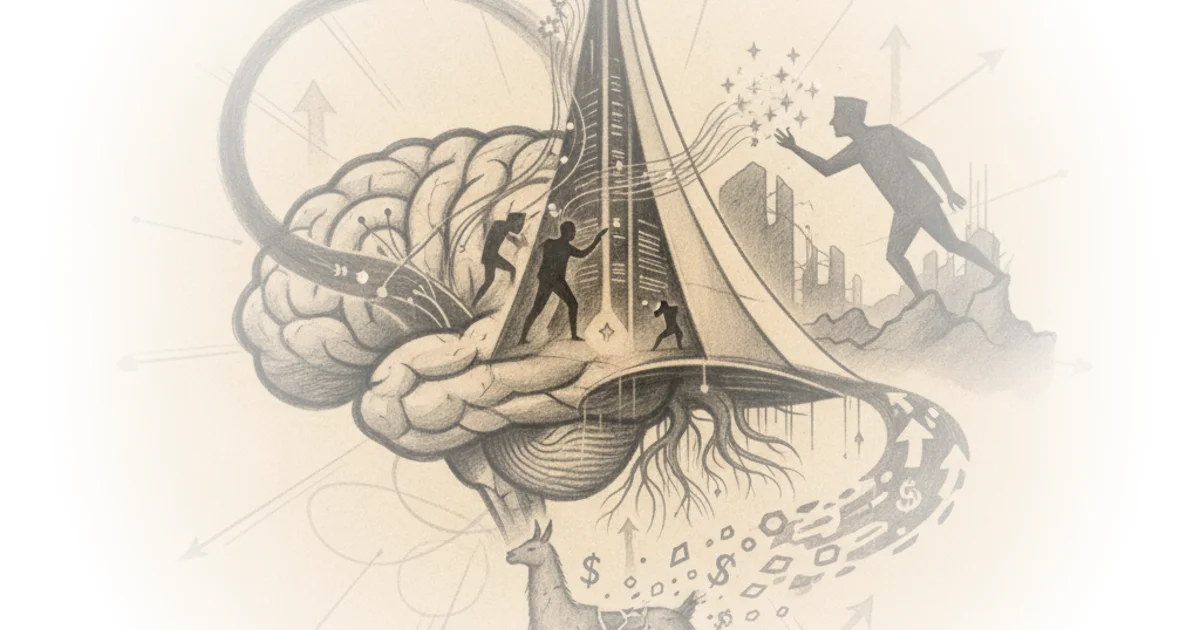
The author argues that Reinforcement Learning (RL) has become the primary engine for capability growth, requiring not just text but interactive environments where models can practice complex tasks. "It is worth emphasizing that many AI insiders believe more RL environments/tasks are all we need to automate virtually all white-collar work," Patel notes. This perspective suggests that the bottleneck is no longer algorithmic innovation alone, but the sheer volume of realistic, high-difficulty scenarios available for training.
Data companies are desperately searching for real recordings of white-collar work because screen recordings guarantee tasks are representative of real knowledge work by definition.
Patel identifies a unique advantage for Meta: its ability to capture this data internally. While competitors like Anthropic must pay exorbitant rates to external contractors, Meta has begun tracking the screens and inputs of its own workforce. "Meta just created a top tier RL environment startup," he asserts, pointing out that the company now employs roughly 3,000 engineers dedicated full-time to creating these tasks. This move transforms internal operations into a massive, proprietary training loop that is difficult for outsiders to replicate.
Critics might argue that relying on internal employee data creates significant privacy risks and could demoralize the workforce, potentially stifling the very creativity needed for high-level engineering. Patel acknowledges the backlash but dismisses it as manageable, suggesting that the strategic value of "real recordings" outweighs the temporary PR hit. However, the long-term cultural impact of such surveillance on a creative tech workforce remains an open question.
The Compute Tsunami
The article's most aggressive claim concerns hardware capacity. Patel contends that Meta is outpacing all rivals in physical infrastructure, building what he describes as "unprecedentedly large compute ramp led by 5 titans." He details the construction of five separate datacenter campuses, each exceeding one gigawatt of power, including massive facilities in Ohio and Louisiana.
"Never in the history of humanity have we ever seen a full 1GW campus under construction simultaneously," Patel writes, noting that Meta currently has two such projects active while competitors lag behind. This scale is not merely about having more chips; it is about the velocity of deployment. The author highlights how Meta's "Tent" datacenter design allows for rapid expansion, effectively turning capital expenditure into a competitive weapon.
Our new Tokenomics Model projects that Meta will have more AI compute than both OpenAI and Anthropic by the end of this year.
This infrastructure advantage is compounded by Meta's financial structure. Unlike Google, which must balance its cloud business against internal needs, or startups reliant on external funding, Meta can absorb negative cash flow to fuel its growth. "Instagram ads can fund a lot of compute," Patel explains, suggesting that the company's advertising revenue provides an endless war chest for AI expansion. This creates a scenario where Meta can afford to experiment and fail at a scale others cannot match.
However, this projection relies on the assumption that these massive datacenters will come online without significant delays or regulatory hurdles. While satellite imagery shows rapid construction, the operational reality of powering and cooling such facilities often presents unforeseen engineering challenges that could slow the projected timeline.
The Talent Pivot
Beyond hardware and data, Patel emphasizes a radical restructuring of Meta's human capital. Following what he calls a "disastrous" previous release cycle, the company has rebuilt its organization around aggressive recruitment and retention strategies. He points to the massive financial incentives offered to top researchers, noting that "multi-hundred million dollar (sometimes $1B+) pay packages [were] offered to top AI researchers/engineers."
This talent acquisition strategy is designed to solve the "slope" problem—the rate at which the company improves—rather than just its current position. Patel argues that while Meta's recent model release, Muse Spark, may have lagged behind open-source competitors like DeepSeek, "evaluating Muse Spark in isolation is missing the forest for the trees." The focus is on the trajectory of the newly assembled team and their access to superior data and compute.
We believe Meta is the only hyperscaler/neolab on track to be world class at all three [data, talent, and compute] and therefore has the best chance at catching up with Anthropic/OpenAI.
The author suggests that the industry is shifting from a "two-horse race" between OpenAI and Anthropic to a multi-polar landscape where Meta's integrated approach could dominate. This contrasts sharply with Google, which Patel claims has "faded dramatically" despite early leads, and Microsoft, which he argues has failed to leverage its partnership effectively.
It is actually quite hard to make an RL task that's sufficiently difficult for frontier models today, so your expert contractors normally spend their time making tasks more challenging.
By internalizing the creation of these difficult tasks, Meta avoids the "contrived" nature of external benchmarks that often fail to reflect real-world complexity. This approach aligns with historical shifts in AI development, where the focus moved from simple pattern matching to complex reasoning and agentic behavior—a transition that requires vast amounts of high-fidelity interaction data.
Bottom Line
Patel's argument is compelling because it moves beyond model benchmarks to analyze the underlying industrial machinery of AI production, correctly identifying infrastructure and proprietary data as the new moats. The piece's greatest strength is its synthesis of financial scale, engineering speed, and data strategy into a unified thesis for Meta's resurgence. However, the analysis may underestimate the friction caused by internal surveillance on employee morale and the technical complexities of scaling gigawatt-level power grids, which could delay the projected timeline. Readers should watch not just for the next model release, but for the operational status of these five massive datacenter campuses as the true indicator of Meta's future dominance.