What makes this piece remarkable is how Wes Cecil uses Greek mythology not as distant folklore, but as the intellectual foundation for understanding one of philosophy's most radical ideas: that chaos itself has rules. This is a counterintuitive claim — and Cecil executes it brilliantly.
The passage begins with what could be an ordinary overview of Greek gods, but quickly reveals something deeper. The narrative moves from Chaos (the primordial void), through the Titans who "kill their fathers" to seize power, to Zeus's strange story of being wrapped in swaddling clothes and swallowed before ultimately castrating his father. These aren't just stories — they're the intellectual backdrop for understanding why Anaximander's claim was so transformative.
"I think underlying this apparent chaos that we live in is a set of orderly rules that drives everything."
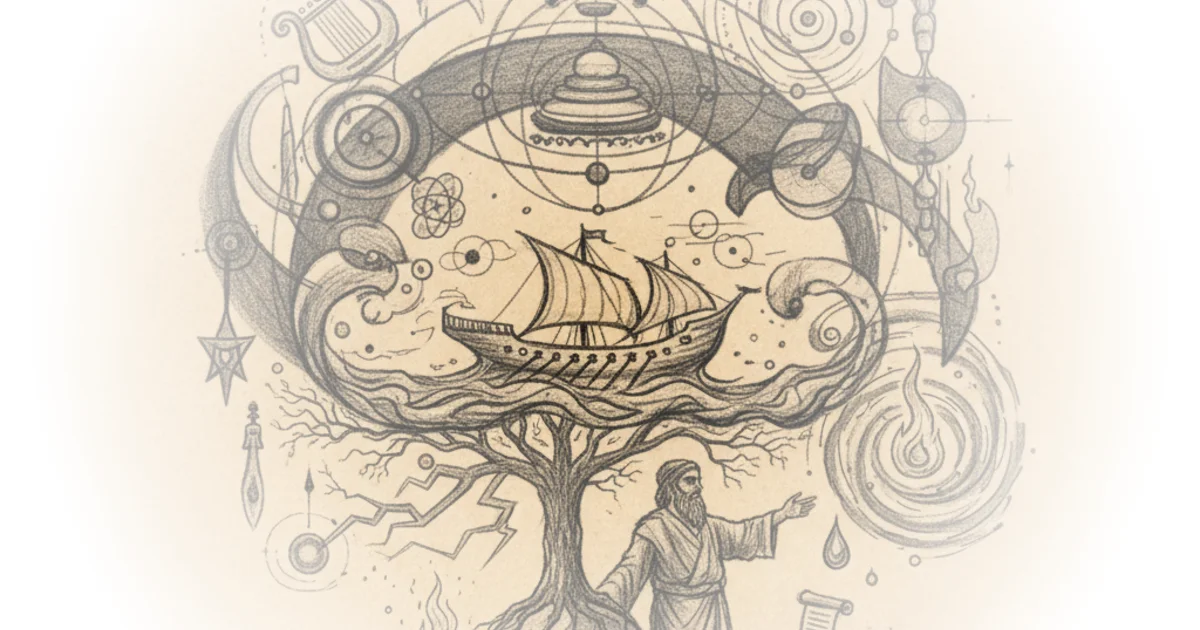
This single sentence captures what Cecil frames as the turning point: moving from mythological narrative to natural philosophy. The Greek world had spent centuries telling stories about gods who behave like powerful humans — petty, vindictive, occasionally hilarious. Anaximander's leap was to suggest those stories obscure an underlying order.
The Teleology Claim
Cecil introduces a concept he calls "tileology" — what others would call teleology: the idea that history has direction. He writes that moving from Chaos to the Titans to the Olympic Gods represents progress:
"This sets up a tileology... that things are in fact getting better we're becoming more orderly and more civilized."
The framing is effective because it connects Greek mythology directly to philosophical thinking about history. What Cecil does here is layered: he argues that Greeks saw their religious system as advancement — from chaos toward order — even while acknowledging the gods were "big dangerous and scary humans that live forever."
The Irreligion of Greek Religion
Perhaps the most distinctive section addresses what Greek religion actually meant. Cecil writes:
"It's not about what you believe it's not what you say it's the specific actions that you carry out."
This is a genuinely surprising claim for readers unfamiliar with ancient Greek culture. The Greeks had no concept of belief as we understand it — no word for "religion" in their vocabulary. Their religious system was entirely transactional: show up, perform the correct rituals at the correct times, and you're compliant. Ethical behavior toward other humans was almost irrelevant.
Cecil illustrates this with a striking example:
"You could go out and kill your neighbor every morning and then go to the temple and they would say well he's a pretty good God right."
This is jarring precisely because it challenges modern assumptions about what religion should do. The Greeks didn't care about moral philosophy — they cared about ritual correctness. This distinction matters enormously when understanding why Socrates and later philosophers faced such hostility.
Why This Matters
The context of the Milesian school — in Miletus, a trading crossroads between Egypt, Persia, and the Black Sea — provides the practical backdrop for this intellectual leap. The city-state's practical mindset, their inability to draw accurate maps, their need for tidal information: all of these real-world problems drove the birth of natural philosophy.
Cecil is strongest when he traces how practical concerns (trade, navigation) transformed into abstract questions about the world's nature. The move from "we need better maps" to "the world has underlying order" is the piece's connective thread.
Critics might note that the transcript occasionally conflates Greek religion with ethics in ways that oversimplify — particularly when noting that Greeks "have almost no concept" of ethical behavior toward others. The heroic code itself was an ethical system, even if it prioritized martial valor over moral consideration. But Cecil's broader point stands: the Greeks' religious practices were disconnected from how they treated their neighbors.
Bottom Line
Cecil's strongest move is connecting Greek mythology to philosophical breakthrough — showing that Anaximander's order-of-chaos insight wasn't just abstract thinking, but a deliberate break from everything before it. The vulnerability lies in overstating the gap between Greek religion and ethics; the Greeks weren't amoral, they just prioritized different virtues. Still, the core argument is sound: understanding how the Greeks thought about their gods helps us understand why philosophy itself began where it did.