Dan Carlin has spent decades immersed in war games — both the tabletop miniatures he played as a child and the modern digital versions he plays today. What makes this piece compelling isn't just nostalgia; it's how Carlin uses his personal history to reveal something fundamental about how humans have always practiced for war.
The Personal History of Wargaming
Carlin's journey begins in 1972 London, where as a six-year-old he played with toy soldiers — but it was the introduction of rules that transformed play into something more structured. "He sat down he started talking to six or seven year old version of me and i didn't like this one bit," Carlin recalls, describing how rules felt to him then: "it ruined the spontaneity and the creativity of it all for me." This is a revealing admission — that structure kills imagination. Yet as he matured, Carlin came to appreciate what those rules represented: the bridge between playing with toys and thinking strategically.
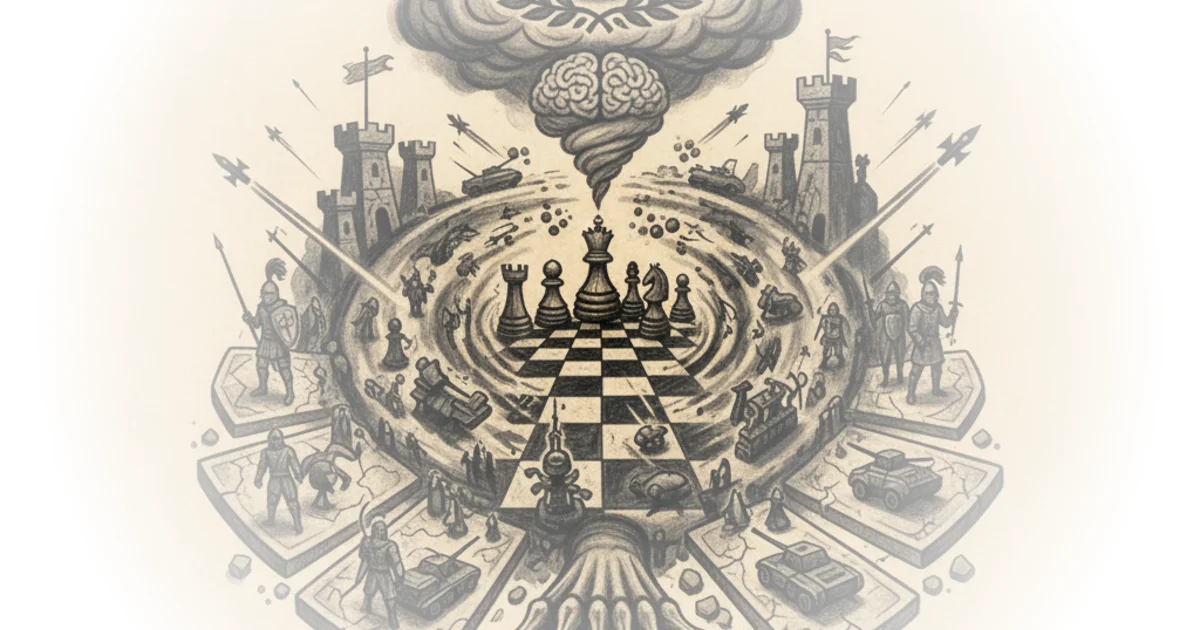
Carlin's historical sweep extends far beyond his own experience. He notes that "one of the really seminal early rule sets for the war gaming genre" was written by H.G. Wells — the author of The War of the Worlds. This connection is more than trivia; it reveals how Victorian-era military planning blended with entertainment, and how those rules eventually fed into Dungeons & Dragons itself.
When you would buy a set of rules in the back it would be like hey you know if you want to get a hold of us uh here's our address you can call us this at this hour but we might be gone during i mean it was it was so informal and clubbish that you felt like the guys that wrote this were just you know your buddy down the street.
This captures something essential about early war gaming culture — it was intimate, local, and deeply personal. The hobby wasn't simply a commercial enterprise but rather "almost a school or a fraternity" where communities formed around shared obsession.
The Rise of Rules Lawyers
Carlin's description of rules lawyers is darkly funny and revealing. He describes how players would "argue that you should get some sort of benefit that ends up leading to well if not a victory for the rules lawyer then a less drastic defeat." This isn't just about winning — it's about finding advantage through technical interpretation rather than tactical skill. "Part of the way you won was not your great tactical expertise right and you you out think the other guy no you just have these little rule things that you noticed or maybe you know it backwards or forwards" — Carlin's voice here is almost self-deprecating, acknowledging how this aspect of gaming could become its own warped competition.
The Abstraction of Violence
Perhaps most interesting is what Carlin reveals about violence itself in these games. "There was no blood there was no violence unless it was between two players arguing with each other" — the actual combat was abstracted into mathematical calculations and paper notation. When casualties occurred, you simply wrote numbers on a piece of paper: "you suffered 17 casualties in that charge okay that doesn't even tell you how many are wounded versus how many are dead." This abstraction is remarkable — violence reduced to pure math, with miniature figures representing human beings who could be counted rather than depicted bleeding. The second world war games they played involved tanks hit and destroyed, represented by "a little puff of black cotton" placed on the toy vehicle.
Carlin also notes something revealing about modern games versus his preference: he plays games that replicate the miniatures version from the 1970s. "The game that i play them the most these days is a game that simply tries to replicate the miniatures version of the games that i played in the 1970s on a computer screen" — graphically it's stone age compared to modern options, yet nostalgia pulls him toward simpler representations.
The Transition to Digital
When computer games first arrived, Carlin was enthusiastic for practical reasons: "you didn't need an opponent you didn't need to spend all day" preparing. The digital version removed the barrier of finding a human opponent and the time commitment required by the hobby's complexity. What emerged was something that let players fight battles without the social overhead — no more arguing about rule interpretations, no more needing to find people physically to play.
Critics might note that Carlin's nostalgia for the old systems sometimes overlooks how exclusionary these communities actually were. The barrier he describes — "this is not easy stuff to do the time commitment alone um is onerous you have to be a bit of a fanatic" — was real. These hobbies required substantial investment in both time and money (he recalls figures costing forty dollars each), making them inaccessible to many.
Bottom Line
Carlin's deepest insight isn't about games at all — it's about how humans abstract violence. The puffs of black cotton, the casualty calculations written on paper, the mathematical representation of death: these reveal something about how military thinking has always been sanitized through rules and simulations. His piece works because it connects personal memory to broader questions about how we practice for conflict. The strongest part is his observation that war gaming communities were "almost like clubs" — small, insular, and deeply personal. That intimacy is what made the hobby work, and it's what digital versions replaced with pure convenience.