In an era where social media reduces Brazil to a backdrop for aesthetic tourism, Kahlil Greene cuts through the noise to reveal a brutal truth: the "Brazilian Renaissance" is built on the uncredited labor and resistance of Black communities. This isn't a travelogue; it is a forensic examination of how state power criminalizes Black culture until it becomes profitable, then attempts to sanitize it for global consumption.
The Architecture of Resistance
Greene dismantles the popular myth that Carnival is merely a celebration of sequins and feathers. He argues that the very rhythm of the nation was forged in the crucible of slavery. "The music, the dance, the energy that makes Brazil feel like nowhere else on Earth didn't come from nowhere," Greene writes. "It came from enslaved Africans and their descendants, who created beauty under some of the most brutal conditions in the Western Hemisphere."
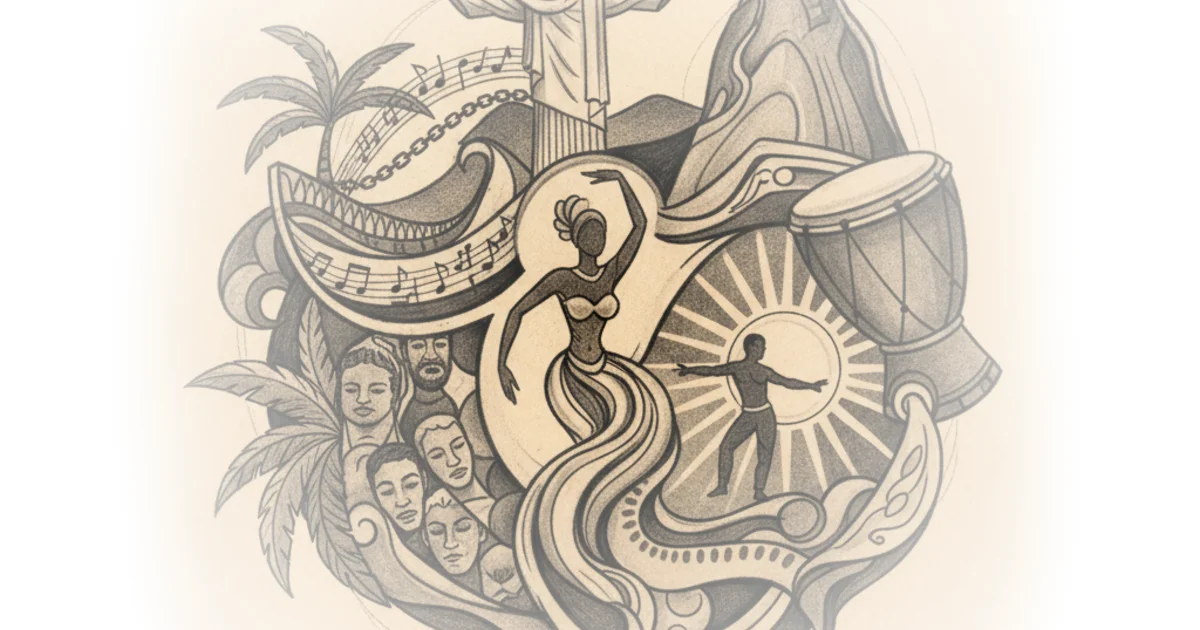
The author traces the lineage of samba back to 1558 in Salvador da Bahia, the first slave market in the New World, where enslaved people from the Congo and Angola were forced to work eighteen to twenty hours a day on sugar plantations. On rare Sundays, they gathered in secret circles to sing and dance, defying bans from European enslavers who deemed these gatherings vulgar. This historical grounding is crucial; it reframes samba not as a party, but as a survival mechanism. As Greene notes, "That circle became samba de roda, the earliest form of samba, which UNESCO recognized as an Intangible Cultural Heritage of Humanity in 2008."
Samba was never just a party. It was, and still is, an act of resistance dressed in rhinestones.
The narrative arc Greene constructs is compelling: from the secret gatherings of the enslaved to the migration to Rio's favelas after abolition in 1888, where authorities continued to criminalize Black gatherings as "disorder" or "witchcraft." The argument holds weight because it exposes the continuity of state suppression. Critics might note that the article focuses heavily on the cultural output rather than the specific economic policies that maintained this inequality post-abolition, but the cultural lens effectively humanizes the structural violence.
The Underground Church of Dance
Moving from the Sambadrome to the North Zone, Greene highlights Baile Charme, a phenomenon often missed by tourists seeking the postcard version of Rio. He describes it as the "Saturday Night Church of Black Rio," a space where Afro-Brazilians have cultivated pride since the 1970s. The tradition emerged when American soul and funk artists like James Brown and Stevie Wonder provided an unlikely source of inspiration for young Black Brazilians facing limited opportunities.
Greene pinpoints a specific moment in 1980 when DJ Corello mixed Marvin Gaye into a set, telling the crowd to slow down and feel the "charme." The name stuck, evolving into a communal ritual with synchronized moves that were "going viral long before TikTok and Instagram existed." This section is particularly effective because it challenges the notion that Black culture in Brazil is derivative of American trends; instead, it shows how global Black culture was localized and reinvented. "Histories are written here," says choreographer Eduardo Gonçalves, a quote Greene uses to underscore that preservation happens organically, without waiting for government permission.
From Criminalization to Commodity
The final lesson tackles the favelas and the rise of Baile Funk, illustrating the cyclical nature of state repression. Greene explains that the favelas themselves trace back to the 1890s, when formerly enslaved people and soldiers were denied land after the War of Canudos. The state's response was neglect and violent policing, a pattern that repeated when Baile Funk emerged in the 1980s as a vehicle for racial consciousness.
The author details how the government attempted to crush the genre through bureaucratic hurdles and police surveillance, specifically citing Law 1392 in 2000, which created obstacles to prevent parties in favelas. "The government only formally protected the genre in 2009, when Law 5543 prohibited discrimination against it," Greene writes, adding the stinging observation: "One might wonder why it took nearly a decade to decide that criminalizing a music genre was, in fact, discriminatory."
The irony is palpable: the sound the state tried to destroy is now a global export, with artists like Anitta and Ludmilla taking the genre worldwide while vocalizing its origins. Greene captures this tension perfectly: "The sound that the state tried to criminalize is now one of Brazil's most profitable cultural exports. Ironic, but not surprising."
The parallels between the oppression and artistic resistance of Black Brazilians and Black Americans are exactly why so many Black history and political content creators love visiting this place.
A counterargument worth considering is whether the commercialization of funk by global stars like Anitta ultimately dilutes its political message, even if it brings financial success. Greene touches on this by noting the artists' vocal commitment to honoring their roots, but the tension between profit and purity remains a complex issue for the genre's future.
Bottom Line
Kahlil Greene's piece succeeds by refusing to let the "Brazilian Renaissance" narrative stand unchallenged, forcing readers to confront the history of slavery and state violence that underpins the country's most famous exports. The argument's greatest strength is its ability to connect historical suppression to modern cultural appropriation, yet it leaves the reader with a sobering question: when the state finally protects a culture, is it out of respect, or because it has finally become too profitable to ignore?