Matt Stoller argues that the true cost of modern monopolies isn't found in stock prices or profit margins, but in the invisible friction they create for everyone else. While a recent Amazon Web Services outage paralyzed the internet, the company's stock barely flinched, leading Stoller to introduce a new economic concept: "Corporate Sludge." This is the hidden tax of wasted time, administrative bloat, and systemic inefficiency that economists fail to measure because it doesn't appear on a balance sheet.
The Invisible Tax
Stoller begins by dissecting the disconnect between the massive disruption caused by the cloud giant's failure and the market's indifference. He notes that while the outage cost the economy hundreds of billions in lost productivity and time, "the costs of the AWS outage did not show up on the balance sheet directly responsible for it, or in the equity markets supposedly measuring long-term expectations of corporate profits." This observation is the piece's strongest hook, forcing the reader to question why standard economic metrics feel so disconnected from daily reality.
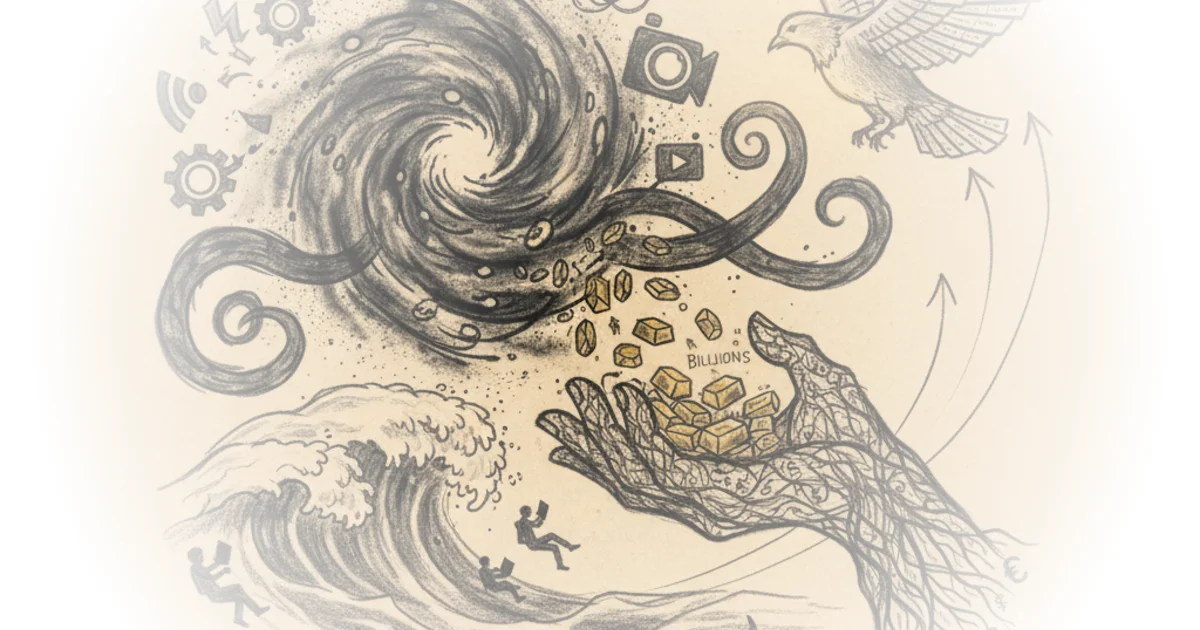
He coins the term "Corporate Sludge" to describe these unmeasured externalities. "Corporate sludge is the cost, or costs, of an excessively monopolized and financialized economy, that do not show up on a balance sheet," Stoller writes. The argument suggests that when a few firms dominate a sector, they don't just extract profits; they extract time and sanity. The author points out that while economists call wasted time a "negative externality," similar to pollution, "it's the equivalent of pollution... But that doesn't mean it's not real." This reframing is effective because it validates the frustration of professionals who feel the drag of broken systems even when corporate reports claim efficiency.
Critics might argue that attributing all unexplained inflation to "sludge" is a convenient catch-all that ignores supply chain complexities or global commodity shocks. However, Stoller's specific examples of procurement failures lend credence to the idea that internal corporate decisions are driving external costs.
The Health Care Paradox
The commentary shifts to the health care sector, where Stoller challenges the prevailing narrative that low profit margins equal efficiency. He critiques the view that insurance companies are merely "efficient pass-throughs," arguing instead that the real cost is hidden in the friction of the system. "To look only at accounting profits is to miss the genuine costs of monopoly or financialization," he asserts. This is a crucial distinction for busy readers who understand that a company can be "profitable" while still being a nightmare to navigate.
Stoller highlights the human toll of this inefficiency, noting that the U.S. health care system generates "a lot of health care millionaires who are good at pricing arbitrage" despite hospitals spending twice as much on administration as on direct patient care. He describes a system where "doctors spending their time fighting with bureaucrats over reimbursements and audits" is the norm. The author's point is that this administrative bloat is a form of sludge that drains resources without improving care. "The experience of health care is full of corporate sludge, from having to dispute weird bills to being steered to medication that may or may not be correct," Stoller writes.
The answer is corporate sludge, hidden inefficiencies that are a result of market power.
The Food and Energy Trap
Extending the analysis to food and energy, Stoller explains how market power distorts supply chains in ways that raise prices without necessarily boosting corporate profits. In the grocery sector, he argues that "slotting fees"—payments from brands to secure shelf space—have pushed out local, fresh food producers in favor of ultra-processed goods. "Since the government stopped enforcing laws against price discrimination in the 1980s, the food industry learned 'how to sell larger quantities of low-nutrient processed foods merely by manipulating their placement.'" This historical context adds weight to the claim that current food prices are not just about inflation, but about a structural shift in how food is sold.
Similarly, in the energy sector, Stoller points out that investor-owned utilities are raising prices faster than publicly owned ones, not because of necessary infrastructure costs, but due to "gold-plating" and excessive legal bloat. "While the publicly owned utilities have a few lawyers on staff, private utilities of significant size seem to employ the equivalent of an internal mid-size law firm," he observes. This disparity suggests that the cost of doing business in a monopolized environment is inflated by the very firms claiming to need higher rates to survive.
Bottom Line
Stoller's concept of "Corporate Sludge" offers a powerful lens for understanding why the economy feels broken even when corporate profits remain high. The strongest part of the argument is its ability to quantify the unquantifiable: the time, anxiety, and wasted resources that monopolies impose on society. Its biggest vulnerability lies in the difficulty of measuring these costs precisely, which could allow skeptics to dismiss the theory as anecdotal. However, the piece successfully shifts the focus from stock prices to the lived experience of the economy, urging a reevaluation of what true efficiency looks like.