This analysis cuts through the dry procedural veneer of a recent Chinese party conference to reveal a profound psychological shift in how the nation's leadership views power. Kaiser Kuo argues that the obsession with codifying rules is not a move toward Western-style judicial independence, but a calculated strategy to impose total order on a system that previously felt chaotic. For investors and strategists, the takeaway is stark: the era of improvisation is over, replaced by a rigid, weaponized legal framework designed to counter Western pressure.
The Psychology of Control
Kuo frames the recent Central Work Conference on Comprehensive Law-based Governance not as a bureaucratic formality, but as a window into the mindset of the leadership. He notes that while the conference itself was "a snooze fest," its existence signals a deliberate, long-term project. "Xi Jinping is obsessed with rules," Kuo writes, challenging the common perception that the leader operates above the law. Instead, the argument posits that the leader's power is exercised through the law, even if he retains the ultimate authority to rewrite it.
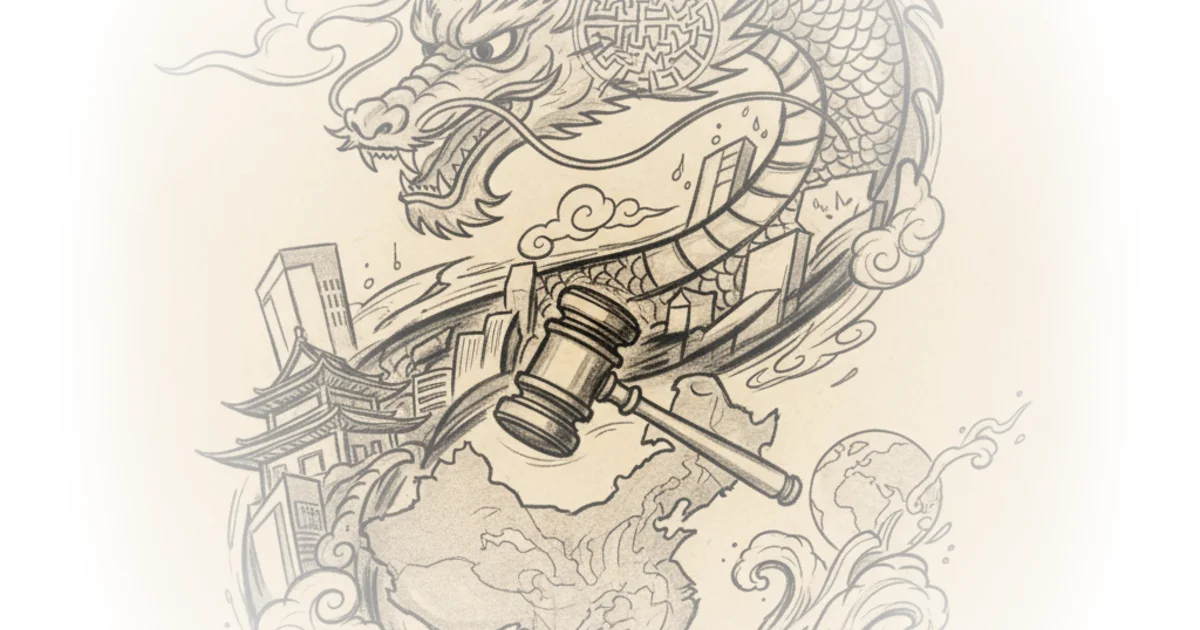
This distinction is crucial for understanding the current trajectory of Chinese governance. Kuo explains that the leader "went through an elaborate process to actually change the law to make it legal for him to stay on for a third term," proving that he prefers the appearance of strict adherence to procedure. "He may be changing the rules, but he is still following rules," Kuo observes. This framing is effective because it moves beyond personality cults to analyze institutional mechanics. It suggests that for foreign businesses, the unpredictability of arbitrary decrees is being replaced by the predictability of codified restrictions.
However, this focus on internal order overlooks the potential for rigidity to stifle the very innovation the state claims to need. Critics might argue that a system obsessed with procedural compliance can become brittle when facing unforeseen external shocks, as the leadership prioritizes control over adaptability.
"Xi Jinping's focus is creating rules... He's rewritten the entire internal party rulebook."
Rule by Law, Not Rule of Law
The commentary draws a sharp, necessary line between Western concepts of the "rule of law" and China's "rule by law." Kuo is blunt about the hierarchy: "Ultimately, Xi Jinping himself and the party more general are above the law. So, they use the law as a tool to govern as opposed to being governed by the law itself." This is not a semantic quibble; it defines the operational reality for anyone engaging with the Chinese state.
The argument suggests that the drive for legal codification stems from a specific historical trauma. Kuo posits that the leader viewed the pre-2012 era as a time when "officials could do whatever they wanted" and "tycoons and the wealthy could do whatever they wanted." The current legal crackdown is framed as a corrective measure to "regain control over the party, over society, over the country, and create order." This historical context is vital, reminding listeners that the current legal rigidity is a reaction to the perceived chaos of the Hu Jintao era.
This perspective aligns with broader trends in Chinese legal history, where the law has often served as an instrument of state power rather than a check on it. Much like the 19th-century Meiji Restoration in Japan, which modernized legal codes to strengthen the state rather than empower the individual, China's current legal overhaul is a tool for centralization. The danger for foreign entities is assuming that a written rule implies a fair process; in this system, the rule is the weapon, not the shield.
The Weaponization of Legal Tools
The most alarming development highlighted by Kuo is the shift from building legal tools to actively deploying them. The recent conference marked a pivot from the 2020 goal of "coordinating the advancement of domestic rule of law" to the 2025 directive to "strengthen the foreign related legal system and capacity building." Kuo interprets this as a clear signal that China is ready to use its new legal arsenal.
"China in the wake of that [U.S. sanctions]... said, 'Oh, you know what? We need to have similar tools,'" Kuo writes, describing the creation of an "anti-foreign sanctions law," "blocking rules," and an "unreliable entity list." The commentary notes that while these tools were previously theoretical, the new directive implies a "much more willingness to use them going forward." This is a critical warning for global commerce. The legal infrastructure is no longer just for show; it is being operationalized to counter U.S. export controls and economic restrictions.
This escalation mirrors the growing legal friction in East Asia, reminiscent of the 2012 Senkaku/Diaoyu Islands crisis where legal and diplomatic posturing replaced direct military conflict. Just as that incident showed how legal claims can be used to justify physical presence, the new "foreign related legal system" allows Beijing to project power through regulatory strikes. The implication is that future disputes will not just be diplomatic spats but legal battles fought in Chinese courts and regulatory bodies.
"All these tools that have been created in recent years... there's much more willingness to use them going forward."
Bottom Line
Kuo's analysis successfully reframes the recent conference from a dull policy meeting into a declaration of a new, rigid legal order. The strongest part of the argument is the psychological insight that the leader's obsession with rules is a mechanism for control, not a concession to liberty. The biggest vulnerability lies in the assumption that this legal rigidity will be sustainable without stifling the economic dynamism it aims to protect. Readers should watch closely for the first major test of these new "foreign related" laws, as the gap between rhetoric and enforcement is about to close.