Most economic debates about China focus on what is happening today or what might happen tomorrow. Adam Tooze, writing for Chartbook, forces a far more unsettling question: what if the entire narrative of "lost opportunity" for the developing world is based on a fantasy of how history should have worked? This piece dismantles the popular "China squeeze" theory—a claim gaining traction among Western and Indian economists that China is hoarding low-skill manufacturing jobs that rightfully belong to nations like India or those in sub-Saharan Africa. Tooze argues that this theory relies on a "canonical path" of development that never actually existed, turning a complex political project into a moral indictment of China's success.
The Myth of the Development Queue
The article targets a specific strain of discourse emerging from Indian economists Shoumitro Chatterjee and Arvind Subramanian. Their argument posits that as rich nations industrialized, they naturally "ceded" low-skill manufacturing to poorer nations in a sequential queue. Tooze identifies this as the "China squeeze" argument, which suggests China is blocking this natural flow. He writes, "The canonical trajectory of economic development in the post-World War II period is for countries to transition from agriculture to manufacturing, first in low-skilled manufacturing and then later on to high-skill manufacturing."
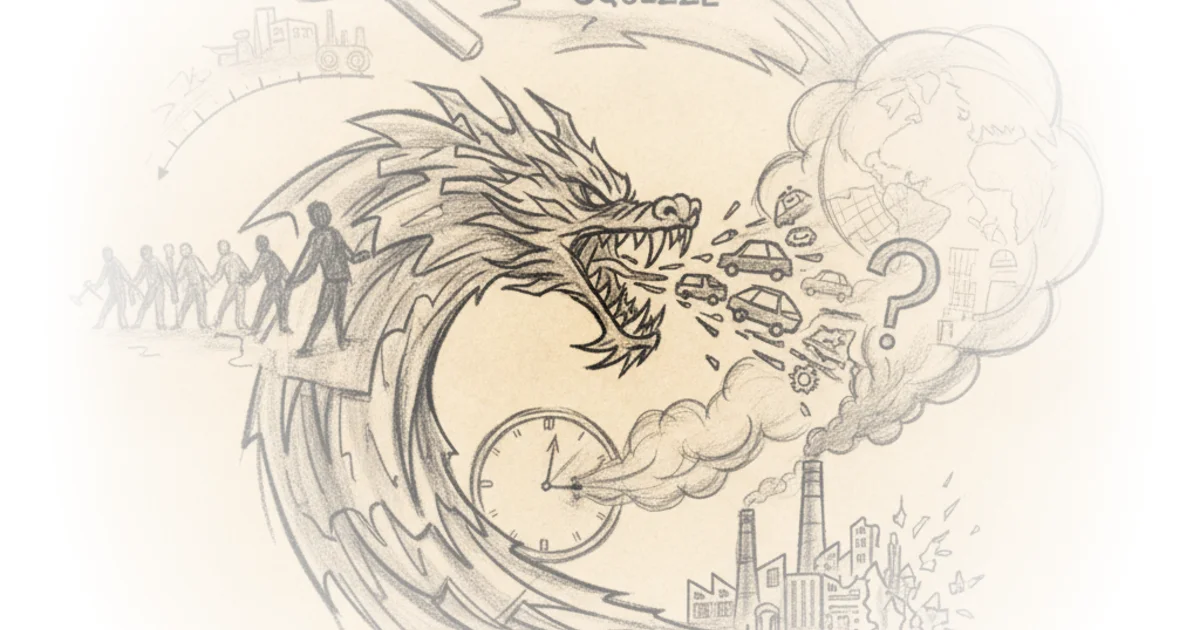
Tooze immediately challenges the premise that this sequence is a law of nature rather than a historical accident. He argues that the "squeeze" narrative is built on a counterfactual—a world that never was. The authors of the "squeeze" theory assume that a country's share of low-skill exports should match its share of the global labor force. Tooze calls this a "pleasant liberal vista of orderly global development," but notes it collapses under scrutiny. He writes, "Development paths do not follow a regular, natural sequence. As David Fishman put it aptly, 'development is not a queue'."
This framing is crucial because it shifts the blame from China's policies to the very idea of a universal development model. Tooze suggests that treating development as a single track ignores the reality that every nation's path is a unique political project. The "squeeze" theory, he argues, is "nothing short of bamboozling" because it assumes all countries are interchangeable units waiting for their turn, rather than distinct economies with different histories.
Development is not so much a process, as a project. Each such project is more or less well adjusted to its context.
The Real Story: Supply Chains and Speed
The "China squeeze" argument relies on the idea that China is artificially holding onto low-skill sectors like textiles and footwear, preventing others from competing. Tooze counters that this ignores the massive shift in what "low-skill" manufacturing actually means today. He points out that China's dominance isn't just about cheap labor; it's about the efficiency of its supply chains and the speed of its production.
"China isn't knocking out 1970s style 'cheap'. It has redefined the entire product cycle," Tooze writes. He highlights that the label of "low-skill" misses the point of modern "fast fashion," where the ability to deliver both fashion and speed is a high-level operational achievement. The argument that China is "hoarding" jobs ignores the network effects that make Chinese factories indispensable.
Critics of this view might argue that even with advanced logistics, China's state-backed industrial policies still distort the market. However, Tooze suggests that the sheer scale of China's supply chain integration makes it impossible for latecomers to simply "slot in" where China used to be. The "low-skill" sector is no longer a simple assembly line; it is a complex ecosystem that China built over decades.
As Tooze notes, "The degree of globalization which Chatterjee and Subramanian decide to conjure away in their model... obscures the point that the networks through which Chinese factories supply the world are themselves key parts of the low-skill industrialization project."
India's "Greatest Development Failure"
Perhaps the most striking part of Tooze's commentary is his pivot to India. He reveals that the "China squeeze" narrative conveniently ignores India's own stagnation. While Chatterjee and Subramanian focus on China's excess, Tooze points out that India is the real outlier. He writes, "China is far above the line, but India, almost as large in terms of population, is no less anomalous, just in the opposite direction."
Tooze draws on a recent book by Arvind Subramanian and Devesh Kapur, A Sixth of Humanity, which frames India's lack of manufacturing growth not as a result of China's unfairness, but as a domestic failure. The authors argue that India's "greatest development failure" was its inability to create formal employment for hundreds of millions of citizens. Tooze summarizes their findings: "The great divergence between China and India did not begin in 1978 with the Deng reforms—it was well underway by then."
The text details how India's early policies—neglect of agriculture, strangling of the private sector, and premature labor regulations—created a "thicket of regulation" that prevented the country from competing globally. Tooze writes, "Scarcity-inducing policies of the planning era, precocious democracy and a Gandhian aversion to size; inefficient, monopolistic supply of critical non-tradable inputs; the behemoth of government; and super-successful skill-intensive services successively undermined India's unskilled labour employment opportunities."
This reframing is powerful. Instead of seeing China as a villain blocking the path, the evidence suggests India took a different, less successful path due to its own political choices. Tooze notes that Subramanian has long argued this point, but the "China squeeze" narrative obscures it by focusing solely on China's surplus.
International trade has never been allocated according to population. A country's population gives it no natural claim to an equivalent share of global exports.
The Political Nature of Industrialization
Tooze's final blow to the "China squeeze" theory is the reminder that industrialization is always political. The idea that there is a "natural" distribution of jobs based on population is a "polemical tool" rather than an economic fact. He argues that the "China squeeze" discourse is a way to avoid confronting the difficult political realities of development in other nations.
"The naturalistic construction of a canonical path leading to a 'level' distribution of low-skilled manufacturing reveals itself to be a polemical tool," Tooze writes. He suggests that the real issue isn't China's success, but the failure of other nations to build the necessary infrastructure, education, and political stability to compete.
This perspective aligns with historical precedents like the "Flying Geese" paradigm, where nations moved in a sequence, but as Tooze notes, that sequence was never guaranteed. The "China squeeze" argument assumes a world where development is a fair game with fixed rules, but Tooze insists it is a "project" shaped by specific political decisions.
Bottom Line
Adam Tooze's critique of the "China squeeze" theory is a necessary correction to a narrative that blames China for the developmental struggles of the Global South. By exposing the "canonical path" as a myth and highlighting India's domestic policy failures, he shifts the focus from external blame to internal capacity. The strongest part of his argument is the demonstration that "low-skill" manufacturing is no longer a simple commodity but a complex, networked industry that latecomers cannot easily replicate. The biggest vulnerability, however, is whether this nuanced view can gain traction in a political climate that demands a simple villain; if the "squeeze" narrative is a convenient scapegoat, Tooze's complex historical analysis may struggle to replace it.