Laura Rozen's latest dispatch from Diplomatic cuts through the noise of daily political theater to identify a structural crisis: the United States is not an authoritarian dictatorship, but a backsliding democracy where institutions are bending under pressure. The piece's most striking claim is that in this specific environment, public opinion alone is no longer a sufficient guardrail; only public mobilization can impose the costs necessary to force institutions to function as intended. For busy readers tracking the erosion of norms, this distinction between a broken system and a bending one is the critical lens needed to understand the current moment.
The Mechanics of Backsliding
Rozen anchors her analysis in the work of Hardy Merriman, president of the International Center on Nonviolent Conflict, who argues that the assumption that "public opinion would be a guardrail on this kind of overreach" is no longer valid in a backsliding democracy. Instead, Rozen highlights Merriman's assertion that "mobilization shows intensity, right? And it also has the capacity to impose costs." This is a vital reframing. It suggests that passive disapproval is useless; the ecosystem supporting the administration—from contractors to enablers—must be targeted by active, organized pressure.
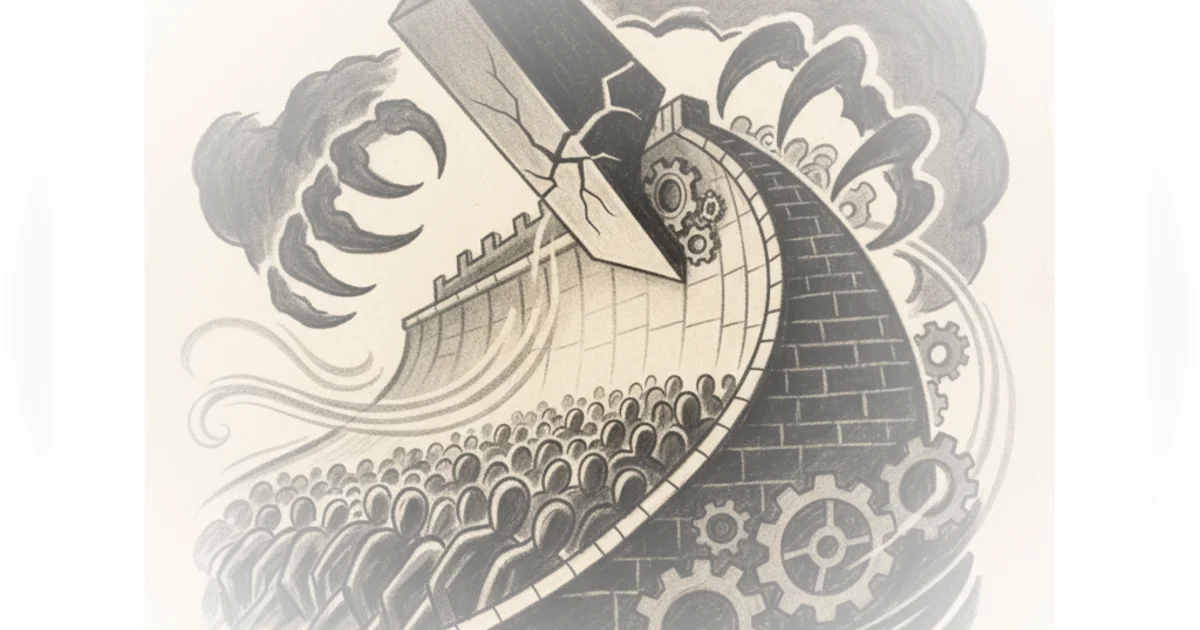
The argument posits that without this countervailing force, the default behavior of an administration seeking to consolidate power is to bend every available institution. Rozen notes that while institutions like elections and courts still exist, they are not self-correcting. "We need to use as much as possible the institutional options available to us," she writes, but adds the crucial caveat that "we need to also develop popular pressure so that the institutions function the way they should." This dual approach—using the law while simultaneously building outside pressure—is the only path the article suggests to prevent the slide into competitive authoritarianism.
Critics might argue that relying on mass mobilization is an unpredictable and slow strategy compared to immediate legal injunctions. However, the text suggests that legal victories without popular backing are fragile, as institutions will eventually succumb to political pressure if the public remains passive.
In a backsliding democracy, though, it's really public mobilization. That's the guardrail.
The Military and the Constitution
The piece shifts to the human and institutional cost of these dynamics through the lens of Colonel Doug Krugman, a 24-year Marine Corps veteran who resigned. Rozen presents Krugman's decision not as a partisan stunt, but as a constitutional imperative. "I could not swear without reservation to follow a commander in chief who seemed so willing to disregard the Constitution," Krugman wrote, a sentiment that Rozen uses to illustrate the deepening fracture within the military's chain of command.
The commentary details how the executive branch's disregard for legal limits creates impossible situations for commanders. Rozen describes orders that put National Guard units "between competing orders with no clear answer," citing a federal judge's intervention regarding the 10th Amendment. The text points out that when a leader describes a city as a "war zone" based on a "fantastical" belief that a few blocks of protest could "obliterate" a city of four million, the credibility of the command structure erodes. "Every dubious basis he gives for an order creates more room for doubt," Rozen paraphrases, highlighting the risk to military cohesion.
This section is particularly potent because it moves beyond abstract policy to the lived reality of those sworn to defend the Constitution. It forces the reader to confront the fact that when the executive branch tests the limits of the law, the first casualties are often the integrity of the institutions meant to check that power.
The Playbook of Confrontation
Rozen then weaves in the perspective of veteran intelligence reporter Walter Pincus and Senator Amy Klobuchar (referred to by her last name in the source text as Slotkin, though the text attributes the quote to Sen. Slotkin, likely referring to Amy Klobuchar or a specific senator named Slotkin in the context of the source material provided). The article cites Senator Slotkin's warning that the administration is "looking for an excuse to send the U.S. military into our streets." Rozen frames this not as a political attack, but as a recognition of a "well-worn authoritarian playbook."
The coverage details how Democratic Senators, including Dick Durbin and Jeff Merkley, have engaged with Northern Command leadership to stress that the nation's military must comply with the Posse Comitatus Act. Senator Merkley's observation that the administration wants to use American cities as "training grounds" is presented as a profound disturbance to the civil-military relationship. Rozen writes, "The Caribbean activities are but a sideshow to what the Trump administration has quietly underway in this country," emphasizing that the domestic deployment of troops is the real story.
A counterargument worth considering is whether these deployments are truly about authoritarian control or a genuine, albeit controversial, response to local law enforcement requests. However, the article's evidence regarding the lack of apparent emergency and the judicial interventions suggests the primary driver is political posturing rather than public safety.
The Path Forward
The final section synthesizes the views of former US intelligence analysts from the organization "Steady State," who warn that the US is on a trajectory toward "competitive authoritarianism." Rozen explains that this is a system where "elections, courts, and other democratic institutions persist in form, but are systematically manipulated to entrench executive control." The assessment concludes that without organized resistance, the US risks losing its credibility as a global model of democracy.
The proposed solution is a multi-pronged approach: peaceful protest, voting, and media vigilance. Oliver John, a retired diplomat and co-author of the assessment, urges citizens to "get out and campaign for candidates that you view as supporting the rule of law," regardless of party. Rozen emphasizes the need to cut through "sane-washing and 'both sides-isms'" and to highlight when actions are legally questionable. The piece closes with Governor Tim Walz's reminder that the White House often tries to make neighbors hate each other, but "Your neighbor isn't the problem. The White House is."
This framing is effective because it redirects anger away from the polarization of the populace and toward the source of the division. It challenges the reader to see the conflict not as a culture war between Americans, but as a struggle between the public and an executive branch seeking to bypass the law.
The public outpouring against Donald Trump in terms of peaceful protest is critical. It gets it into people's minds.
Bottom Line
Rozen's strongest contribution is the clear distinction that in a backsliding democracy, institutions will not save themselves without the active, costly pressure of a mobilized public. The piece's greatest vulnerability lies in its reliance on the assumption that the public can organize effectively enough to counter the resources of the executive branch. The reader should watch for whether the proposed "localized responses" can coalesce into the national scale pressure the article deems necessary to stop the slide.