Heather Cox Richardson delivers a chilling diagnosis of a presidency operating without guardrails, using the farcical failure of a gold-plated smartphone as a metaphor for an administration that has lost its grip on reality. The piece is notable not for its inventory of scandals, but for its specific argument that the collapse of institutional checks has left the executive branch vulnerable to its own worst impulses, with catastrophic consequences for the economy and global stability.
The Illusion of Dominance
Richardson opens by dissecting the "Trump Mobile" venture, a venture that promised a device "proudly designed and built in the United States" but ultimately delivered nothing but confusion and a non-binding deposit. She notes how the marketing shifted from "MADE IN THE USA" to the vague "designed with American values in mind" once the fantasy of domestic manufacturing proved impossible. This isn't just a story about a bad product; it is a microcosm of a broader strategy where image supersedes substance.
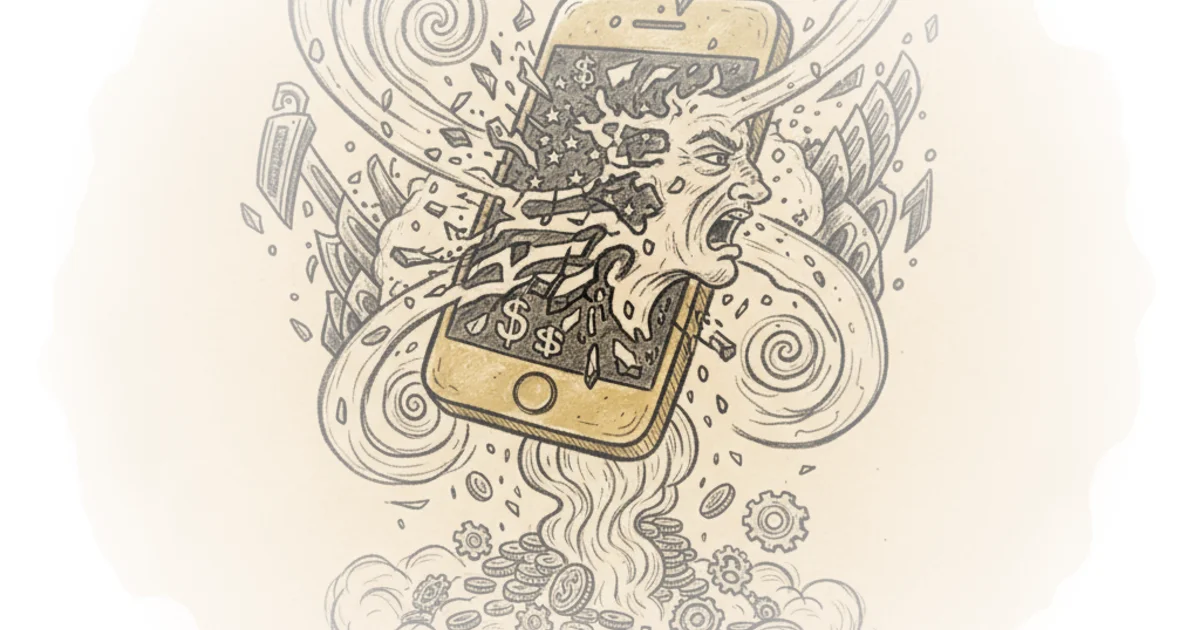
The author draws a sharp historical parallel to the first term, where figures like former National Economic Council director Gary Cohn would physically remove executive orders from the president's desk to prevent economic self-sabotage. Richardson writes, "In Trump's second term, though, those people who curbed his worst impulses have been replaced with yes-men, and there is no one to protect him from the fallout." This observation is the piece's analytical anchor. Without the friction provided by experienced officials—much like the role Allen Weisselberg once played in the corporate structure—the administration is now a feedback loop of its own delusions. Critics might argue that the president's base supports this unfiltered style, but Richardson suggests this lack of restraint is now a liability rather than an asset.
In Trump's second term, those people who curbed his worst impulses have been replaced with yes-men, and there is no one to protect him from the fallout.
The Court and the War Machine
The commentary shifts to the administration's increasingly erratic relationship with the judiciary and foreign policy. Richardson highlights the president's bizarre demand that the Supreme Court explicitly state in its ruling on tariffs that "Any money paid to the United States of America does not have to be paid back." When the Court declined, the reaction was not to accept the legal reality but to threaten the institution itself. Richardson quotes the president's warning to his own appointees: "They have to do the right thing, but it's really OK for them to be loyal to the person that appointed them... What is the reason for this?"
This section underscores a dangerous erosion of the separation of powers. The administration is treating the judiciary not as a co-equal branch but as a subordinate entity that failed to deliver a specific outcome. Richardson notes the president's threat to "PACK THE COURT" if they do not align with his views on birthright citizenship, framing the judiciary as an obstacle to his economic agenda rather than a constitutional check.
The foreign policy section is even more grave. Richardson details how the administration's war on Iran, intended to be a swift victory, has instead mired the nation in a conflict that has strengthened regional adversaries. She cites neoconservative scholar Robert Kagan, who ranks the Iran debacle as worse than Vietnam, noting that the conflict has revealed an America that is "substantially diminished." The human cost is implicit but heavy; the war has drained weapons stocks and destabilized the Strait of Hormuz, a critical global choke point.
Richardson points out the administration's refusal to seek congressional authorization under the 1973 War Powers Act, relying instead on a tenuous ceasefire that the president himself describes as being on "massive life support." The economic fallout is immediate: gas prices have jumped more than 50%, and the national debt has surged past $39 trillion. The administration's response—suspending the federal gas tax without a funding mechanism—demonstrates a disregard for fiscal reality that mirrors the Trump Mobile scam.
The Propaganda Machine
Perhaps the most disturbing element Richardson identifies is the administration's reliance on artificial intelligence to manufacture a reality that contradicts the facts on the ground. She describes a social media feed filled with AI-generated images of Iranian ships sinking and the president standing triumphantly on a bridge, alongside fabricated claims about renovating the Lincoln Memorial reflecting pool for $2 million.
"Trump is putting words in our mouths," Richardson observes, referencing the signs appearing in Washington, D.C., that thank the president for construction that hasn't happened. This manufactured consensus is a desperate attempt to maintain an image of dominance while the administration faces rising farm bankruptcies, corporate failures, and a crumbling international reputation. The administration is not just lying; it is using technology to create a parallel universe where the failures of the Iran war and the economic chaos of tariffs never occurred.
Anyone can see that "just a few weeks of war with a second-rank power" drastically reduced American weapons stocks, opening the way for aggression from China or Russia.
Bottom Line
Richardson's most compelling argument is that the removal of institutional guardrails has not made the administration more efficient, but rather more fragile and prone to self-destruction. The strongest part of the piece is the connection between the trivial failure of the smartphone and the catastrophic failure of foreign policy: both stem from a leadership style that prioritizes the projection of power over the mechanics of governance. The biggest vulnerability in this trajectory is the administration's inability to pivot when reality intrudes, leaving the nation to bear the cost of a leader who is increasingly detached from the world he governs.