Dylan Patel doesn't just track chip shipments; he maps the invisible fault lines of a global technological cold war. In this analysis, the most startling claim isn't that China is building its own AI hardware, but that the United States' own export controls may have inadvertently created a massive, temporary reservoir of foreign-made silicon that will keep Beijing's AI ambitions alive for another two years. This is not a story of inevitable American victory, but of a complex, lagging regulatory game where stockpiles and loopholes currently outweigh policy intent.
The Strategic Reservoir
Patel frames the current moment as a precarious equilibrium where compute is the "lifeblood of AI" and the United States holds a commanding lead with "more than 70% of the worlds deployed FLOPs." Yet, he argues that the administration's strategy of "Limiting your competitor nation state from compute, which will limit them from intelligence" has produced an ironic side effect: it forced Chinese firms to adapt and stockpile. The core of Patel's argument rests on the existence of a "Die Bank"—a massive inventory of logic chips fabricated by TSMC before restrictions fully took hold.
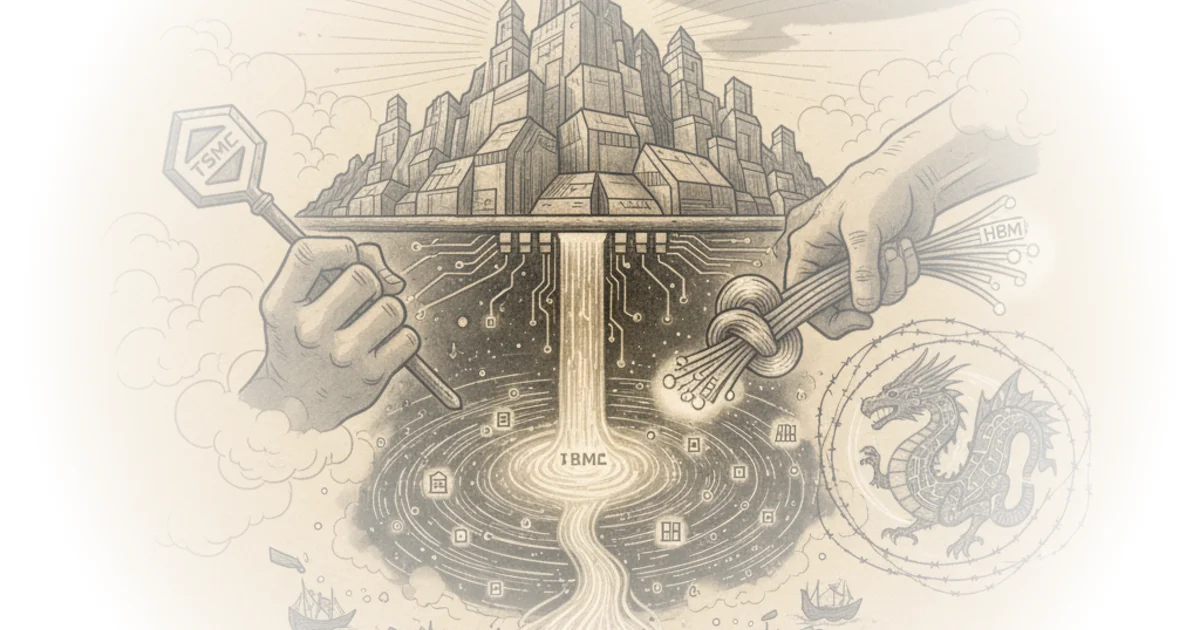
He writes, "It is specifically this 'Die Bank' of foreign chips from TSMC that gets them through 2024 and 2025. Without this Die Bank, Huawei's Ascend production numbers would be much lower." This evidence is crucial because it shifts the narrative from China's immediate inability to produce to a calculated delay in their domestic manufacturing ramp. Patel suggests that the administration's timeline for enforcement was too predictable, allowing for a rush to build inventory. "The U.S. routinely exempts Japanese and Dutch companies from its equipment export controls... The problem, however, is that when new export controls come out, Japan and the Netherlands do not immediately follow." This lag creates a window where Chinese entities can "rush order years' worth of equipment to stockpile."
Critics might argue that focusing on stockpiles underestimates the long-term degradation of Chinese capabilities once these reserves are exhausted. However, Patel's data on the sheer volume of these reserves suggests the timeline for exhaustion is further out than many policymakers assume.
"Beijing plans for the long term and knows it must secure its own domestic compute destiny."
The Vertical Integration Gamble
The commentary then pivots to Huawei, which Patel identifies as the central actor in China's quest for sovereignty. He notes that "China loves national champions... and in it's characteristic capitalism, tends to funnel resources to a few national champions." Today, that champion is Huawei, which is attempting to replicate the entire semiconductor stack, from design to fabrication tools. Patel highlights the scale of this ambition, noting that Huawei has become the "4th largest WFE customer globally in two years" and is investing billions to build its own fabs.
The author argues that this vertical integration is a direct response to the "irony" of the situation: "In the 2010s China kicked out Google to enforce its Great Firewall and foster its domestic industry, this time the US government is withholding hardware technology so they cannot seize the lead in AI." Patel's analysis of Huawei's production numbers is particularly compelling. He estimates that Huawei shipped 507,000 Ascend units in 2024 and expects that number to rise to 805,000 this year, largely fueled by the TSMC inventory. He asserts that "SMIC, however, now has more than enough capacity to produce meaningful volumes of chips," suggesting that the domestic foundry is no longer the primary bottleneck.
This framing is effective because it moves beyond the binary of "can they make chips?" to "how many can they make and for how long?" Patel's data suggests that even with lower yields than Western competitors, the sheer volume of capacity allocation at SMIC could support millions of chips annually. "If 100% of capacity was allocated to Ascend die, their production capability would be in the tens of millions per year." This challenges the prevailing narrative that sanctions have effectively halted China's AI progress.
The Memory Bottleneck
Despite the optimism around logic chips, Patel identifies a critical vulnerability in China's supply chain: High Bandwidth Memory (HBM). He argues that while logic die production is ramping, memory remains the "key constraint." The analysis details how Samsung, anticipating the restrictions, exported a staggering amount of HBM to China in the final quarter before enforcement. "Samsung exported as much as possible to China in that one quarter... This comprises the majority of China's HBM."
Patel writes, "We expect that China will be bottlenecked by HBM by the end of the year as they run out of foreign HBM." This is a pivotal distinction. The administration's recent "Action Plan" to tighten controls on semiconductor subsystems is noted as a positive step, but Patel points out that "many subsystem firms that supply western players such as VAT Group in countries like Switzerland without controls will not be stopped from shipping critical chambers to China." The argument here is that while the logic chip bottleneck may be solved through domestic production and stockpiles, the memory bottleneck is a harder nut to crack without tighter international coordination, particularly with South Korea.
A counterargument worth considering is whether China's domestic memory manufacturers, such as CXMT, can scale fast enough to fill the gap before the foreign stockpile runs dry. Patel acknowledges this risk but maintains that the current reliance on foreign HBM is a significant strategic weakness.
"HBM production is the bottleneck. China does too, which is why they have asked US officials to relax controls on HBM as part of the recent trade talks."
Bottom Line
Patel's strongest contribution is his granular dissection of the "Die Bank," revealing that the impact of US sanctions is not immediate but deferred, creating a dangerous illusion of containment while China builds its own infrastructure. The argument's greatest vulnerability lies in its reliance on yield improvements at SMIC and the assumption that domestic HBM production cannot scale quickly enough to replace the lost foreign supply. Readers should watch for the next six months: if the TSMC inventory depletes before Huawei's domestic memory capabilities mature, the bottleneck will shift from a manageable constraint to a critical failure point for China's AI ambitions.