In an era where faith is often reduced to a set of checkable doctrines or a political platform, Anarchierkegaard offers a jarring corrective: the moment you try to systematize Christianity, you destroy it. This piece argues that the very tools of modern philosophy—logic, propositions, and totalizing systems—are not just inadequate for understanding God, but are actively hostile to the nature of faith itself. It is a provocative challenge to the intellectual class, suggesting that their greatest strength, the ability to build coherent worldviews, is actually their spiritual fatal flaw.
The Failure of the System
Anarchierkegaard begins by dismantling the assumption that faith can be treated as a philosophical theory. The author writes, "When Christianity is held as a theory, faith then becomes exposed as nihilism." This is a stark opening claim that immediately separates the piece from standard theological apologetics. The argument proceeds to contrast the philosopher's reliance on "approximation-knowledge" with the believer's encounter with "the absurd." The author suggests that while scientists accept the limits of their methods, philosophers often arrogantly assume they can encompass the divine within their logical frameworks.
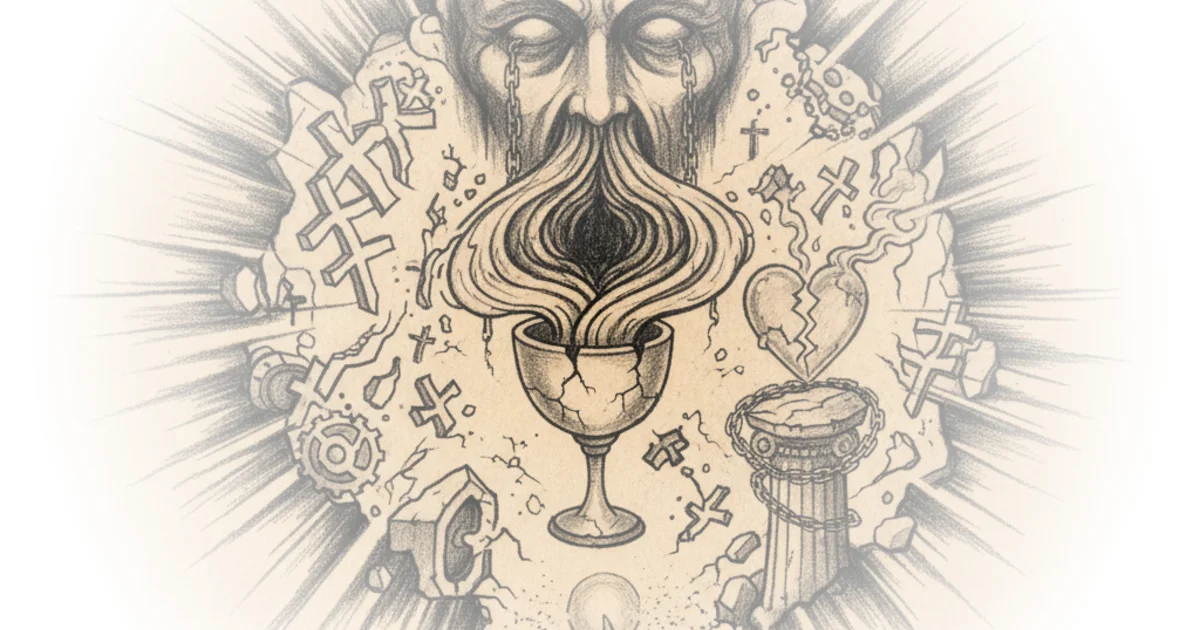
The piece takes aim at Georg Wilhelm Friedrich Hegel as the primary example of this overreach. Anarchierkegaard describes Hegel's attempt to create a "compendium of everything" as a house built on sand. The author argues that by trying to make God compatible with immanent metaphysics, Hegel effectively collapses the divine into human thought. "A thinker erects a huge building, a system, one that encompasses the whole of life and world-history," Anarchierkegaard quotes, only to reveal the hypocrisy: "if one then turns attention to his personal life one discovers to one's astonishment the appalling and ludicrous fact that he himself does not live in this huge, high-vaulted palace, but in a store-house next door."
This critique lands with significant force because it targets the disconnect between intellectual abstraction and lived reality. The author posits that Hegel's system reduces God to a "gentlemanly play of approximation-facts," stripping away the "Wholly Other" nature of the divine. Critics might argue that this is a strawman of Hegel's actual intent, which was to show how the divine manifests through history rather than being separate from it. However, the author's point remains potent: any system that claims to fully explain the relationship between God and man inevitably reduces the mystery of faith to a manageable, and therefore lesser, concept.
Philosophy and Christianity can never be united, for if I'm to hold fast to what is one of the most essential features of Christianity, redemption, then of course for it really to amount to anything it must extend to the whole man.
The Resistance of Subjectivity
Moving beyond the critique of systems, Anarchierkegaard pivots to the necessity of subjectivity. The author argues that the "riddle of life" cannot be solved through objective proof or propositional wrestling. Instead, faith requires a "qualitative change" in the individual, a surrender of the self to the "Wholly Other." The text describes this not as a logical progression but as a "leap" that defies standard causal patterns.
The author emphasizes that this leap is not a retreat from reality, but a deeper engagement with it. "Reality is itself incessantly fractured between the actual and the possible," Anarchierkegaard writes, suggesting that the space between what is and what could be is where the spiritual life actually happens. This framing challenges the modern demand for certainty and empirical verification. The author asserts that Christ stands against the "demand of the times" which seeks to turn life into an object of study.
This section is particularly effective in its rejection of the "lazy half-thinker" who treats their own existence as a problem to be solved rather than a mystery to be lived. The author notes that the individual must find the "God-relationship" subjectively, a move that requires the "surrender of the self to the 'Wholly Other'." A counterargument worth considering is whether this radical subjectivity risks isolating the believer from the communal aspects of faith and the ethical responsibilities that arise from shared human experience. Yet, the author's insistence on the "Knight of Faith" who must "surrender all—self and other—to the Lord God" suggests that true community is only possible after this individual surrender.
The Moment of Truth
The piece concludes by framing the believer not as a system-builder, but as a sojourner. Anarchierkegaard writes, "It is by no means the case that the fiction is a lens we must use to enhance our sight... On the contrary, the manifestatory expression-through-possibility belongs wholly within ontology." This is a dense but crucial point: faith is not a tool to interpret the world, but the very condition of the world's reality for the believer.
The author's final image is one of a fractured but invigorated self, caught between actuality and possibility, finding rest only in the "yes! of faithfulness." This is a call to abandon the safety of intellectual certainty for the risk of divine love. The text argues that the "fullness of time" rips through our attempts to categorize and control, revealing a God who "weeps with His creation" rather than a God who fits into a syllogism.
The Knight of Faith understands that to receive everything that one must first surrender all—self and other—to the Lord God.
Bottom Line
Anarchierkegaard's most compelling argument is that the pursuit of a complete philosophical system is not just a distraction from faith, but an active obstruction to it. The piece's greatest vulnerability lies in its potential to dismiss all rational theological inquiry as futile, yet its core message—that faith is a subjective, lived reality rather than an objective dataset—remains a powerful corrective to modern intellectualism. Readers should watch for how this radical subjectivity translates into concrete ethical action in a world that demands systemic solutions.