Matt O'Dowd delivers a rare glimpse into a phenomenon that sounds like science fiction but is now backed by experimental data: the ability to move energy across space without it traversing the gap between points. This isn't about building warp drives tomorrow, but rather a fundamental shift in how we understand the quantum vacuum—not as empty space, but as a resource we can tap into using information. For busy minds tracking the frontier of physics, the confirmation of quantum energy teleportation (QET) in 2022 and 2023 marks a pivotal moment where theoretical loopholes become laboratory reality.
The Vacuum is Not Empty
O'Dowd immediately dismantles the classical intuition of space as a void. He writes, "The vacuum of space is a chaotic sea of quantum fluctuations." This framing is crucial because it sets the stage for the entire argument: if the vacuum is active, it can be interacted with. The author explains that while energy cannot be created from nothing, the universe allows for a peculiar exchange where energy is drawn from one location and extracted from another, provided the information about the measurement travels at light speed or slower.
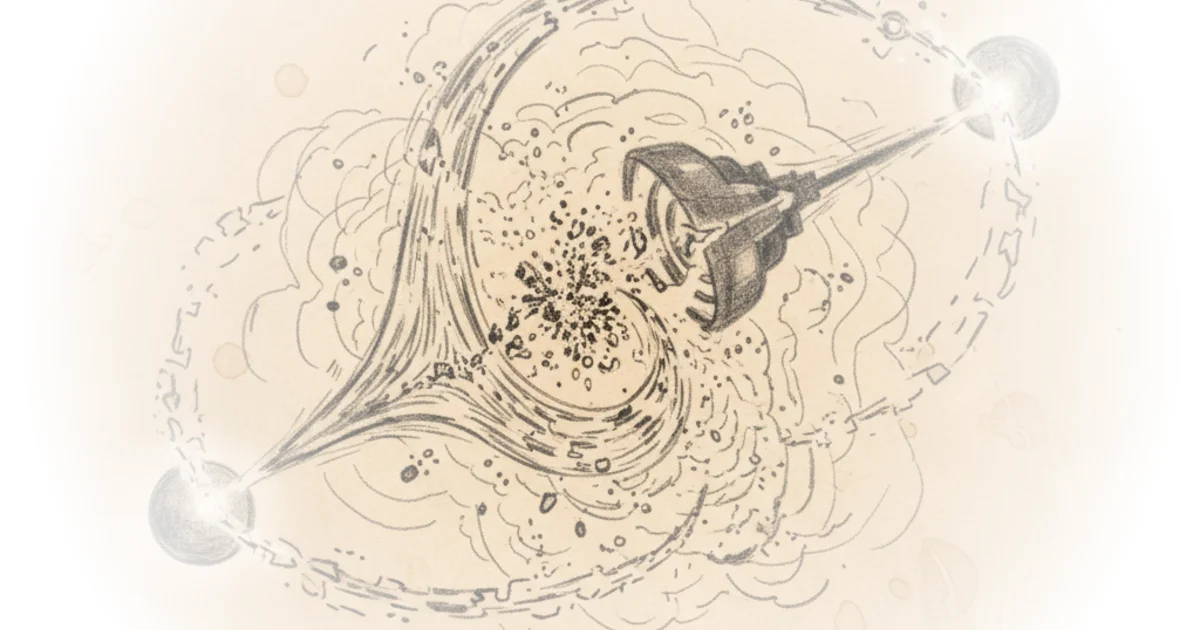
The piece leans heavily on the concept of entanglement to explain this. O'Dowd illustrates this with a thought experiment involving two parties, Alice and Bob, sharing entangled particles. "The only thing that's really known about the spins of A and B are that they're opposites," he notes. By measuring her particle, Alice instantly influences the state of Bob's, but crucially, this doesn't allow for faster-than-light communication. The real magic happens when this correlation is used to extract energy. As O'Dowd puts it, "It turns out that it's okay to draw energy from the vacuum of space as long as we put energy into the vacuum somewhere else."
This is where the commentary becomes most compelling. O'Dowd argues that the act of measurement itself injects energy into the system, disturbing the vacuum's balance. Bob then uses the information Alice sends him to tune his own measurement, allowing him to extract that injected energy. It feels like teleportation because the energy appears at Bob's location without ever physically traveling through the space between them. "Energy injected into the quantum vacuum at one location is extracted at a different location without ever taking the form of real particles," O'Dowd writes. This reframing of energy conservation—where information acts as the currency for energy transfer—is a sophisticated way to explain a counterintuitive quantum effect.
Energy injected into the quantum vacuum at one location is extracted at a different location without ever taking the form of real particles.
Maxwell's Demon in the Quantum Realm
To make this abstract concept digestible, O'Dowd draws a parallel to a famous thought experiment. He compares QET to "Maxwell's demon," a hypothetical agent that sorts gas particles to create a temperature gradient and extract work. In the quantum version, the "demon" is the information Alice sends to Bob. O'Dowd clarifies that this doesn't violate thermodynamics: "The demon had to expend energy to do the computations required to sort the gas... and expend at least as much energy as was extracted." The innovation here is that QET allows this sorting to happen remotely via the vacuum's inherent entanglement, a feat impossible with classical gas.
Critics might note that the energy scales involved are currently infinitesimal, raising questions about practical utility beyond fundamental research. However, O'Dowd anticipates this by highlighting the experimental validation. He details how a team in 2022 used carbon atoms in a molecule of trichloroethylene to demonstrate the effect, followed by a 2023 confirmation using IBM's superconducting quantum computer. "The team found that the correct measurement process enabled energy to be deposited in one cubit and then extracted from its entangled partner despite the latter being in the lowest energy state," he reports. This empirical backing moves the discussion from pure theory to observable fact.
Implications for the Future of Physics
The final stretch of the piece connects these microscopic experiments to the grandest scales of cosmology. O'Dowd points out that QET generates negative energy density, a prerequisite for exotic general relativity solutions like wormholes and warp drives. "This is the type of energy density required in general relativity to produce exotic effects like wormholes and warp drives," he writes. While he cautions that we are far from building a starship, the ability to manipulate negative energy density is a significant step toward understanding the fabric of spacetime.
The author's choice to focus on the mechanism rather than the fantasy keeps the piece grounded. He acknowledges the limitations: "The amount of energy transferred in these experiments is very small... The latter will also have a very limited range." Yet, the potential for applications in quantum computing and nanodevices remains high. By treating the vacuum as a network of entangled fields rather than a passive backdrop, O'Dowd suggests a future where information and energy are even more deeply intertwined than previously thought.
Bottom Line
Matt O'Dowd succeeds in demystifying a complex quantum protocol by anchoring it in experimental reality and clear analogies, proving that energy teleportation is no longer just a theoretical curiosity. The piece's greatest strength is its refusal to oversell the technology while still highlighting its profound implications for our understanding of the universe's fundamental rules. The biggest vulnerability remains the sheer scale of the energy involved, which keeps this firmly in the realm of high-tech physics rather than near-future engineering, but the path forward for quantum information science is now undeniably clearer.