Cory Doctorow doesn't just review a history book; he dissects the very machinery of how we construct the past to serve the present. In his commentary on Ada Palmer's Inventing the Renaissance, he argues that the "Renaissance" was not a sudden, organic rebirth, but a deliberate political invention used to legitimize power—a lesson that resonates with terrifying clarity in our current era of information control and self-censorship.
The Architecture of History
Doctorow frames Palmer's work not as a standard chronicle of dates and battles, but as a masterclass in "historiography"—the study of how histories get written and rewritten. He posits that the central thesis of Palmer's magnum opus is that the idea of a "Renaissance" was a tool, "created and demolished, for centuries and centuries, including during the centuries when the Renaissance was actually underway." This is a crucial distinction for the busy reader: it suggests that our understanding of any "golden age" is often a retrospective fabrication designed to justify current hierarchies.
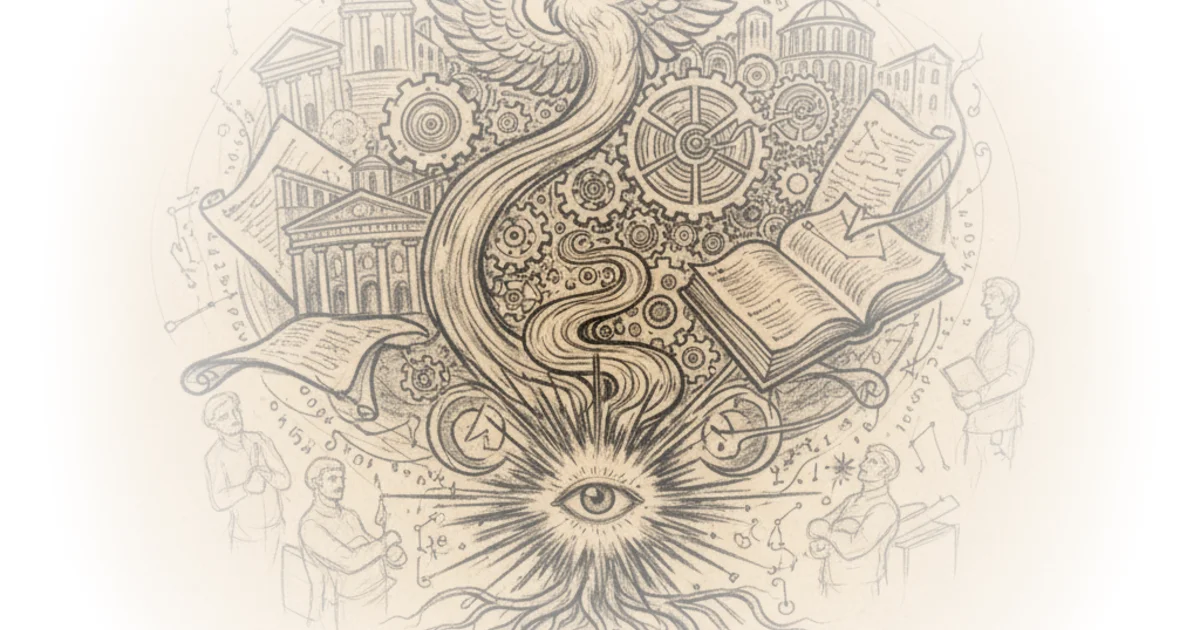
The author highlights Palmer's unique pedagogical approach at the University of Chicago to illustrate this point. She runs a weeks-long live-action role-playing game where students reenact the election of a Medici Pope, complete with period costumes and intricate character biographies. Doctorow calls this exercise "nothing short of genius," noting that it forces students to confront the tension between "great historical forces" and individual agency.
"The point of this exercise is to expose the students to the power and limits of both 'great historical forces' and the human agency that every one of us has within the envelope defined by those forces."
This framing is particularly effective because it moves history from a static list of facts to a dynamic simulation of human choice. It reminds us that while we cannot always stop the "floodwaters" of history, we retain the power to channel them. Critics might argue that such role-playing games risk trivializing the brutality of the era, yet Doctorow suggests the opposite: by making the stakes personal, the exercise reveals the genuine weight of historical consequence.
The Myth of the Single Narrative
The commentary shifts to the structural brilliance of Palmer's book, which avoids a linear narrative in favor of a multi-perspective approach. Doctorow draws a parallel between Palmer's method and the work of science fiction author Jo Walton, whose novels often explore the impossibility of a single, objective truth. He notes that Palmer, like Walton, understands that "the omnipotent third person narrator is a lie."
"There will always be multiple histories, overlapping each other, warring with one another, supplanting each other, or being revived as 'lost' histories that reveal a truth that 'they' have buried."
This is the book's most potent argument for the modern reader: history is not a monolith, but a battlefield of competing narratives. Doctorow emphasizes that Palmer's account of the Renaissance highlights "contradictions" that "can't ever be resolved, only acknowledged and understood." This approach dismantles the comforting illusion that there is one "correct" version of the past, a concept that is increasingly vital as information ecosystems fracture.
"You could not ask for a better account of why there is not, and can never be, a single, canonical 'history' of an era or a moment."
The argument gains further depth when Doctorow connects this historical insight to the mechanics of censorship. He points out that Palmer's research reveals that the majority of censorship is not the result of overt state edicts, but of "self-censorship."
"The Inquisition could only intervene in a tiny minority of cases of prohibited thought and word, and they had to rely on key people — printers, for example — anticipating the Inquisitors' tastes and limiting their speech without an Inquisitorial edict."
Doctorow explicitly links this historical mechanism to contemporary dynamics, noting the chilling effect of anticipating the preferences of powerful institutions. While he briefly alludes to the current administration's rhetoric regarding "woke" culture, the focus remains on the structural reality: when gatekeepers (whether medieval printers or modern tech platforms) preemptively silence content to avoid trouble, the result is a distorted reality. This is a vital insight for anyone navigating the digital age, where the "Inquisitor" is often an algorithm or a corporate policy.
The Living Connection
Doctorow weaves in the broader intellectual community, noting how Palmer and Walton influence each other's work. He mentions Walton's upcoming novel, Everybody's Perfect, which utilizes Palmer's technique of "telling a story from many viewpoint characters, each of whom perceives the events so differently that their versions can't really be reconciled."
"It is a wonderful living example of how intellectual and creative movements (like those that are attributed to the Renaissance) feed one another."
This observation underscores the idea that the "Renaissance" was not a solitary event but a networked phenomenon of ideas. Just as the Conciliarist movement of the 15th century attempted to limit papal power through collective governance, or the Pazzi conspiracy of 1478 demonstrated the fragility of Medici dominance, Palmer's work shows that historical "moments" are actually complex webs of human interaction.
"Though Palmer unpacks this exercise and its meaning and results in the final part of her magnum opus, this message about forces and people is really the key to her historiography."
The commentary concludes by affirming the timeliness of Palmer's work. It is a book that connects the deep past to the immediate present, showing that the tools used to manipulate history in the 15th century are the same ones used today.
"The correspondences between the deep historical record and our current moment make Inventing the Renaissance extremely important and timely — a book hundreds of years in the making, and bang up to date."
Bottom Line
Doctorow's review succeeds by elevating a history book into a manual for understanding power, showing that the "Renaissance" was a political construct as much as a cultural one. Its greatest strength is the demonstration that self-censorship is the most effective tool of control, a lesson that applies as much to modern digital platforms as it did to medieval printing presses. The only vulnerability is the sheer density of the historical connections, which may require the reader to pause and reflect on the parallels between the Inquisition's tactics and today's information wars.