In a political landscape often defined by abstract ideological battles, Matt Yglesias offers a startlingly concrete and idiosyncratic lens: the physical built environment of Washington, D.C., under the current administration. He argues that while the executive branch's behavior is often chaotic or authoritarian, its specific interventions in the nation's capital reveal a bizarre form of urbanism that defies traditional partisan expectations. This is not a story about policy platforms, but about fountains, arches, and the strange alchemy of federal power reshaping local geography.
The Ego vs. The City
Yglesias begins his assessment with a sharp critique of the administration's most vanity-driven projects, specifically the attempt to rename the Kennedy Center. He writes, "Trying to rename the Kennedy Center the 'Trump Kennedy Center' is genuinely appalling." The author frames this not merely as a political slight but as a violation of settled norms regarding how society treats public institutions and living figures. He notes that while renaming can be a tool for justice, as seen when Yale replaced Calhoun College with Grace Hopper College to honor a computer science pioneer, self-aggrandizement is a different beast entirely.
"You can't name something after yourself — that's psychotic."
The commentary here is biting but grounded in a specific cultural logic: the distinction between honoring legacy and manufacturing it. Yglesias suggests that this move was so devoid of ideological purpose that it stands out even among other controversial executive actions. He acknowledges that some critics might argue the name on the building doesn't change the art inside, yet he counters that the act itself signals a disregard for institutional dignity.
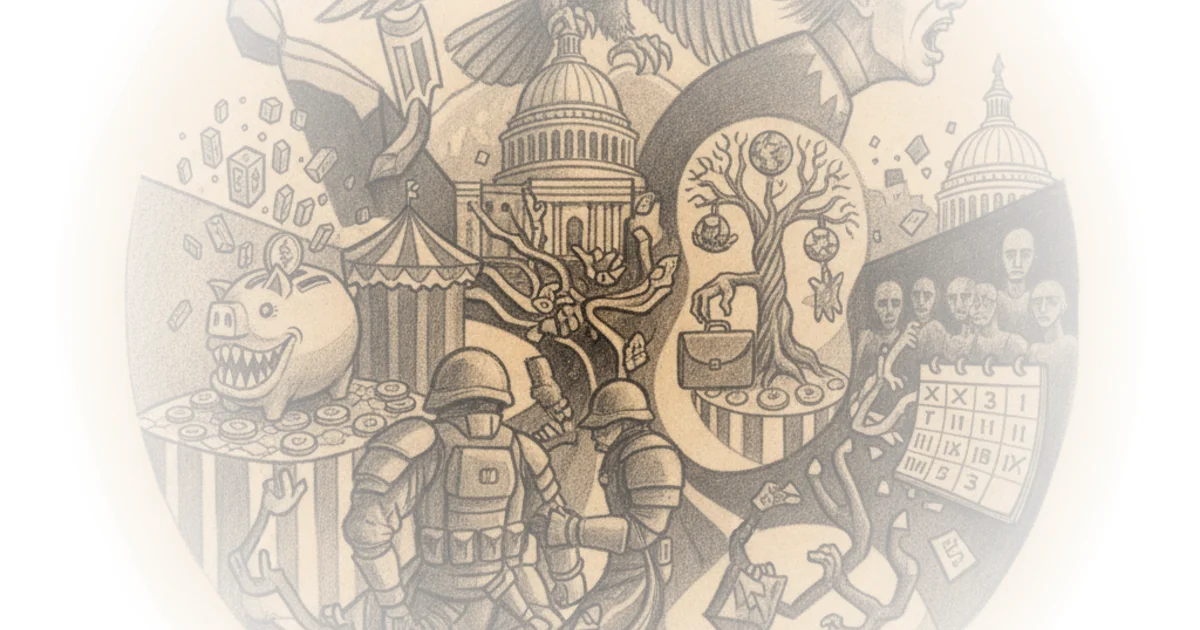
Monumental Ambitions and Practical Realities
Shifting to infrastructure, Yglesias evaluates the administration's push for a triumphal arch in Memorial Circle. He admits the basic concept has merit, noting that the original 1920s design intended columns there before aviation safety concerns intervened. However, he critiques the specific choice of an arch as culturally mismatched for America. "Every prior president was probably too busy focusing on the important parts of the job to dream up a specific monument for this location," he observes, contrasting this with the administration's focus on aesthetics over substance.
He draws a parallel to Paris, where the Axe historique features a sequence of monumental arches, suggesting the U.S. lacks the singular imperial triumph that such a structure traditionally celebrates. Yet, he finds a kernel of sense in the desire to expand the White House footprint, citing the cramped working conditions in the West Wing and the discomfort of holding events on the lawn during humid June days. He proposes a solution in the spirit of I.M. Pei's addition to the Louvre Pyramid—a modern facility that respects history while solving functional problems.
The Reflecting Pool as Political Metaphor
The piece turns to the administration's handling of the National Park Service, specifically the draining and repainting of the Reflecting Pool to address algae issues. Yglesias identifies this as a potent symbol for broader executive failures. "Trump drained the Reflecting Pool, repainted it, and then bragged that he'd solved an algae problem... only to discover that he actually didn't solve it at all." He connects this physical failure to diplomatic outcomes, noting a parallel timeline where efforts to renegotiate deals with Iran yielded no better results than previous administrations.
The author highlights the administration's tendency toward performative action followed by evasion. "He's gone off on a whole insane binge of lying about the situation, arresting people for touching the water," Yglesias writes. This behavior creates a paradox where critics focus on trivialities like algae while ignoring substantive policy failures, yet the administration itself refuses to own the failure, instead doubling down on false narratives.
The National Guard Paradox
Perhaps the most counterintuitive section of the commentary concerns the deployment of National Guard personnel in D.C. Yglesias challenges the standard progressive narrative that such deployments are inherently authoritarian or dangerous. He argues that while the tactical logic is flawed—troops patrol high-visibility areas during business hours rather than targeting high-crime zones at night—the outcome has been a reduction in petty crime.
"As a D.C. resident, if Trump wants to waste federal dollars on reducing petty theft in my neighborhood, I'm not going to object too strongly."
He cites research indicating that while the Guard lacks arrest authority and is cost-ineffective compared to local police, their visible presence correlates with declines in opportunistic property crimes. Critics might note that this justification risks normalizing the militarization of domestic spaces for political optics rather than public safety strategy. However, Yglesias maintains a pragmatic stance: the results, however inefficiently achieved, have provided tangible benefits to residents.
The Urbanist Pivot
Finally, Yglesias arrives at his most provocative claim: that despite his flaws, this administration has acted as America's first "urbanist" president. He points to the decision to redirect fee revenue from major national parks like Yosemite and the Grand Canyon to repair urban fountains in Washington, D.C. This move bypassed congressional gridlock, which had previously stalled funding for local improvements because D.C. lacks voting representation.
He notes the political irony: "I also strongly suspect that if Barack Obama or Joe Biden had taken fee revenue away from our patriotic heartland parks and used it to make my neighborhood nicer, they would have ended up impeached." Instead, Republican members of Congress remained silent while Democratic senators issued low-key complaints. Yglesias frames this as a genuine, albeit accidental, prioritization of urban infrastructure over rural recreation.
"Fundamentally, though, for all his many flaws, Trump is America's first urbanist president."
This conclusion reframes the administration's erratic behavior through a specific policy lens: a focus on dense, walkable environments and civic amenities that appeal to city dwellers. It suggests that the executive branch's engagement with the built environment has produced unexpected wins for urban residents, even if the motivation was largely ego-driven.
Bottom Line
Yglesias's argument is strongest in its refusal to dismiss the administration's actions as purely chaotic; instead, he isolates specific policy outcomes that have tangibly improved city life. The piece's greatest vulnerability lies in its willingness to separate these urbanist wins from the broader context of authoritarian overreach and democratic erosion. As the nation approaches its semiquincentennial, readers should watch whether this unique alignment of ego and urbanism can be replicated through more stable, less personality-driven governance.