Erik Hoel doesn't just curate links; he curates a mirror, holding up a fragmented reflection of a digital age that feels increasingly alien to its own creators. This snapshot of 2025 is notable not for its predictions, but for its diagnosis of a collective exhaustion—a sense that the tools we built to connect us are instead fracturing our shared reality into incompatible internets. For the busy mind seeking clarity, Hoel offers a rare synthesis of biology, philosophy, and technology that suggests our current crises are not bugs, but features of a system that has lost its moral and cognitive center.
The Biology of Behavior and the Loss of Virtue
Hoel begins by dismantling the simplistic hierarchies often used to justify social structures. He highlights Doctrix Periwinkle's challenge to the popular "lobster" analogy, noting that "evolved animal behaviors are legion, so why do we choose the examples we do to explain our own?" By pointing out that spiny lobsters form "choreographed 'queues,' 'rosettes,' and 'phalanxes' to keep each other safe" rather than fighting, Hoel uses this biological nuance to question the inevitability of human conflict. This is a sharp move; it reframes our social instincts not as fixed laws of nature, but as contingent outcomes that can be reshaped.
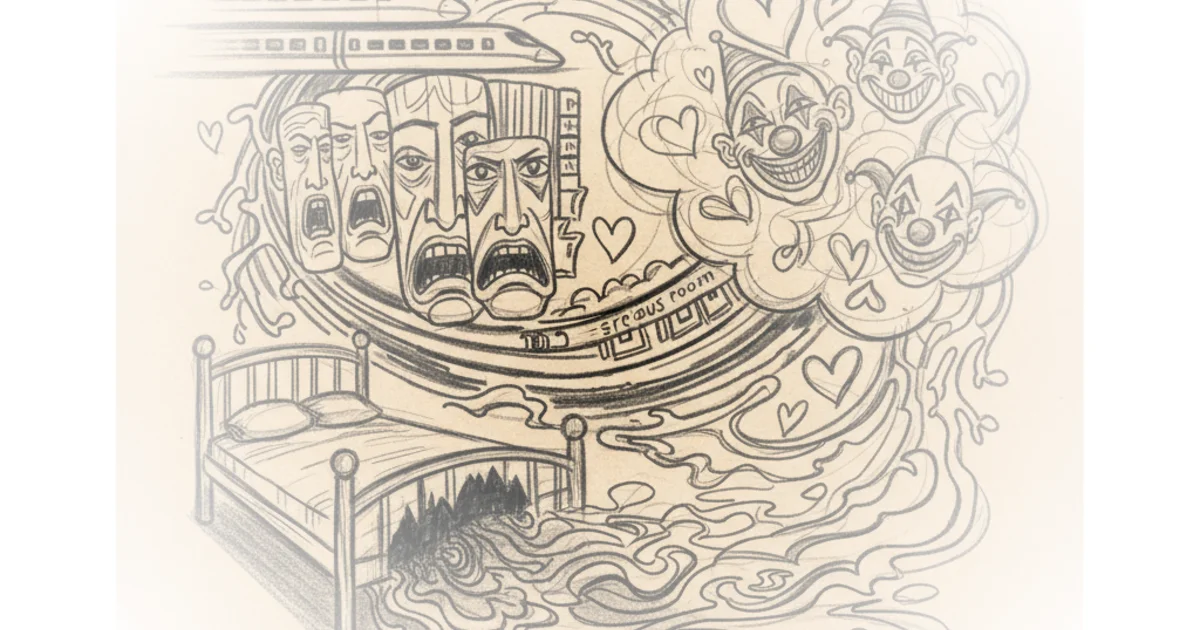
This biological skepticism sets the stage for Matt Duffy's critique of modern culture, where Hoel finds a parallel in the loss of moral clarity. Duffy argues that "fluency replaced virtue in elite culture," creating a world where "singular focus is not a human trait. It is a machine trait." Hoel presents this as a crucial distinction: we are trying to optimize humans like algorithms, ignoring that "human life is fragmented on purpose." The argument lands because it validates the feeling of burnout not as a personal failure, but as a structural mismatch between our biology and our institutions.
Singular focus is not a human trait. It is a machine trait. Human life is fragmented on purpose.
Critics might argue that demanding "visible moral seriousness" is a nostalgic fantasy in a rapidly changing economy, but Hoel's curation suggests that without it, institutional coherence is impossible. The stakes are high, as Duffy warns that we have inherited stability but lost the "clarity on virtue itself."
The AI Age and the Erosion of Understanding
The commentary shifts to the technological frontier, where Hoel explores the philosophical tremors caused by artificial intelligence. He introduces the Ho brothers' concept of the "AI-driven tragedy of the commons," where short-term gains drive the release of "half-baked AI products and AI-generated contents that produce superficial information and knowledge." This framing is vital; it moves the conversation beyond job displacement to a deeper epistemological crisis. As the authors note, we are facing a future where we "will be able to craft planes without ever understanding why birds can fly."
Hoel weaves in R.B. Griggs's exploration of Large Language Models, asking if they are "subject, an object, or some strange new thing in between." Griggs admits that while engineers see them as "nothing but data, algorithms, and matrix multiplication," they remain "perhaps the strangest object that has ever existed." This ambiguity is the core of the anxiety Hoel identifies. We are building entities that mimic human affectation so convincingly that the line between tool and agent blurs, creating a "Schrödinger's Chatbot" that is both real and fake until observed.
The danger, as Hoel presents it through Davi's "Knowledge 4.0," is that we are bypassing understanding entirely. The text warns that machine learning removes the cost of creating knowledge, potentially making "much of our intellectual activity for understanding the world" obsolete. This is a chilling prospect: a society that can generate answers but has forgotten how to ask questions. A counterargument worth considering is that this efficiency might free humans for higher-order creativity, but the pieces selected by Hoel suggest a more immediate risk of cognitive atrophy.
The Search for Meaning in a Fractured World
Amidst the technological and biological analysis, Hoel curates a profound search for meaning. He features Eva Shang's reflection on returning to Christianity, which required "abandoning worship of the world." Shang contrasts the cruelty of ancient hierarchies with the radical proposition of Christ: "that both the emperor and the cripple are made in the image of God." Hoel uses this to highlight a recurring theme in the collection—the desperate need for a moral framework that treats every individual as equal, a stark contrast to the "hierarchy of men" that dominates secular discourse.
This search for meaning extends to the personal and the sensitive. Trevy Thomas writes about the 25 percent of the population with high sensitivity, describing how a song can be "so lodged in my brain that it would wake me in the middle of the night." Hoel includes this not as a niche interest, but as a testament to the depth of human experience that often gets flattened by the "bright and clean" internet. Similarly, Joshua Skaggs's story of a foster child who chooses not to drink his father's whiskey because "Josh has been good to me" offers a quiet, powerful moment of human connection that transcends the noise of the digital age.
The collection also touches on the cultural stagnation caused by demographic shifts. Victor Kumar notes that "population decline means fewer and fewer young people," leading to "cultural stagnation and moral regress." He admits that while children are a "consolation for my own mortality," the economic and personal costs of raising them have become "enormously expensive." This creates a tragic feedback loop: the very people needed to sustain the culture are priced out of it.
The Future of Structure and Leisure
Finally, Hoel looks to the cosmos and the self for answers. Julian Gough's "Blowtorch Theory" suggests that the universe is not shaped passively by gravity but actively by black hole jets, mirroring an "evolved set of rules baked deep into its matter." This cosmic perspective serves as a metaphor for the pieces on human agency: we are not just passive victims of our environment, but active shapers of our reality. Yet, Stuart Whatley warns that "the West is bored to death," arguing that without a "leisure ethic," a society cannot distinguish between "titillation and the sublime."
The curation concludes with a look at political polarization, specifically Carlos's argument that "liberalism is the root cause of MAGA." Carlos suggests that the "liberal thought cop" in our heads creates a shadow self that explodes in toxic spaces like 4chan. This is a provocative, if controversial, take that challenges the reader to look inward at their own complicity in cultural division. It forces a reckoning with the idea that the "voice of the collective" is often a source of repression rather than liberation.
The tragedy of the commons is the problem of inner group conflicts driven by the lack of cooperation... Thus, we define the AI-driven tragedy of the commons as short-term economic/psychological gains that drive the development, launch, and use of half-baked AI products.
Bottom Line
Erik Hoel's curation succeeds by refusing to offer easy answers, instead presenting a mosaic of ideas that exposes the deep fractures in our collective consciousness. The strongest element is the seamless weaving of biological reality with digital anxiety, proving that our technological problems are often just amplified versions of our ancient human struggles. However, the collection's biggest vulnerability is its reliance on a shared sense of crisis that may alienate readers who feel the current system is working fine for them. The reader should watch for how these fragmented "internets" begin to solidify into distinct, non-communicating realities, as the pieces suggest we are already drifting apart into incompatible worlds.