Some Guy argues that the universal nightmare of modern customer service is about to be solved not by hiring more humans, but by a radical re-engineering of how artificial intelligence interacts with regulated industries. The piece's most startling claim is that we are on the verge of an era where corporate voices become auditable, non-deceptive entities that can resolve complex transactions instantly, effectively turning the customer experience from a cost center into a seamless, self-correcting utility.
The End of the Menu
The author begins by dismantling the current state of affairs with brutal efficiency, describing the familiar cycle of frustration: "You wind up having a problem with some company you do business with, you call, and then you get hung up on because none of the menu options are correct." Some Guy posits that the solution lies in a system where the language spoken is the process followed, creating a direct link between a customer's request and the execution of a task. "That voice will not be able to lie to you," the author asserts, a claim that flips the script on the current perception of AI as a hallucinating chatbot. Instead, the author envisions a "Rigid Rule Mode" where the AI is constrained by the very logic of the business process it serves.
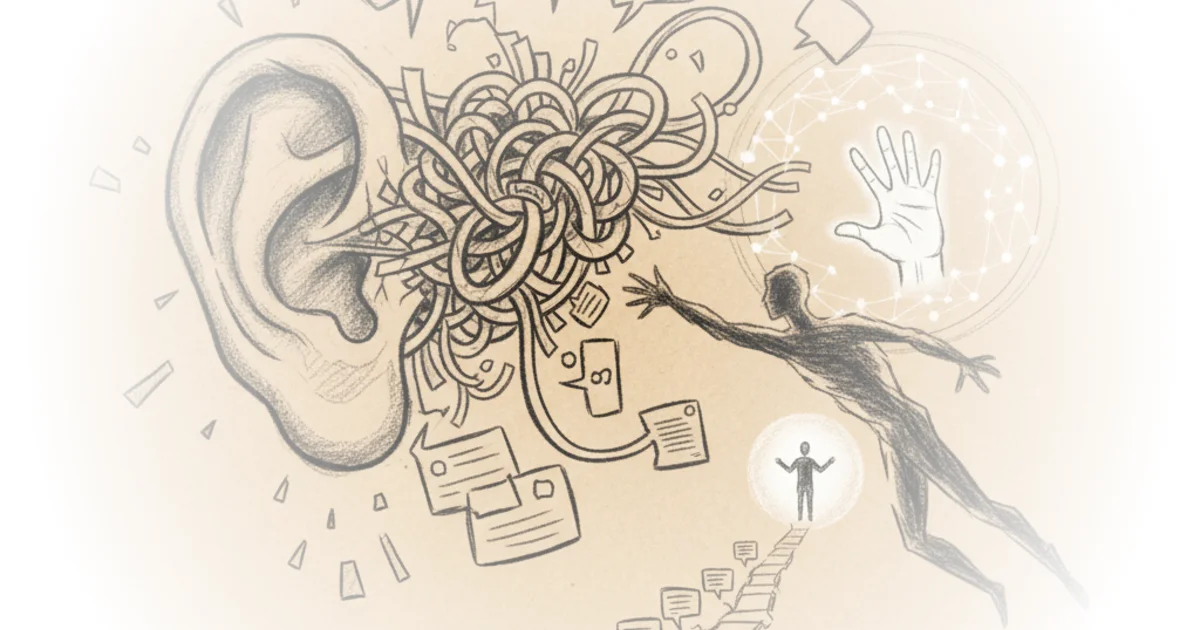
This framing is compelling because it addresses the root cause of consumer anger: the lack of agency and the feeling of being passed around. The author suggests that in this new model, human agents are no longer the primary interface but rather the safety net. "The person who helps you has a conversation, but the forms on their screen fill themselves out, and their whole job is to press one button at the end and then provide feedback on the AI model performance." While this promises efficiency, critics might note that reducing human roles to a "largely ceremonial" function could create new friction points if the AI encounters a scenario it hasn't been trained to handle, potentially leaving customers stranded in a digital void.
"Humans are always the weak spot in any process. Even the best person ever messes something up once in a few hundred or few thousand iterations."
The Audit as a Feature, Not a Bug
The piece shifts from consumer convenience to the gritty reality of high-stakes industries like banking, healthcare, and insurance. Some Guy draws on personal experience with "adversarial audits" to argue that the current reliance on human button-pushing creates unfixable data gaps. "So much weird stuff can happen when people are pressing buttons and moving through windows," the author writes, highlighting how timing errors and missed steps can lead to catastrophic failures in regulated environments. The proposed solution is a system where "utterance to transaction reporting" is absolute, ensuring that every request is recoverable and traceable.
The author's background in "fallout reporting and audit-ready system design" lends weight to the argument that this is not just a technological upgrade but a compliance necessity. By making the system "auditable, trackable, and consistent," the author suggests that corporations can finally meet the impossible standards of regulators without the current overhead of legal review for every minor interaction. "If anyone finds out that you are just going to shrug off an event that happens to one in one-hundred thousand customers, literal hell will descend upon you," Some Guy warns, illustrating the high stakes that drive the need for this technology. This perspective is vital, as it moves the conversation beyond "cool tech" to the fundamental mechanics of trust in a digital economy.
Corporations as Disembodied Spirits
Perhaps the most provocative vision in the text is the idea of the corporation as a singular, persistent entity. "Your children will understand companies to be something like a disembodied spirit that speaks with a particular voice," the author predicts. In this future, a customer might interact with a persona named "Doug" who manages HVAC services, chit-chats about social media, and proactively schedules maintenance. The author envisions a world where the customer's own AI agent negotiates with these corporate spirits to secure the best prices, effectively automating the market.
This section imagines a future where consumer power is maximized through automation. "You will pay the cheapest price for every good you regularly consume without having to lift a goddamn finger," Some Guy writes, suggesting that the friction of shopping will be eliminated entirely. However, this vision of total automation raises significant questions about market dynamics. If every consumer has an agent driving prices down to the cost of materials, it could destabilize business models that rely on price discrimination or service premiums. The author acknowledges this tension by noting that the system would also allow for automated boycotts, a counter-pressure that could force companies to buckle under collective digital action.
The Human Role in an Automated World
Despite the heavy emphasis on automation, the author reserves a crucial role for humanity: defining values. "The last remaining human jobs will be to be human and to describe what is important to humans," Some Guy concludes. The piece argues that while the execution of tasks can be fully automated, the "minimal intent guidance" and ethical boundaries must be set by people. The author calls for a "Trust Assembly" to serve as a shared source of data on human values, ensuring that these autonomous agents coordinate in ways that align with societal norms.
This is the piece's most hopeful, yet perhaps most fragile, argument. It assumes that we can build a consensus on values fast enough to guide the technology before it scales beyond our control. The author admits the timeline is long—"twenty years to get to this kind of future"—but insists that the technology already works. The urgency comes from a desire to "steer the whole system" before it becomes a black box. "I feel like it's a chance to show some legitimacy," the author writes, revealing a personal stake in ensuring that the transition to this AI-driven future is managed with human intent at the core.
"The last remaining human jobs will be to be human and to describe what is important to humans."
Bottom Line
Some Guy's argument is strongest when it reframes AI not as a replacement for human conversation, but as a mechanism for enforcing accountability and auditability in high-stakes industries. The vision of a "Rigid Rule Mode" that prevents corporate lying is a powerful counter-narrative to current fears about AI hallucinations. However, the piece's biggest vulnerability lies in its optimistic assumption that a "Trust Assembly" can successfully define and enforce human values across a fragmented global economy. The technology may be ready, but the political and social infrastructure to guide it remains a formidable challenge.