Stephen West doesn't just summarize Byung-Chul Han's latest work; he diagnoses a silent epidemic eroding the very architecture of human identity. The most startling claim here isn't that we are distracted, but that our digital ecosystem is actively hostile to the formation of stories, turning our lives into a series of unconnected, data-mined fragments. In an era where attention is the currency, West argues we are paying with our ability to make sense of who we are.
The Death of the Deep Story
West anchors his commentary in the philosophical lineage of Walter Benjamin, a thinker obsessed with how industrialization altered human perception. He explains that for Han, the shift began when mass media trained us to consume novelty rather than meaning. West writes, "Walter Benjamin says that people are more interested in a fire in a Paris attic than they are a revolution that's going on in Madrid." This distinction is crucial: the fire is immediate, visceral, and requires no context, while the revolution demands historical understanding and narrative reflection.
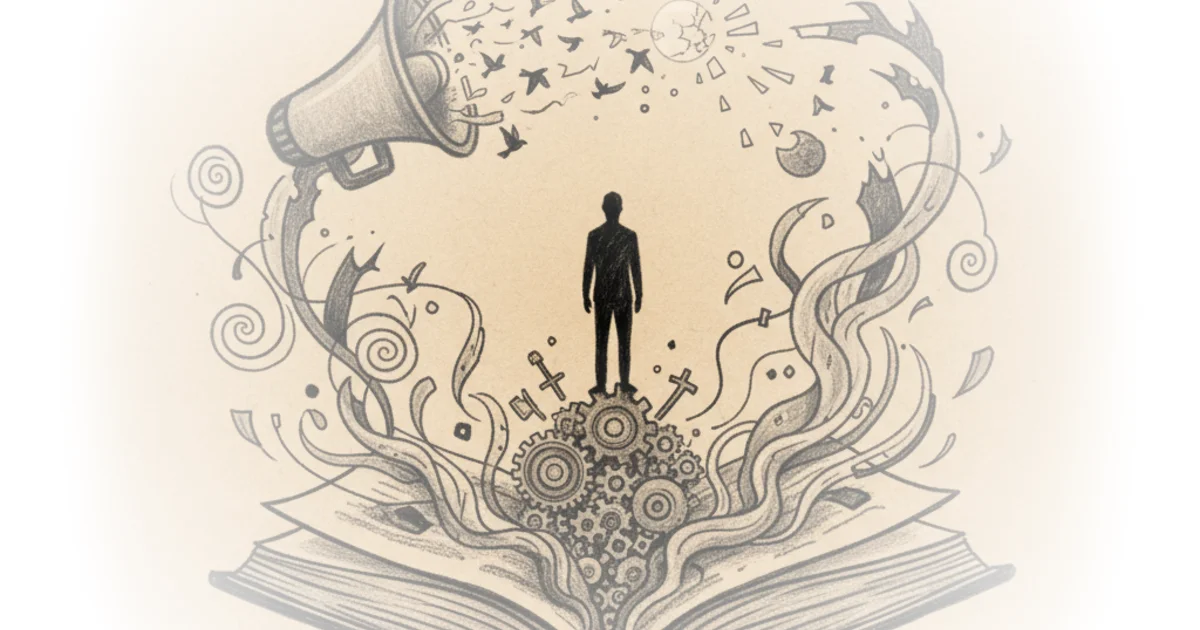
The argument lands because it reframes our scrolling habits not as a personal failing, but as a structural design feature of modern technology. West notes that "real stories for him are things that are always linking past, present, and future together in a way that is significant to us." By contrast, the modern digital experience severs these links. He observes that "Instagram stories... disappear after 24 hours," creating a "bunch of fragmented present moments" that never coalesce into a coherent whole. This is a sharp critique of the very platforms that claim to help us "share our stories."
Real stories are selective, requiring mystery and tension, whereas social media demands we broadcast every vanity project with zero context.
Critics might argue that this view romanticizes the past, ignoring that pre-digital life was often just as fragmented and mundane. However, West's point isn't about nostalgia; it's about the mechanism of memory and connection. He argues that when we outsource our memory to digital archives, we lose the cognitive work required to weave those memories into a personal narrative. "A picture on your phone is a type of total recall," West explains, noting that "there's no distance. There's no storytelling." This total recall prevents the natural forgetting and reinterpretation that gives life its narrative shape.
The Algorithmic Antonym to Meaning
The commentary deepens as West connects the loss of story to the loss of the self. He suggests that the ideal user for these platforms is someone who never stops to think, someone who remains in a state of perpetual emotional reaction. "The goal of these platforms is to keep people operating at a level where they don't stop to reflect on anything," West writes. This is the "antonym to storytelling," a system designed to maximize engagement by minimizing the time between stimulus and reaction.
West draws a chilling parallel to the Black Mirror episode "The Entire History of You," where characters can replay any memory at will. He suggests we are living in a "pseudo version of this" right now. The consequence, he warns, is a life that feels full of activity but empty of meaning. "You'd expect to see people that get a lot done at work... but the feeling is they don't really have any idea what any of this is all about." This is the existential cost: a life of high productivity but low significance, where one wakes up at sixty having "strung a lot of these days together without them feeling like they make any sense."
Even when we turn to the news for meaning, West argues we are misled. He posits that "what you're consuming there as you're following the news is mostly information, not stories." The 24-hour news cycle operates on the same logic as social media: it delivers fragmented bits of data designed to trigger an emotional spike before moving to the next headline. This leaves us with a sense of global crisis but no narrative framework to understand our place within it.
Bottom Line
West's coverage of Han is a powerful reminder that the crisis of narration is not just an intellectual problem, but a threat to our psychological survival. The strongest part of this argument is its ability to link the mechanics of algorithms directly to the erosion of selfhood. Its biggest vulnerability lies in assuming that the only valid form of storytelling is the traditional, linear kind, potentially overlooking how new, non-linear forms of meaning might emerge from digital chaos. Readers should watch for how this "crisis" evolves as AI begins to generate not just content, but entire narratives for us to consume without any human agency at all.